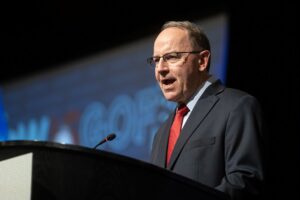
Montana’s National Forest Protections: A Contentious Issue in Congressional Race
Aaron Flint, a candidate representing the Republican Party in Montana’s first congressional district, has expressed his approval for the reduced protections of the state’s national forests.
In a significant policy shift last year, Agriculture Secretary Brooke Rollins decided to repeal the Roadless Rule, a policy from 2001 that had safeguarded 6.4 million acres of Montana forest from development activities. Flint applauded this move, stating on X in June 2025, “The rescission of the roadless rule last week was HUGE news for better management of our federal lands.”
The Roadless Rule initially aimed to prevent water pollution and habitat destruction caused by industrial logging, as well as to reduce taxpayer expenses for maintaining roads on public lands.
Environmentalists have voiced concerns regarding the rule’s termination, citing potential negative impacts. Jeff Lukas, head of Montana Trout Unlimited, underscored the rule’s significance, saying, “The rule is vital to protecting the backcountry experiences so many Montanans enjoy,” as reported by the Daily Montanan in February.
The rescinded rule now opens development opportunities in notable national forests such as Flathead, Gallatin, Kootenai, Bitterroot, and Beaverhead. The possibility remains for Congress to reinstate these protections.
Flint’s stance on public lands isn’t new. As documented by Public Domain, a conservation-focused news outlet, he has previously advocated for transferring federal lands to state control since 2013. “If the state of Montana is doing a better job managing their land, then why do we want the federal government to own the land?” Flint remarked during a 2014 broadcast.
Critics argue that Montana lacks the capacity to manage these lands independently. An analysis by natural resources manager John Tubbs in 2025 warned that such a transfer could financially burden Montana counties reliant on federal support, potentially necessitating the privatization of public lands. Further, the Montana Wildlife Federation reported that state control could “undermine generations of work by hunters, anglers, landowners, and conservationists.”
Despite Flint’s assertions of supporting land protection, he has dismissed conservation efforts as a partisan agenda. In a radio interview earlier this year, Flint criticized the media for highlighting what he described as “fake, phony left-wing protests,” suggesting a cyclical focus on issues including public lands.
Jake Eaton, a political strategist managing a super PAC in support of Flint, commented in April that Democrats fail to gain traction in Montana due to their focus on land conservation.
Contrasting this view, Flint’s Democratic rival, Sam Forstag, argues for increased federal investment in public lands, emphasizing the need for sustainable and proactive financial commitments. “Reinvesting in our public lands doesn’t mean just going back to the way things were,” Forstag’s campaign website states. “Let’s proactively invest in local, good-paying jobs so we can escape this constant state of crisis response that leaves us all paying more and getting less.”
According to an Impact Research poll conducted in June, the electoral contest between Flint and Forstag remains evenly matched.