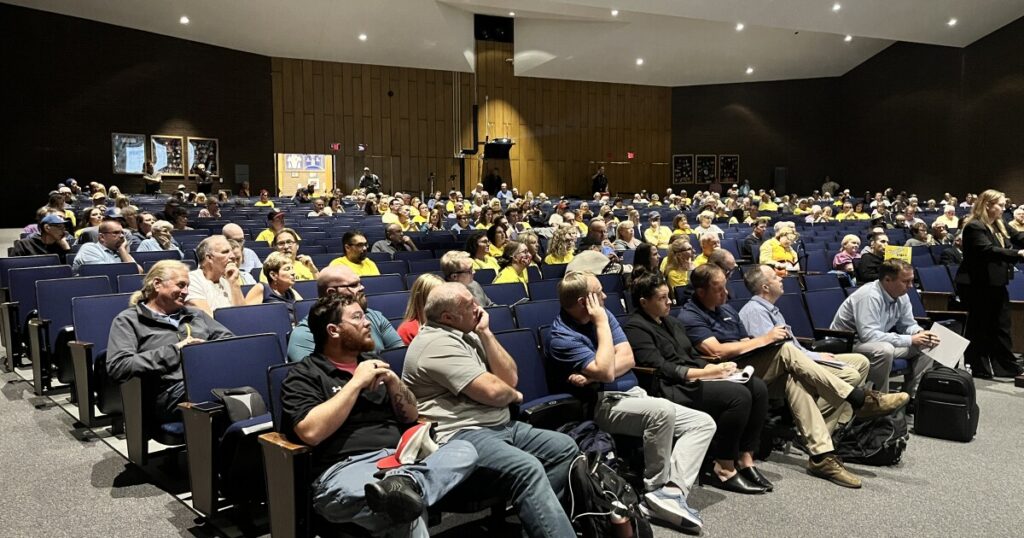
In a recent public hearing, concerns over potential health risks associated with a proposed data center in Archbald have sparked debate. The use of diesel generators as backup power sources is at the heart of the controversy, raising questions about the project’s environmental impact.
Michael Cork, Ph.D., a public health expert, presented testimony indicating that the 588 diesel generators planned for the Wildcat Ridge Data Center could result in annual health damages ranging from $3 million to $124 million. “In my professional opinion, the proposed Wildcat Ridge Data Center raises material public health, safety, and welfare concerns because of the exceptionally large scale of its proposed diesel backup generation system, and because key aspects of that system remain undefined in the current record,” Cork stated.
Backed by the Stop Archbald Data Centers group, Cork conducted research into the health effects of diesel exhaust, a known public health issue due to emissions of fine particulate matter and other pollutants. The developer, Cornell Realty Management Group, plans to build the data center on a 500-acre site, one of six such projects proposed in Lackawanna County.
Health Implications of Diesel Exhaust
Cork’s analysis utilized the U.S. Environmental Protection Agency’s COBRA tool to assess potential health outcomes from pollutants emitted by the proposed generators. The scenarios considered various operational hours and capacities of the generators, including worst-case scenarios.
Though Megan Haines, the attorney representing the developer, noted that the generators would not operate simultaneously except in emergencies, Cork emphasized the need for clarity on the types of generators and emission controls to be used.
Addressing the ongoing zoning process, Cork explained, “What I have is the total number of generators that have been proposed, the generator capacity, and then I’ve run a variety of plausible scenarios for how these generators might be run and how that might impact the population health.”
Balancing Regulatory and Health Concerns
During the hearing, Haines questioned Cork’s neutrality, suggesting he might be biased against data centers. Cork clarified, “I do not take an official stand on the projects. I focus on presenting the science.” He elaborated that his role is to provide evidence-based assessments rather than advocate for or against specific projects.
Haines also inquired about the possibility of obtaining necessary air-quality permits from the Pennsylvania Department of Environmental Protection (DEP). Cork noted that his report did not address regulatory compliance, focusing instead on potential health impacts. “What the science is pretty clear on is there’s no threshold below which there’s no health effects. So, what that means is that any increase in fine particulate matter increases health risks, even if below regulatory standard,” he said.
Considering Cumulative Impacts
Residents have expressed frustration with the segmented evaluation of each data center proposal, advocating for a comprehensive analysis of cumulative health impacts. Cork supported this perspective, emphasizing the importance of assessing all proposed projects collectively.
The next hearing is set for Monday, July 13, at 5 p.m. in the Valley View High School Auditorium, where a noise expert will provide additional testimony.