Arenal Volcano National Park: A Magnet for American Tourists
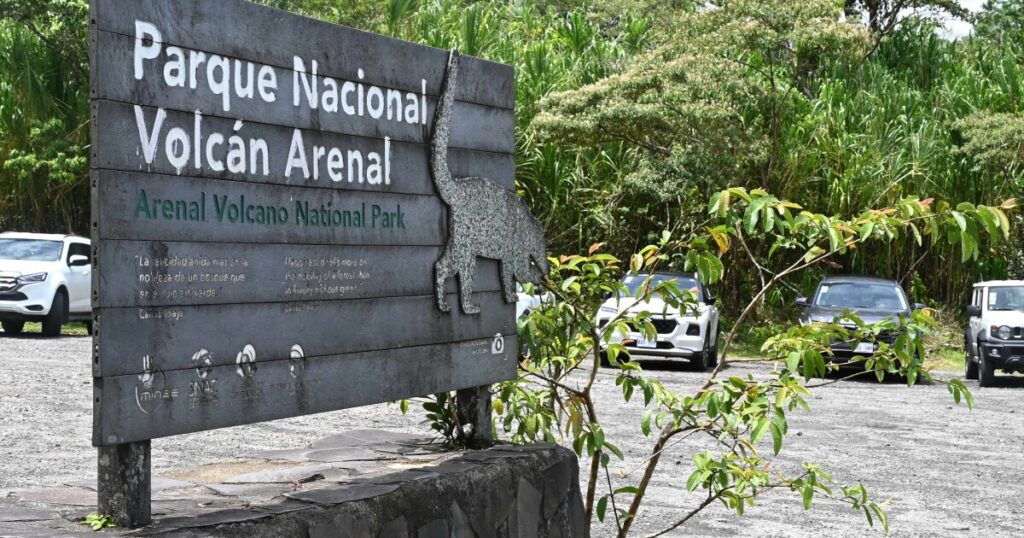
Under a cloudy sky in the warmth of Arenal Volcano National Park, English echoes through the trails as tourists from the United States explore the lush surroundings. Among them is Rutha “Rooty” Patel, who, along with friends, is hiking to celebrate her birthday by conquering an active volcano.
“I wanted to hike an active volcano for my birthday, so instead of Hawaii, I picked Costa Rica, since it’s a little bit more budget friendly,” says Patel.
Mariel Day / KUNR Public Radio
Not far behind, another group of American travelers stop to capture memories with their cameras. Emmett Mixon, perched atop a tree branch for a photo, expresses his admiration for the pristine environment.
“I mean, honestly, what surprised me was how spotless this wilderness is,” Mixon remarks.

Mariel Day / KUNR Public Radio
Arenal Volcano National Park has become a key attraction in Costa Rica, drawing approximately 100,000 visitors in 2024, as reported by the Costa Rican Tourism Board. This year alone, 700,000 tourists from the United States visited from January to April, which is nearly 50,000 more than the same period last year.
Geinier Alvarado Guzmán, a strategist in regenerative tourism, explains the appeal: “A los estadounidenses les encanta Costa Rica por eso, no tienen que tener visa. Costa Rica en sí es un lugar bien seguro… el Tico es siempre muy cálido y muy genuino del pura vida.” “Americans love Costa Rica for that reason – they don’t need a visa. Costa Rica in itself is a very secure place… Costa Ricans are very warm and embody the ‘pura vida’,” he elaborates.
The draw of Costa Rica extends beyond just its natural beauty, as Guzmán notes a shift in generational preferences towards more sustainable tourism. “Esta nueva generación de jóvenes hay un segmento grandísimo de ellos… que están muy preocupados, no solamente de que sea sostenible, sino que sea regenerativo.” “This new generation of young people, there’s a huge section of them that are really worried, not only that [tourism] be sustainable, but that it be regenerative,” he says.
While ecotourism is not new to the region, the concept of regenerative practices is beginning to take root. Guzmán describes, “El turismo regenerativo es turismo donde el turista que llega no solamente no tiene un impacto negativo, sino que más bien hace un impacto positivo.” “Regenerative tourism is tourism where a tourist doesn’t have a negative impact, but rather makes a positive impact,” he explains.
Venturing less than 50 miles east of the bustling La Fortuna area reveals La Selva Research Station, a lesser-known destination nestled within Costa Rica’s lowland rainforest. Managed by the Organization for Tropical Studies (OTS), this station has welcomed tourists for the past two decades, offering stays that range from a few days to several weeks.

Lupe Alvarez / KUNR Public Radio
La Selva emphasizes education over luxury, providing a unique opportunity for visitors to engage with conservation efforts. Kenneth Alfaro González, an academic groups coordinator, asserts that tourism has grown without detracting from the station’s primary mission. “La organización siempre sigue teniendo su enfoque en investigación y educación.” “The organization always and still has its focus on research and education,” he affirms.
Despite funding challenges, tourism has emerged as a valuable resource for La Selva. “Y el turismo, pues ha resultado una fuente importante, tal vez no para sustituir completamente esos otros fondos, pero sí han ayudado.” “And tourism has become an important source, maybe not fully replacing other funds, but it has helped,” González notes.
Regular visitor Katherine Grall appreciates the station’s approach, saying, “It gives me everything that I want, and of all our experiences, of all the places we’ve gone to, I feel very at home here. I feel safe.”
As more people consider visiting Costa Rica, Guzmán encourages them to experience the country’s diverse offerings. “Aquí tenemos turismo casi que para todo el mundo, pero sí nos encanta enfocarnos en el turismo que es ecológico, el turismo que es con conciencia.” “[In Costa Rica] we have tourism for nearly for the whole world, but we do love to focus on tourism that is eco-friendly, tourism with a conscience,” he concludes.
This story is in partnership with the Hitchcock Project for Visualizing Science and the Reynolds School of Journalism.