Electric Road Trip Across Nevada: A Journey Highlighting Charging Infrastructure Gaps
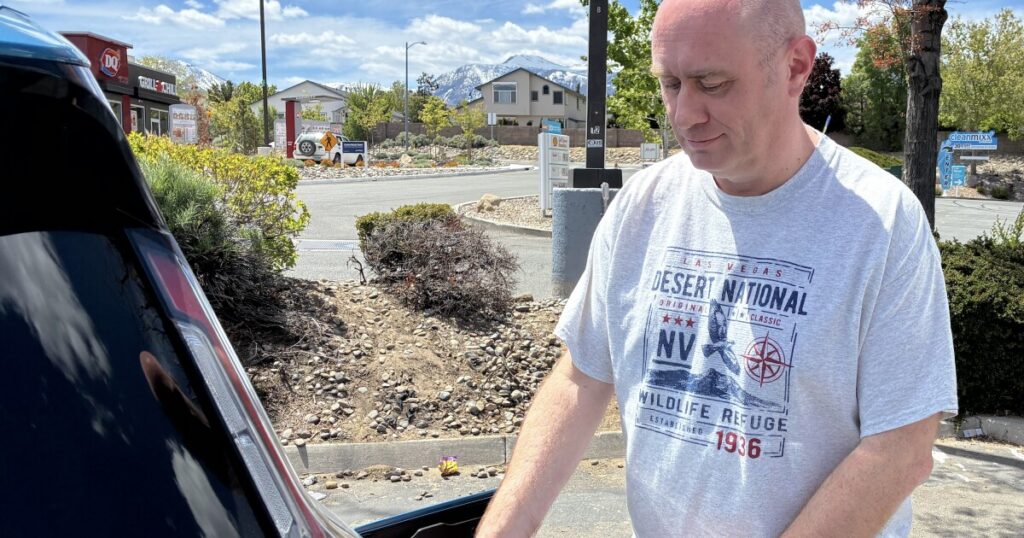
Embarking on a cross-state journey in an electric vehicle (EV) can be an adventurous experience, as Scott Allison discovered on his recent trip across Nevada. Instead of following the shortest route from Las Vegas to Reno, Allison chose an extended path through California to ensure access to working charging stations.
Allison’s six-day road trip was not just about exploration but also an experiment to test Nevada’s charging network for long-distance EV travel. He said, “It depends on how much Nevada you want to see,” emphasizing the necessity of planning based on available charging infrastructure.
Kaleb Roedel
/
Mountain West News Bureau
Allison opted for California’s Highway 395 over Nevada’s Highway 95 due to the availability of more reliable charging options. “There’s like a single point of failure,” he noted about Highway 95, where a non-functional charger could derail the entire trip.
This personal experience underscores the broader challenge faced by Nevada’s EV infrastructure as adoption grows across the state and the Mountain West region. Nevada now boasts over 90,000 registered EVs, as per the Nevada Department of Motor Vehicles. However, rural areas lag in providing adequate charging facilities.

Courtesy of Scott Allison
Assemblymember Howard Watts remarked on the limited charging infrastructure beyond major interstates, describing it as insufficient to support seamless travel across the state. “Some of the stations are not operational or fully reliable,” Watts noted, which poses a challenge given the vast desert stretches separating communities by over 100 miles.
Additionally, the issue is compounded by Nevada’s loss of more than $12 million in federal funding meant for charging infrastructure expansion. This impacts not just current EV users but also the tourism sector, as more visitors arrive in electric vehicles each year. Watts highlighted, “If they have difficulty doing so, then that impacts our economies.”

Despite these hurdles, Lizzie Stears from Advanced Energy United asserts that modern EVs are capable of meeting the demands of rural travel, and the infrastructure is more robust than perceived. She stressed that lower fuel and maintenance costs often render EVs economically viable over time, despite their higher initial purchase price.
Allison acknowledges that planning is essential for EV travel, yet he believes that with preparation, cross-state journeys are feasible. His advice speaks to the preparedness needed among EV drivers, stating, “I think there’s two types of EV drivers… those who plan and those who don’t realize until it’s too late that they’re going to get stranded.”

Ultimately, Allison’s journey reveals that while the road for EVs in Nevada may be longer, it remains open for those willing to chart their course thoughtfully.