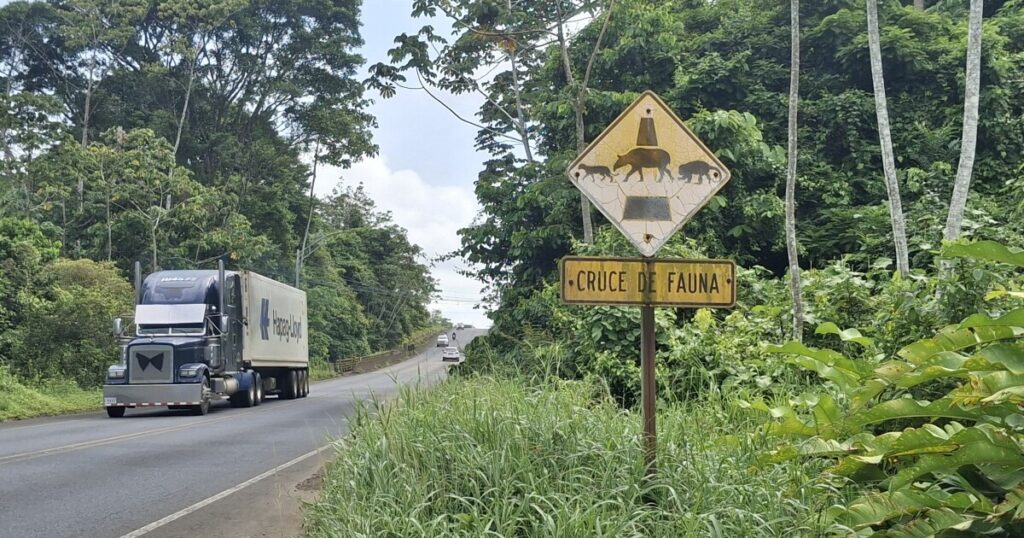
Across the globe, animals frequently find themselves in peril on busy roadways, a scenario playing out from the rainforests of Costa Rica to the deserts of Nevada. In an effort to mitigate these adverse encounters, both regions are working on implementing wildlife crossings.
In Costa Rica’s lush Sarapiquí rainforest, the vibrant ecosystem is juxtaposed with nearby urban expansion. As the jungle gives way to roads, the intersection of nature and infrastructure becomes deadly for wildlife. Experts estimate that vehicle collisions result in the death of about four animals every hour on Costa Rican highways.
In San José, the Toucan Rescue Ranch serves as a sanctuary for animals injured in such collisions. Guide Pablo Bonilla recounted a recent case, stating, “We just recently, a couple of months ago, got a baby howler monkey, that the mom got hit by a car, so the mom passed away.”
Species such as coatis, monkeys, and sloths are often victims, especially near the heavily trafficked Route 32. Naturalist Reyder Mesen explains that roads pose significant barriers to wildlife movement. “There are many animals that need to cross these areas or other parts of the forest, and the presence of roads poses an obstacle for them,” he said. “And we actually saw it, there are monkeys using the aerial bridges, the suspension bridges.”
Similar challenges are faced in Nevada, where roads intersect the natural habitats of diverse wildlife. Each year, thousands of animals fall victim to vehicle collisions according to the Nevada Department of Transportation (NDOT), which has constructed 80 wildlife crossings since 2010.
Nova Simpson, who manages the wildlife crossing program for NDOT, mentioned the success of these initiatives. “We’ve actually had bighorn sheep bedded down underneath the bridges for shade, so it’s kind of created its own little micro habitat,” she said. These structures have been highly effective, reducing collisions by about 80%.
Nevada Department of Transportation
In 2023, Nevada lawmakers granted an additional $5 million to support the expansion of wildlife crossing infrastructure. This contrasts with Costa Rica, where governmental support has been lacking, according to Bonilla. However, there is hope as Costa Rican legislators consider new laws to enhance wildlife protections, pending further legislative approval.
Recognizing the permanence of roads, Bonilla emphasizes the need for human adaptation to safeguard wildlife. “These past few years have not been like the best government about wildlife or taking care about the wildlife, so that is why we haven’t seen too much about it,” he noted.
This story is in partnership with the Hitchcock Project for Visualizing Science and the Reynolds School of Journalism.