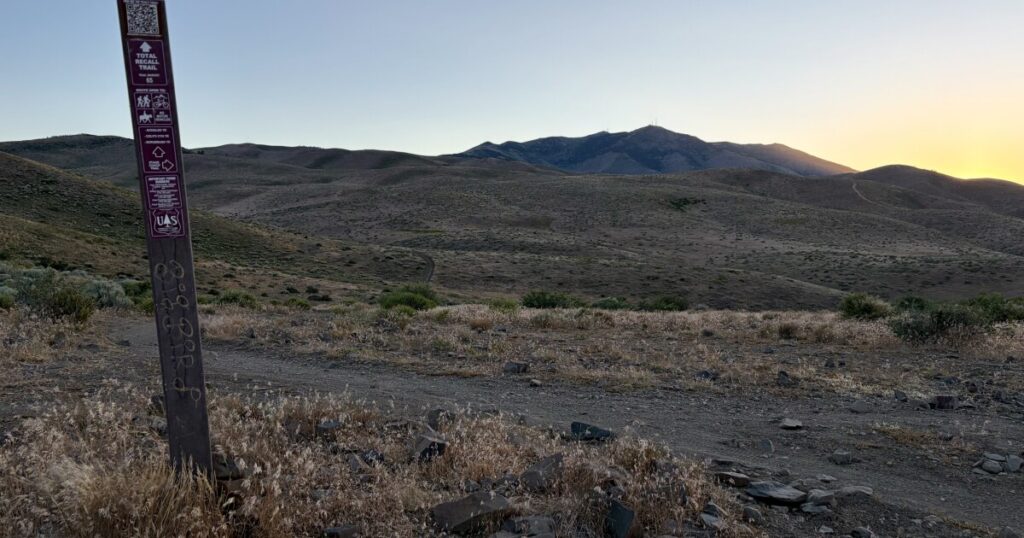
As the sun set over Keystone Canyon on a cool evening last month, mountain biker Will Boyer took to the trails. While conditions were favorable that day, Boyer expressed concern over the dirt becoming loose due to the intense sun exposure in coming weeks. “Sometime during the summer you get to that one day where you’re out, and you’re like, ‘Oh my gosh, I’m just riding through a trench of dust,’” Boyer shared, hoping for some monsoon moisture soon.
The dusty trails are part of a broader issue tied to climate change. Last winter brought the lowest peak snowpack on record, raising concerns about long-term effects. As winters warm faster than other seasons, the impact is visible in reduced time for skiing and snowboarding, but it also affects year-round outdoor activities.
Nevada State climatologist Baker Perry noted that the region experienced a snow drought, with higher temperatures causing more precipitation to fall as rain rather than snow. This shift has led to quick runoff and critically dry conditions throughout the state. The U.S. Drought Monitor reports that all of Nevada is at least “abnormally dry,” with about 75% facing full-on drought conditions.
“It’s not just the snow drought that we’re coming off of. It’s not just the record warmth in the winter that we experienced. It’s not just the record warmth in March, but all of these things compound,” Perry explained.
However, Curtis Johnson, president of the Biggest Little Trail Stewardship, sees a silver lining in the dry winter. “Actually, dry conditions in the wintertime for us means a longer building season,” Johnson stated. The nonprofit manages trails around Truckee Meadows and is raising funds for a new shade structure at Sierra Vista Park.
Trail-building is ideally done in spring and fall when moisture levels are just right. In contrast, winter rains and snow create sticky mud, and summer dryness poses its own challenges. “Right now, you bring that dry soil back into the trail, and people ride through it or walk through it, and just poof! It’s gone,” Johnson commented.
Despite the extended building season, ongoing dry conditions could limit work if red flag warnings are issued, preventing the use of power tools due to heightened fire risks. Such warnings occur when high temperatures combine with low humidity and strong winds. In 2022, the Mosquito Fire demonstrated this danger, burning 76,788 acres and blanketing Reno-Sparks with smoke.
For Boyer, air quality is a major concern. “Oh man, brutal topic,” he said, reflecting on smoky years that made him reconsider living in Reno long-term. The risk of wildfires remains uncertain for 2026, with Perry indicating that the snow drought increases the risk, though El Niño conditions could bring much-needed rain. “We have higher ocean temperatures that can oftentimes result in higher moisture and water vapor content in the atmosphere,” Perry noted.
While weather predictions remain challenging, especially in the Eastern Sierra, there’s hope for favorable trail conditions. “The perfect condition is not immediately after a rain, it’s like, after the rain, and then 10 other people rode the trail,” Boyer described, referencing the term “brown pow” used by some trail enthusiasts.