Pesticide Concerns in Costa Rica’s Pineapple and Banana Plantations
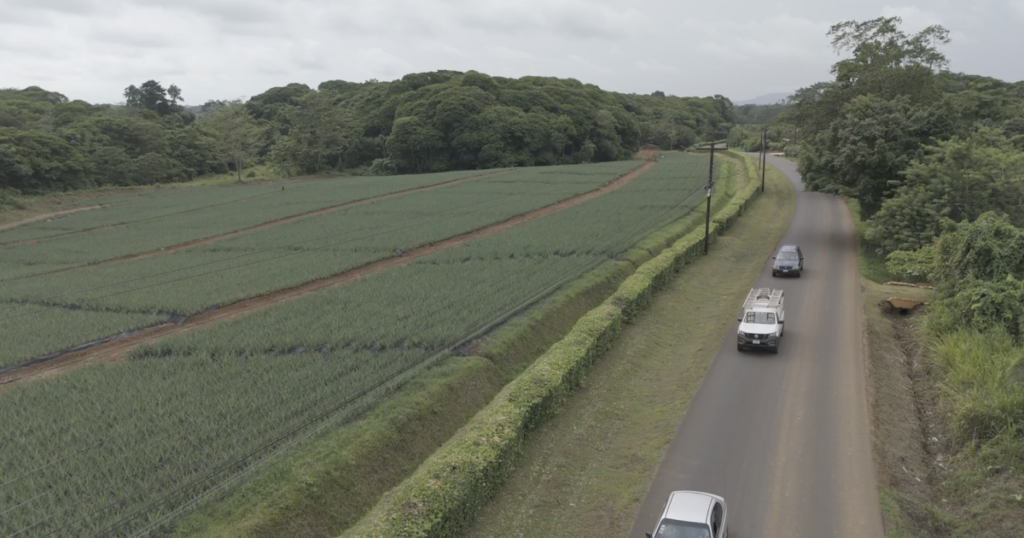
In the heart of Costa Rica’s Sarapiqui region, the sight of sprawling pineapple and banana plantations is hard to miss. Yet, beyond the lush greenery, locals are often greeted by a pungent smell reminiscent of strong alcohol, along with skin-irritating droplets – the unintended drift of pesticides from the plantations.
Ariel Ugalde Chavez, a resident of Chilamate, encounters these issues firsthand. His young son frequently questions the unusual scent that pervades their area. “And he says: ‘Well, daddy, it smells bad,’ for example: I say ‘Yes, yes, it’s a chemical from the pineapple, but it won’t last long’ … it’s an effect that lasts 30 minutes and done,” Ugalde Chavez said. Despite these concerns, he believes that the health of plantation workers remains unaffected.
Research published in Toxicology Reports highlights the adverse effects of pesticides, which, while aimed at controlling pests, often harm the environment and human health. The Pesticide Action Network (PAN) advocates for stricter regulations, raising awareness about the health risks of exposure.
Malory Shaw / KUNR Public Radio
Emily Marquez, a senior scientist at PAN, warns of the potential long-term impacts of childhood pesticide exposure on brain development and other health issues like cancer and neurotoxic effects. “There’s definitely a pretty good link to cancers for general exposure to pesticides, and then also neurotoxic effects,” Marquez said.
Dr. Mecca Howe of the University of North Carolina at Charlotte conducted extensive research on the subject, focusing on how pesticide exposure affects young girls in Sarapiqui. She noted that the exposure levels in this region surpass those found in farm workers in other areas.
Despite the findings, Howe acknowledges that the Costa Rican Ministry of Health requires more data to implement changes. “Costa Rica does do a really good job at conservation and protecting their environment, but there’s this other side of Costa Rica that most people don’t know or see, and I think that that side needs its story told as well, ” Howe remarked.
Franciny Gonzalez Hidalgo, residing near an organic Dole plantation in Chilamate, observes that while organic methods are in place, they are not without issues. She mentions that the intense smell of organic fertilizers like fish meal and bull blood can cause headaches and skin allergies.
Randall Montoya Solano, a biologist at Refugio Lapa Verde, is utilizing Howe’s research to propose educational programs on sustainable farming and pesticide awareness in local schools. “Right now, we are developing a proposal with strategies to implement work with these schools about agroecology to tackle the pesticides topic,” Montoya Solano stated, emphasizing the importance of balancing production with human health.
This story is in partnership with the Hitchcock Project for Visualizing Science and the Reynolds School of Journalism.