This coverage is made possible through a partnership between BPR and Grist, a nonprofit environmental media organization.
In a promising development for wildlife enthusiasts and conservationists, researchers in North Carolina have reported the capture and sighting of a notable population of Indiana bats in the western part of the state. This marks the first such occurrence in a decade for the federally endangered species, which has been severely affected by disease.
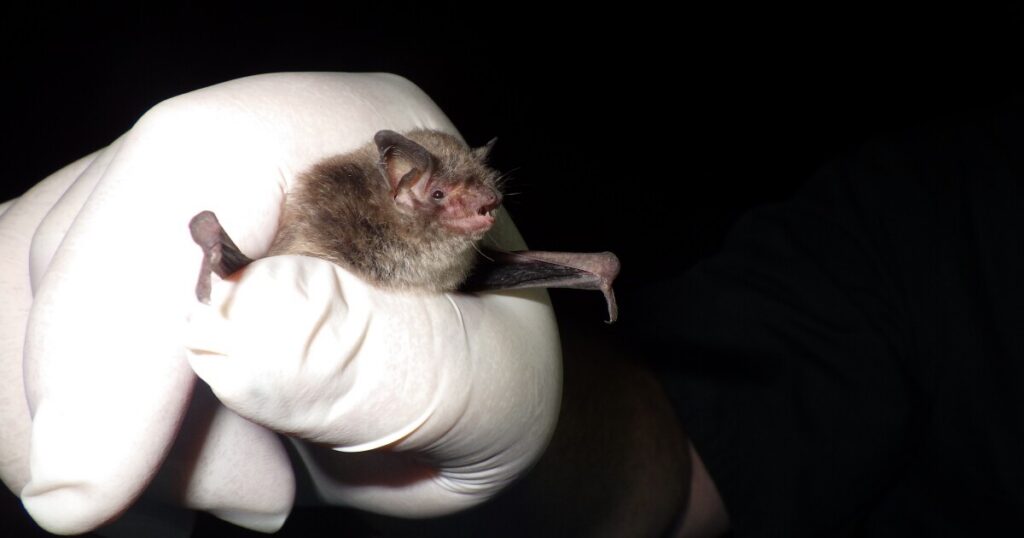
The North Carolina Wildlife Resources Commission (NCWRC) has identified twenty-four Indiana bats roosting in a dead hemlock tree within the Joyce Kilmer-Slickrock Wilderness of Graham County. According to Gabrielle Graeter, the Western Wildlife Diversity Supervisor for NCWRC’s Wildlife Diversity Program, this tree serves as a maternity roost where bats congregate to birth their young.
A significant threat to the Indiana bat population is a fungal disease known as white nose syndrome. This disease has decimated approximately 90% of three bat species in North American caves, according to the U.S. Fish and Wildlife Service. It disrupts hibernation, causing bats to deplete their energy reserves prematurely.
Graeter noted that the disease posed a grave risk to North Carolina’s bat population, which was already sparse. “Indiana bats were really on the edge of their range,” she explained. “Before white nose syndrome arrived, we didn’t find a lot of them, but it was not uncommon to find one or two or a few here or there.”
The NCWRC employs various methods to study bats, including mist nets for capture, cave counts during winter, and acoustic monitoring to detect bat calls. The recent capture of the Indiana bats was achieved through mist netting.
While the recent sightings are a positive sign, Graeter cautioned that they do not guarantee recovery. “The ones that survived may, you know, be more able to withstand white nose syndrome in some regard and we don’t really have answers to that yet on why,” she said.
Environmental factors such as climate change, including flooding and extreme heat, have also impacted bat populations, according to Graeter. Hurricanes have destroyed roosting trees, and temperature fluctuations have affected the availability of insects, the bats’ primary food source.
Jesse de la Cruz, a bat researcher at Virginia Tech, emphasized that Indiana bats face threats across the Appalachian region mainly due to white nose syndrome. Despite surviving various habitat disruptions over the years, these bats continue to struggle with the current challenges.
Indiana bats typically move between networks of dead trees, seeking warmth and sunlight. “They kind of form nomadic colonies whereby they find that next clump of dead trees,” de la Cruz explained. These colonies are generally female-centric, composed of grandmothers, mothers, sisters, and aunts, who rear the young, perpetuating the cycle over generations.