Urban areas in North Carolina are grappling with economic challenges due to a shrinking pool of immigrant workers. A report from the Kenan Institute for Private Enterprise has highlighted how declining international net migration is impacting labor-intensive sectors, offering potential solutions to mitigate these issues.
According to Census data, there was a significant decrease in the number of foreign-born individuals moving to metropolitan areas like Raleigh, Durham, Charlotte, and Greensboro in 2025 compared to the previous year. Specifically, the Triangle metro observed a reduction of nearly 10,000 international migrants, affecting industries heavily reliant on immigrant labor, such as construction, hospitality, manufacturing, and elder care.
The trend of fewer foreign workers entering the U.S. and more choosing to leave—often through self-deportation—is attributed to heightened federal immigration enforcement under former President Donald Trump and recent state laws, including House Bill 10 and Senate Bill 153.
“All of these different factors are contributing to reduced (immigration) inflows and increased outflows, and I think that makes it likely that labor shortages will continue,” stated Sarah Dickerson, a research professor at the Kenan Institute and the report’s author.
Recent U.S. Census Bureau statistics reveal a historical drop in international migration to the U.S., plummeting from 2.7 million to 1.3 million between July 2024 and June 2025.
NC Department of Commerce
Foreign-born individuals engage more in the workforce compared to their native-born counterparts. In 2022, the labor force participation rate for foreign-born individuals was 68.6%, while it was 59.8% for native-born, as per the North Carolina Department of Commerce.
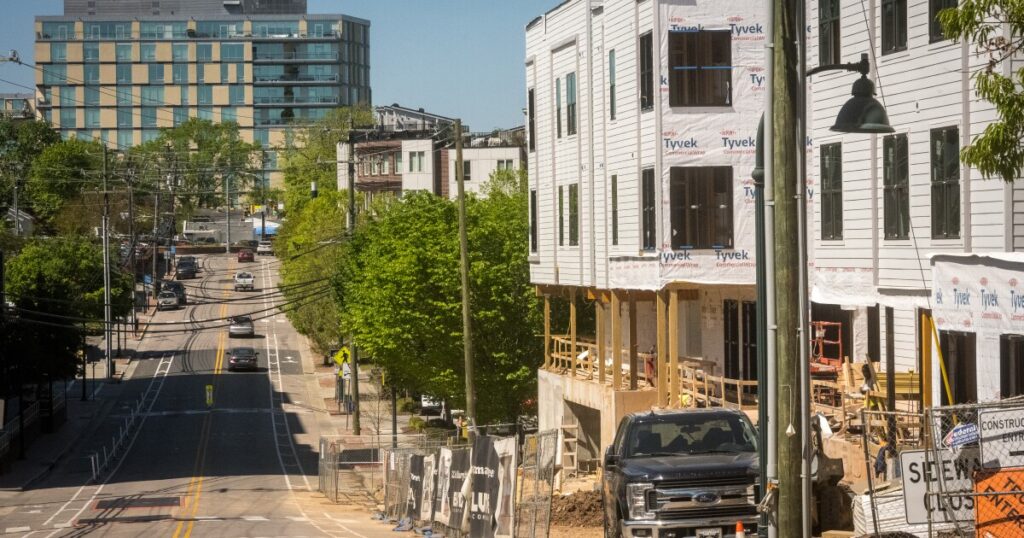
“Businesses and consumers are likely to feel these effects through a tighter labor market and higher costs,” said Dickerson. Immigrants hold a significant portion of jobs in sectors such as construction. In Raleigh-Durham, construction makes up 5.7% of employment and 4.7% of the metro’s GDP, surpassing national averages, according to federal labor data estimates by the Kenan Institute.
In the short term, the Kenan Institute suggests using automation and artificial intelligence to fill these labor gaps, particularly in logistics. This could involve accelerated training programs for American workers to step into high-demand roles.
“Again, there’s a challenge in that some native-born workers don’t always want the vacated roles,” Dickerson noted, referring to the reluctance of some to fill in-demand positions, potentially leading to housing market pressures.
Brian Turmail from the Associated General Contractors of America highlighted the looming impact on the construction sector, telling WFAE last year that “not only are you going to get higher no-show rates, but you’re going to have more and more firms that don’t have enough people to bid on construction projects.”