This coverage is made possible through a partnership between BPR and Grist, a nonprofit environmental media organization.
Efforts to enhance energy resilience in disaster-struck regions of western North Carolina have taken a significant step forward. On Friday, a coalition of nonprofit organizations convened at MANNA Food Bank in Mills River to announce advances in a solar energy initiative aimed at providing off-grid power solutions during severe weather events.
This development follows the Department of Environmental Quality’s allocation of $5 million last August for microgrid projects, in collaboration with both renewable energy and economic development nonprofits. Key collaborators include the Footprint Project from Louisiana, alongside regional entities such as the Land of Sky Regional Council and the North Carolina Sustainable Energy Association.
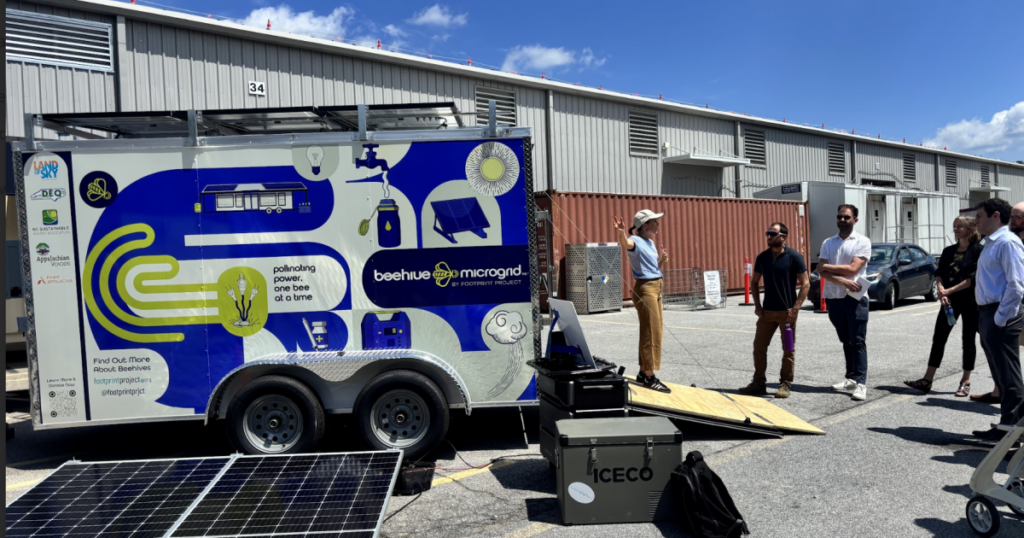
The initiative focuses on solar-powered microgrid installations, termed Beehives, which are designed to deliver up to 100 kilowatt-hours of energy, sufficient to sustain a large building’s essential functions for up to 10 hours during power outages. Plans include establishing 24 stationary units, along with two mobile units capable of reaching as far as Cape Hatteras if necessary. These mobile solar-powered trailers, equipped with batteries, function in various weather conditions to store and provide power.
The five initial locations for these Beehives are the East Asheville Library in Buncombe County, the Beacon of Hope food distribution hub in Madison County, Buladean Community Center in Mitchell County, Bill’s Creek Community Center in Rutherford County, and the Burnsville Fire Department in Yancey County.
Provided by the Footprint Project
Footprint Project CEO Will Heegaard explained, “Beehive Microgrids are made up of an ecosystem of solar and battery systems on towable trailers that provide a range of services.” He detailed the functions of different units, noting that “Cooler Bees include fridges and freezers and can store food, medicine and ice. Power Bees charge electronic devices, medical equipment, and portions of entire buildings, and Water Bees provide drinking water filtration.”
The project includes two new mobile units expected to be fully operational by 2027. Stationary installations at the five designated sites will start this summer, readying them for emergency deployment during crises.
“It’s going to be powering well pumps to keep water access open, fridges to keep food and medications, fresh and functional lights on critical facilities, right?” Heegaard added.
This initiative follows similar efforts in communities affected by storms across the U.S. and territories, including Puerto Rico and New Orleans.
The Land of Sky Regional Council has coordinated the placement of these microgrids, with Energy and Economic Development Program Manager Sarah Nichols expressing the project’s broader vision. “We are essentially setting the model in the president for what we hope will be a much bigger statewide and national project to duplicate,” Nichols said.
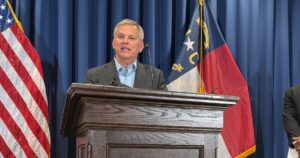
Department of Environmental Quality Secretary Reid Wilson is in ongoing discussions with state partners to further integrate small-scale solar solutions for enhancing local climate resilience. The potential for future federal funding remains uncertain, but efforts are made to remain adaptable.
“If Congress was to come through with another disaster recovery bill, quite conceivable that they would decide to put microgrids in it, but it’s conceivable they wouldn’t,” Wilson remarked.
For the Burnsville Fire Department, one of the sites for a stationary microgrid, this development offers significant relief. During Hurricane Helene, Chief Niles Howell had to rely on a generator, worrying about fuel shortages and the ability to maintain essential services. This new solar solution provides a backup that can mitigate such concerns.
“I love redundancy, because inevitably what you plan for will fail at some point in time, so the more avenues you have to keep things going, the better off you are,” Howell noted.