In the mountainous West, drones have become indispensable tools, transforming industries from agriculture to emergency services. Nationwide, the drone industry employs over 100,000 individuals, with a growing need for skilled pilots.
Inside the Boys and Girls Club of Truckee Meadows gym in Reno, Nevada, the next generation of drone professionals is taking shape.
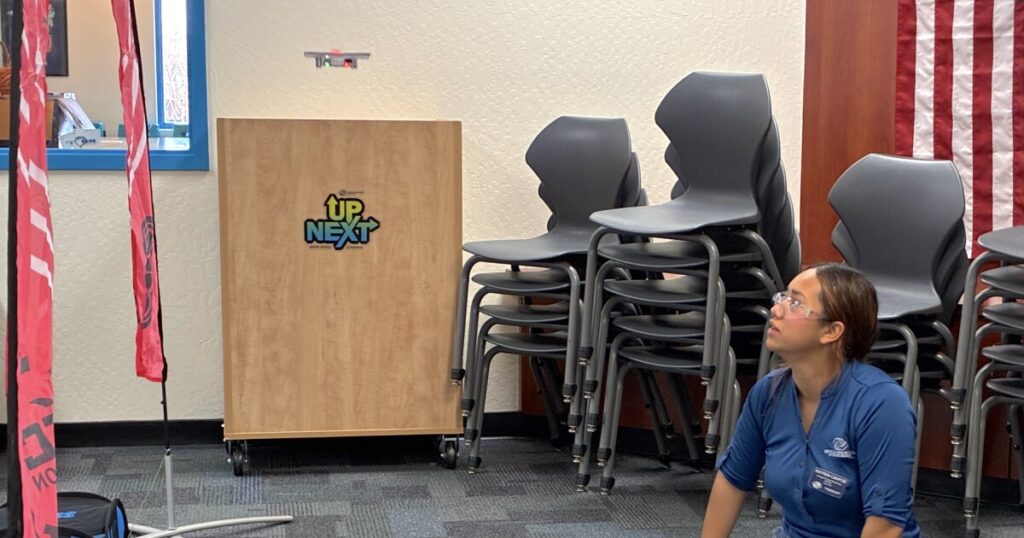
A small drone zips through a pink arch, navigates a green hoop, wobbles, and lands on a purple platform as staff cheer on.
This week, it’s the staff, not the kids, who are learning.
In collaboration with the Desert Research Institute, the club is hosting a multi-day drone certification training aimed at equipping staff with the skills to teach students about aeronautic technology, programming, and flight safety.
“They’re not aware that these are valuable life and job market skills needed in many fields,” said Mayrem Campos, the club’s director of college and career readiness. “They don’t know they can get a drone pilot license at 16.”
Campos herself had never flown a drone until recently.
“I think my younger brother had a drone as a kid,” she laughed. “He crashed it within the first 30 minutes, and that was the end of that drone.”
Now, she’s learning to both fly and program drones.
The training sessions, funded by the George W. Gillemot Foundation, don’t provide a commercial license. Professional drone operation requires passing the FAA’s Part 107 test, covering airspace classifications, weather patterns, safety, and emergency protocols.
Nonetheless, organizers see these workshops as an entry point to a fast-growing career.
Drones Become Crucial Tools in the Mountainous West
Across the West, drones have evolved from recreational gadgets to essential equipment.
Dirk Giles
/
U.S. Forest Service
In agriculture, drones monitor crop health and irrigation efficiency. In mining and energy, they inspect pipelines, transmission lines, and remote facilities. Public safety agencies deploy them during disasters when it’s too dangerous for personnel to be on the ground.
The U.S. Forest Service increasingly integrates drones into wildfire response.
Dirk Giles leads the agency’s national unmanned aircraft systems program. Currently, the Forest Service operates over 400 drones, logging more than 10,000 flights annually—a number that has steadily risen as wildfire seasons lengthen and become more destructive.
“Drones won’t replace manned aviation,” Giles stated. “They’re simply another tool in our toolkit.”
Drones can perform tasks that helicopters and planes cannot, particularly at night.
“The drone can observe up to a mile and a half beyond the containment line and spot a fire the size of a coin,” Giles explained.
It’s not just about distance; it’s also about visibility.
“Infrared vision is helping those on the ground see what traditional tools can’t detect,” added Giles.
Wildfires now consume far more acreage than decades ago, particularly in Western states. Firefighting personnel have not increased proportionately, leading agencies to leverage technology to fill operational gaps and enhance response times.
Private Companies Expand Operations
The push extends beyond government agencies.
California-based startup Seneca is developing autonomous aircraft for firefighting—essentially 500-pound drones designed to operate in coordinated swarms, deploying retardant foam in a fire’s early stages.
“Fires grow exponentially,” said Landesberg. “Even very large fires can be controlled if detected early.”

The goal is rapid response: aircraft capable of launching within minutes, well before traditional tanker aircraft mobilize.
The company plans initial deployments this summer in California and Colorado. Seneca recently signed a five-year agreement with the Aspen Fire Protection District. This marks one of the first coordinated, autonomous wildfire response systems adopted by a U.S. fire agency.
With nearly 50 employees, Seneca is rapidly expanding.
“We’re hiring at a fast pace,” said Landesberg. “I bet we’ll grow the team by 50% over the next six months.”
Building the Future Workforce Early
Back in Reno, Michelle Gallivan-Wallace, an instructor at Nevada Robotics in the Desert Research Institute (DRI), guides staff through obstacle courses and flight exercises.
“They’re like sponges,” she noted. “They love learning and also passing on knowledge to prepare kids for the workforce in science, technology, engineering, and math.”
For Campos, drone training’s value extends beyond aviation.
“It teaches them teamwork,” she said. “It teaches communication skills. It teaches them to be comfortable with failure and improvement—all skills employers look for.”
Staff mastering obstacle courses in this gym aren’t just earning certifications. They’re preparing to impart those skills to students who may one day design, build, or pilot the aircraft transforming industries across the mountainous West.
In a region where drones increasingly feature in daily life, from farms to firefighting lines, this preparation could open doors far beyond the gym’s walls.
This story was produced by the Mountain West News Bureau, a collaboration between KUNR, Wyoming Public Media, Nevada Public Radio, Boise State Public Radio in Idaho, KUNC in northern Colorado, KANW in New Mexico, Colorado Public Radio, KJZZ in Arizona, and NPR, with additional support from affiliate newsrooms across the region. The Mountain West News Bureau is funded in part by the Corporation for Public Broadcasting and Eric and Wendy Schmidt.”
Here is the story in English.