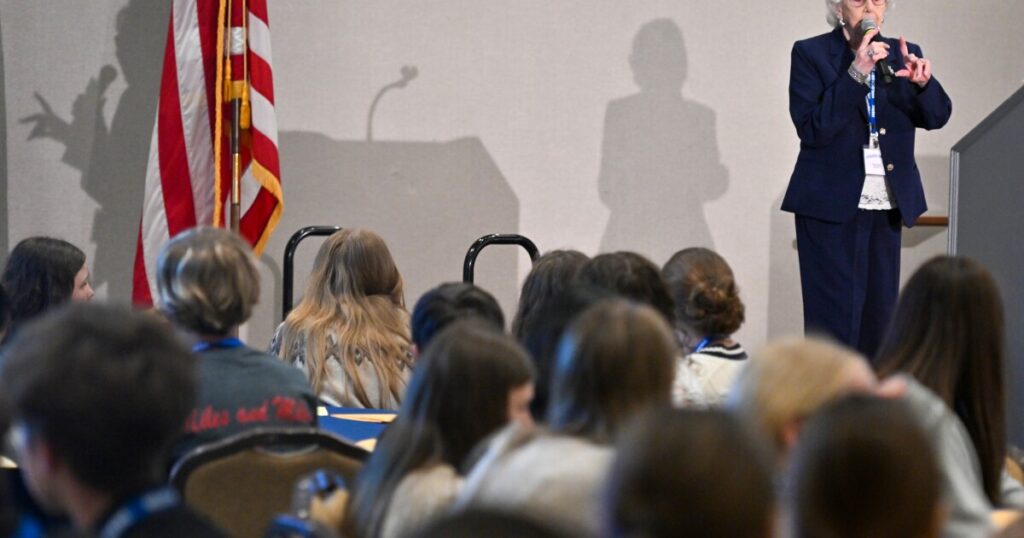
Amidst the haunting echoes of history, a group of students gathered to hear stories of survival and resilience from Holocaust survivors. At the heart of these narratives is Maud Dahme, who, as a child, evaded the horrors of the Nazi regime in the Netherlands.
Maud Dahme, now 90, recounted her experiences of evading Nazi capture to students in Scranton. When Dahme was just six years old, her parents sent her and her younger sister away to hide. “My father gave me the two little suitcases, and he said, ‘Maude, we’ll see you in a couple of weeks.’ And he said, ‘Take very good care of your little sister and have a good time,’” she shared.
During the Nazi occupation of the Netherlands, Dahme relied on Christian resisters who provided refuge on farms and other locations, keeping her safe from the concentration camps. The years in hiding were fraught with challenges, including the constant threat of discovery and enduring food shortages that sometimes led her to eat tulip bulbs and bugs for sustenance.
For decades, Dahme kept her story to herself, explaining, “I never spoke about it, because after the war, everyone was saying it’s over, life has to go on.” It wasn’t until the 1980s, prompted by Holocaust denial comments, that she began to share her experiences.
This week, Dahme’s story, along with those of other survivors, is reaching 1,400 students through the Teen Symposium on the Holocaust in Scranton. While some narratives are shared directly by survivors, many are passed on through video recordings or descendants, as time takes its toll on the number of living witnesses.
Susan Blum Connors, a volunteer for the 38th annual event, emphasized the importance of these stories. “It’s such an important topic and one that needs to be told,” she said. “We bear witness now by listening to these survivors. We bear witness to what happened to prove that it did for all the deniers out there.”
Lasting Impact
Anthony Massa, a history and civics teacher, recalls how the story of Ruth Kapp Hartz impacted him when he was in eighth grade. Hartz, who as a child went into hiding in France, shared her story with Massa’s class in Northeast Philadelphia in 1995. Decades later, Massa brought his students to hear Hartz speak at the symposium.
“It is incredibly important,” Massa reflected. “There’s growing hate and antisemitism in this world, and there’s growing Holocaust denial, unfortunately. So these stories are just as important now as they ever were.”

East Stroudsburg High School North senior Dylan Krumanocker expressed gratitude for the opportunity to hear Hartz’s story, acknowledging the importance of Holocaust education.
Realizing the Importance
After the war, Dahme and her sister were reunited with their parents, who had spent years hiding in an attic. Tragically, much of their extended family perished at Sobibor death camp. The family immigrated to America in 1950, and Dahme has since dedicated herself to Holocaust education.
At the symposium, organized by the Holocaust Education Resource Center of the Jewish Federation of Northeastern Pennsylvania, Connors highlighted the long-term impact these stories may have. “I always say to the kids the impact this has on them may not be felt today or tomorrow, but somewhere down the line, all of a sudden, they’re going to think about what they heard here and realize how important it was,” she noted.