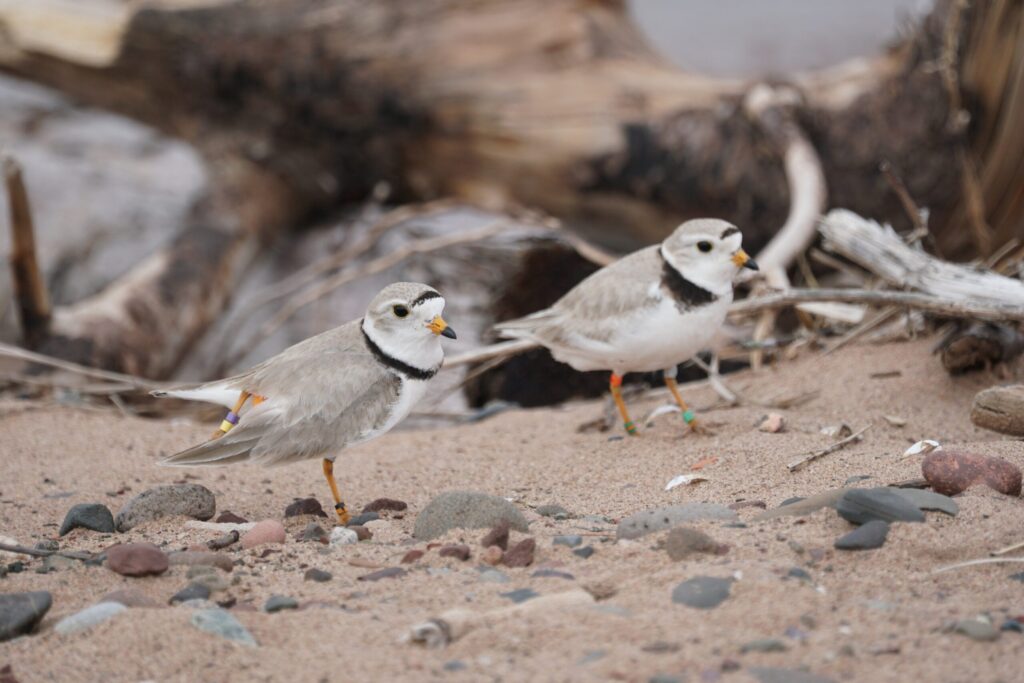
In an unexpected development, a pair of endangered piping plovers have returned to nest on a Lake Superior sandbar, a sight not witnessed in nearly five decades. This remarkable event took place at Wisconsin Point in Superior, marking the first time since 1977 that these shorebirds have been seen nesting in the St. Louis River estuary.
Ryan Brady, a conservation biologist with the Wisconsin Department of Natural Resources (DNR), emphasized the significance of this finding, describing it as a “really big find.” The piping plover, characterized by its sandy grayish-brown color and distinctive black breast band, is a small bird known for its unique nesting habits.
For over a decade, Kris Eilers of the St. Louis River Alliance has collaborated with partners to observe these birds in the Duluth-Superior region. It was a notification from a monitor with the Bad River Band of Lake Superior Chippewa that led to the discovery of the nesting pair in late May. Eilers remarked on their excitement, saying, “He witnessed breeding behavior, so he called us, and we went out right away and started monitoring the site.”
The nesting pair comprised a male from Michigan and a female from Long Island in the Apostle Islands. They chose a beach in Superior restored as a habitat for these endangered birds.
Efforts in Restoring Great Lakes Habitats
In a 2019 effort to restore habitats in the St. Louis River Area of Concern, various agencies and partners dedicated $4.5 million to create a suitable nesting site. This initiative, funded by the federal Great Lakes Restoration Initiative, involved entities such as the U.S. Environmental Protection Agency, DNR, and the St. Louis River Alliance.
Ryan Brady from the DNR expressed satisfaction with the outcome, noting, “For all the management and conservation work that goes into a particular site, or a given pair of birds, it’s very rewarding to see that come to fruition and to see a pair of birds set up and do their thing.”
The restoration project aimed to address pollution and habitat loss in the Great Lakes, with the EPA highlighting the importance of such efforts for endangered species like the piping plover.
Piping Plovers’ Record Year in the Great Lakes
This nesting event coincides with a record-breaking year for piping plovers in the Great Lakes, credited to conservation efforts and lower water levels. The U.S. Fish and Wildlife Service reported 99 breeding pairs and 184 fledged chicks, the highest since the bird was listed as endangered in 1986.
Jillian Farkas, a biologist with USFWS, emphasized the importance of ongoing conservation work, stating, “That work is crucial to Great Lakes habitat being available, at locations like Wisconsin Point, so we can foster piping plover generations to come.”
Historically, the Great Lakes were home to as many as 800 pairs of piping plovers. However, only 17 pairs remained by the time they were federally protected, with hopes to restore the population to 150 pairs.
Challenges in Plover Conservation
Despite these successes, piping plovers continue to face challenges, including habitat loss from rising water levels and disturbances from human activities. To protect the birds, the Wisconsin Point area is closed to the public during breeding season.
Monitoring teams, including Eilers’ group, faced challenges such as severe weather that impacted the birds’ nesting efforts. Despite losing eggs to predators, the pair persevered and were later sighted on Long Island, likely heading to their winter grounds in Florida.
Funding for monitoring these birds at Wisconsin Point ended last year, but the recent nesting success may prompt renewed financial support for conservation efforts.