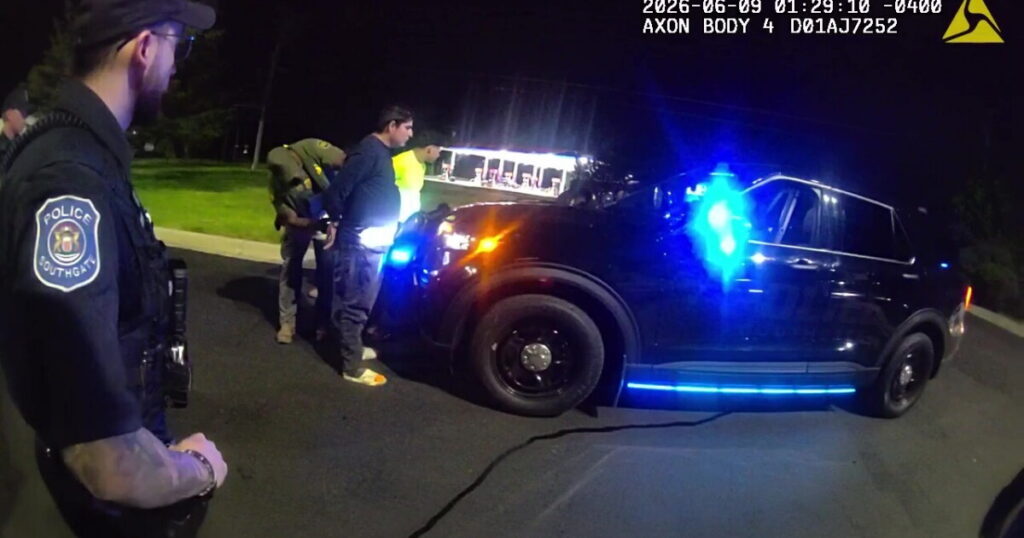
A late-night walk across a two-lane street in Southgate, Michigan, ended with two men in handcuffs and in federal custody — not because of what they did, but possibly because of who they are. The incident, captured on body-worn camera footage, is raising serious questions about whether some local police officers are using minor violations as cover to target immigrants.
Around 1 a.m. on a Tuesday in June 2026, three people crossed a two-lane road between a hotel and a gas station. Officer Alexander Zielinski of the Southgate Police Department observed the crossing and waited for the group to return to the hotel parking lot before stopping them for jaywalking. He asked all three for identification. A middle-aged white woman said her ID was in her hotel room. She received a citation and walked back inside. The two young, Spanish-speaking men she was with did not go home that night.
Body-worn camera footage obtained by Michigan Public shows four Southgate officers surrounding the two men for approximately 30 minutes while they waited for Customs and Border Protection agents to arrive. You can watch the footage here. Officers had difficulty communicating with the men, who spoke only Spanish. One attempted to show an officer he hadn’t been drinking by motioning for him to smell his breath, saying, “No huele, no estamos.” Officer Zielinski’s response to a fellow officer was direct:
“I’m far from concerned about their drinking.”
When Zielinski called dispatch, he noted,
“Two of them don’t speak English.”
His written report states: “Dispatch was advised and subsequently contacted CBP.” The men’s immigration status — not their jaywalking — appears to have been the central concern from the start.
What Are Pretextual Stops?
It is generally not considered legal for police to stop someone based on their race or language. However, officers can legally stop individuals for minor code violations — even if their actual motivation is something else entirely. These are known as “pretextual stops.”
Stephen Rushin, a law professor at Loyola University Chicago, explained the dynamic plainly:
“Instead, they look for some technical violation, often of traffic code, to give them that legal justification to make that stop.”
Thaddeus Johnson, a senior fellow at the Council on Criminal Justice and former Memphis police captain, reviewed the Southgate jaywalking stop and called it particularly “disturbing.”
“Jaywalking has been one of those things that officers [have] used as pretextual grounds,”
he said. Johnson described these stops as providing an
“opportunity”
to perform a
“visual frisk,”
ask questions, and investigate further — and was direct about what really drove the encounter:
“It was never about the jaywalk.”
Proving a stop was pretextual is notoriously difficult, experts say, unless an officer explicitly admits it. In one exchange caught on camera, after Officer Zielinski commented that he had been surprised to see all three people crossing the street, another officer responded:
“Like a kid on Christmas morning right there.”
Camera Muting and Policy Questions
The body-worn camera footage from the stop raises additional concerns. One officer’s camera was muted for nearly the entire encounter — a pattern that appears to conflict with Southgate Police Department policy, which permits muting only during tactical or investigative discussions and requires officers to unmute as soon as that portion of the conversation ends. The extended muting left much of what was discussed with the two men unrecorded or redacted.
Michigan Public reached out to Southgate Police Chief Mark Mydlarz, the city’s mayor, city administrator, and members of city council. None responded.
A Pattern Involving Local Police and Immigration Enforcement
The June jaywalking stop is not an isolated incident. An investigation by Michigan Public and Outlier Media identified several hundred cases across Michigan in which local police handed individuals over to immigration enforcement following minor stops — including broken tail lights, tinted windows, jumpstarting a truck, or sleeping under a tree. Legal experts who reviewed a sample of these cases said they bear the “hallmarks” of pretextual stops.
In Southgate specifically, two other encounters with immigration consequences emerged from records requests. In one instance in March, officers stopped a vehicle and noted — alongside a license plate check —
“an air freshener tree hanging from the rear view mirror.”
When the driver and passenger provided only Guatemalan IDs, dispatch was contacted and CBP agents arrived to make arrests. In a separate stop, an officer pulled over a vehicle for a license plate violation and directly asked whether the driver or passenger were in the country illegally. Before June 2026, Southgate police appear to have had no CBP calls for at least five years.
Nationally, immigration arrests have surged, reaching 50,000 in July alone. Federal incentives are also playing a role locally — ICE has offered local police departments significant funding, including money for salaries, equipment, and vehicles, to participate in programs that authorize officers to make immigration arrests.
Ron Wiles, executive director of the Michigan Association of Chiefs of Police, declined to review any of the cases flagged by Michigan Public but offered a general defense of officers:
“I assume that [officers] didn’t have some ulterior motive behind stopping those people.”
He added,
“I caution against broad-brushing all these cases.”
Johnson, however, pointed to the broader consequences when officers use minor stops as pretexts for immigration enforcement:
“It’s the cost of time… and how officers could be spending their time more productively and proactively reducing crime and servicing citizens.”
Civil rights organizations have echoed that concern, warning that local law enforcement cooperation with federal immigration authorities erodes community trust and may ultimately cost taxpayers.
When CBP agents finally walked the two men to a federal vehicle that June night, Officer Zielinski told the agent:
“Honestly, this went way better than the last time I called.”
What happened to the two men after they were taken into Border Patrol custody remains unknown. For a deeper look at how this investigation was conducted, and for related reporting on immigrants unlawfully detained at an ICE facility in Northern Michigan, additional coverage is available from Michigan Public.