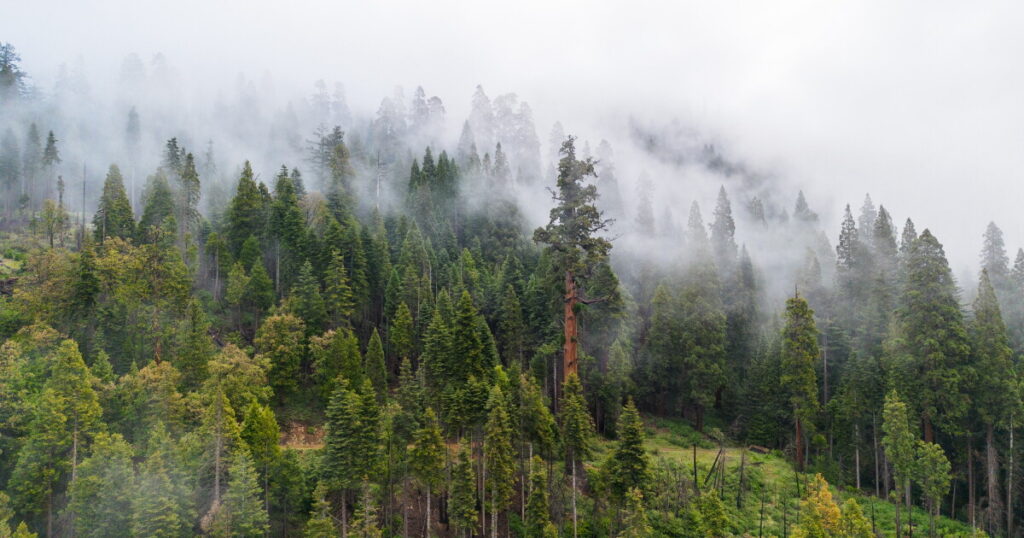
Fire Management Strategies Show Promise in Protecting Giant Sequoias
Giant sequoias, known for their towering presence and ancient lineage, are facing unprecedented threats from wildfires. Over the past decade, nearly 20% of these majestic trees have been lost due to fires, a concerning trend for a species that can live for thousands of years. However, recent research suggests that not all hope is lost.
A study conducted by researchers at the University of Nevada, Reno, and published in the journal Forest Ecology and Management, offers a glimmer of optimism. The research focused on Mountain Home Demonstration State Forest, which hosts the largest old-growth grove of sequoias in the world. This area was severely affected by the 2020 Castle Fire.
In their study, researchers compared sections of the forest that had undergone thinning or controlled burns over a 15-year period to those that had not. The findings were significant: sequoias in untreated areas perished at more than double the rate of those in sections that had received preemptive care, according to Bryant Nagelson, the study’s lead author.
“Our survival rate was about twice as high as the survival rate in areas that had not received any kind of recent treatment within that 15-year window,” Nagelson stated.
The proactive strategy of reducing potential fire fuel is seen as a crucial method to combat intense wildfires. Sarah Bisbing, a forest ecologist from UNR and co-author of the study, explained, “We have burned up the fuel ahead of a fire, so when a fire arrives, there is limited fuel to actually be able to burn on that landscape.”
Giant sequoias have historically thrived in fire-prone environments, with heat playing a role in their seed dispersal. Yet, decades of fire suppression have led to an accumulation of fuel, resulting in fires that burn hotter and more destructively than the trees can handle.
This imbalance is not unique to sequoia groves but is a widespread issue across western forests. As the climate continues to warm, the urgency for proactive treatment like prescribed burns and fuel reduction becomes more apparent.
Researchers also point to the Great Basin bristlecone pine as a species that could benefit from similar management practices. “For all remaining old-growth forests across the West, we’re talking about relatively small native ranges,” Nagelson noted. “So, that is a point of optimism for me. That when we boil it down to a small area, we can really make a difference through prescribed fire.”
This report is part of an initiative by the Mountain West News Bureau, a partnership involving multiple public radio stations and NPR, supported by various regional newsrooms and the Corporation for Public Broadcasting.