Historical Marker Unveiled to Honor Pioneering Hospital in North Carolina
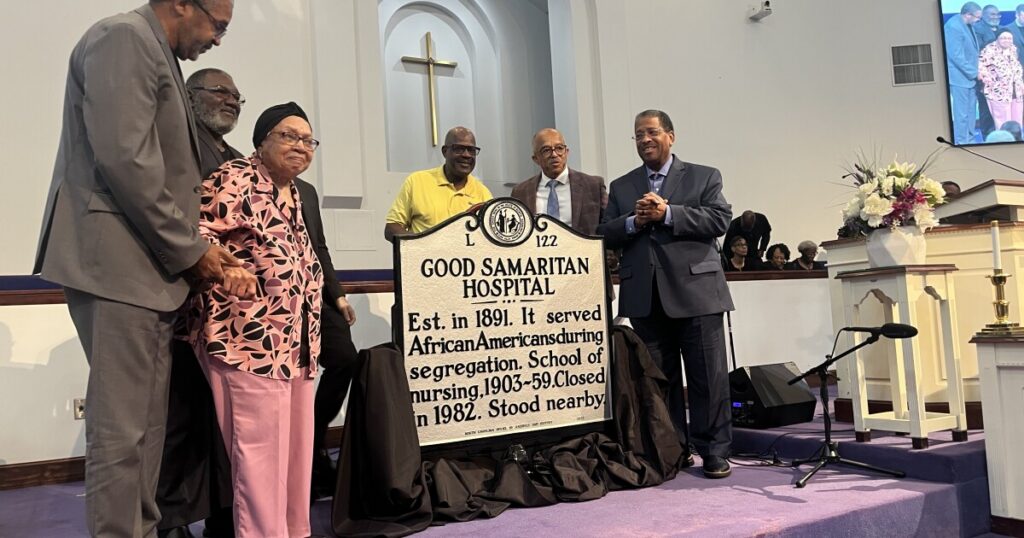
A significant chapter in North Carolina’s history was commemorated on Thursday as hundreds gathered in Charlotte to witness the unveiling of a historical marker for Good Samaritan Hospital. Known as the first public hospital in the state to provide care to African Americans during segregation, this institution’s legacy was celebrated at a ceremony held at Ebenezer Baptist Church on West Sugar Creek Road.
Good Samaritan Hospital, which began operations in 1891, initially accommodated about 20 patients before expanding to a capacity of approximately 100. Alongside providing medical services, the hospital also ran a nursing school specifically for Black students, addressing the educational and healthcare disparities faced by African Americans at that time.
The initiative to honor the hospital with a commemorative marker was led by Dr. Alvin Powell, who emphasized the importance of acknowledging this part of history. “This history is extremely important and unknown and not remembered, so we need to recognize our history so we can understand the present,” Powell remarked.
The marker was sanctioned by the North Carolina Highway Historical Marker Program, following Dr. Powell’s application that highlighted the hospital’s far-reaching influence. Leslie Leonard, the program’s administrator, noted that the hospital’s ability to treat patients from various counties elevated its significance beyond local boundaries. “Dr. Powell submitted documentation that showed not only was Good Samaritan Hospital the first privately funded segregated hospital in North Carolina, but they also were able to treat patients from across county lines, which made it more than just a locally significant space,” Leonard explained.
A panel of ten professors unanimously approved the marker, adding it to the state’s collection of 1,669 historical markers. Leonard mentioned, “It is very difficult to get a marker approved. Any applicant has to demonstrate statewide significance for a marker. We receive many applications per year. At each committee meeting, I would say 40-60% of those markers get approved.”
For many attendees, the event was deeply personal. Nancy Huntley, aged 81, was born at Good Samaritan Hospital. Reflecting on the hospital’s role, she said, “It was essential that we had a place for us to be born in, you know, because sometimes, you know, back in those days there were like the midwives and things like this, so with the hospital, the hospital, it was more professional, it was more convenient if a child was born with something.”
Huntley also shared that the marker acknowledges the community’s significance. “That we’re important, we are important, and we’re part of this human race, and at the time we were getting what the human, what we needed,” she stated.
Though the hospital ceased operations in 1982, the newly established marker ensures that its critical contribution to healthcare and education will remain in public memory.