In the rural areas of Syria, children are embracing a renewed sense of joy and culture, thanks to the initiative of a vibrantly painted Mobile Cultural Bus providing access to books, art workshops, and puppet shows.
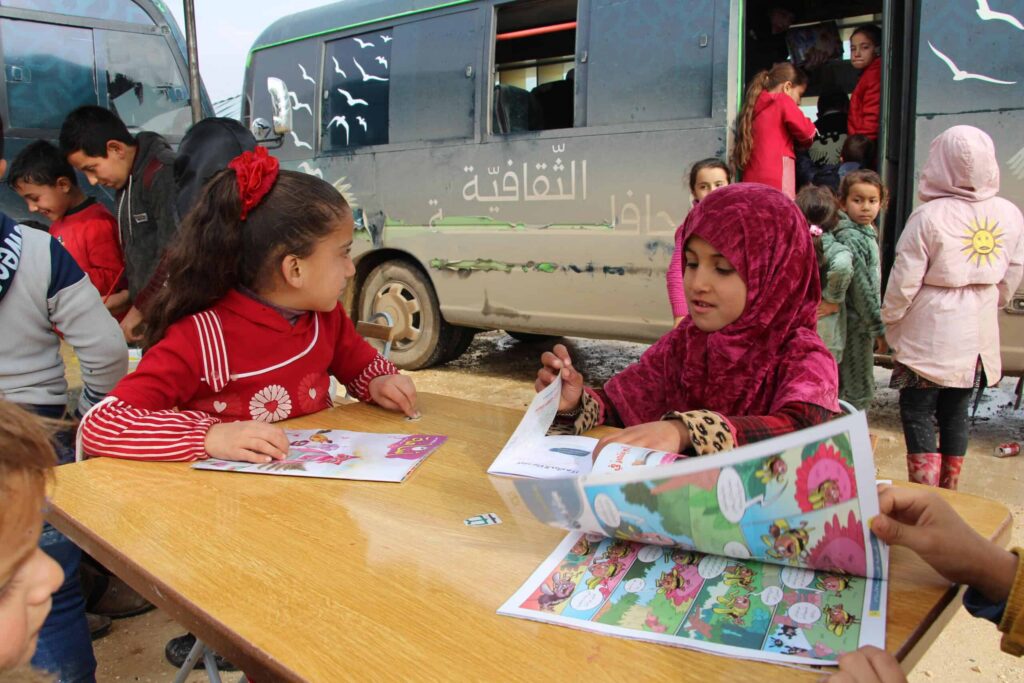
The bus, adorned with numerous book titles and animated characters, arrives at the Kafr Lusin camp in northern Idlib, Syria, attracting young, curious minds. As the doors swing open, it unveils a treasure trove of books, art materials, and a compact puppet theater, providing a much-needed break from the realities of war and displacement that has been these children’s upbringing.
The project, propelled by the Syrian Ministry of Culture and a team of committed volunteers, aims to promote art and culture among children and families in remote areas. This initiative combats the lack of libraries and safe creative spaces in these regions, using the bus as a mobile cultural hub.
However, the Mobile Cultural Bus goes beyond being a mobile library. It offers a welcome distraction and an opportunity for children to unleash their creativity, many of whom are owning a book for the first time. These cultural activities provide a hiatus from their daily struggle for necessities amidst the devastating years of conflict that have crippled Syria’s education and cultural landscape.
“The bus was conceived precisely because many of these children have never been to a library,” says Mohammad Murad, the project director. “Our idea was straightforward: If children can’t access culture, we must bring culture to them.”
The Mobile Cultural Bus started with an old bus that was donated, refurbished, and transformed into a roaming educational center. It now carries novels, short stories, learning materials, and artistic supplies for kids and adults alike. When it arrives, the team spends hours with the children, conducting group storytelling sessions, drawing, handicrafts, reading, and ending with a puppet show or educational games.
“For these children, the arrival of the bus is an extraordinary event,” says Sarah al-Khatib, a volunteer teacher with the project. “Many have spent years in tension and fear due to war. But when we arrive, we see the atmosphere shift completely; laughter and joy reclaim the space.”
Al-Khatib emphasizes that while a book or puppet show can’t erase the harsh realities the children have lived through, it can offer a semblance of routine, attention, and a brief return to their childhood. The impact is palpable, especially among children with limited access to books.
Walid al-Samahi, a 12-year-old science fiction enthusiast from Al-Qutayfah, rural Damascus, can’t afford books. The bus’s visit offers him a rare opportunity to immerse himself in a world beyond his everyday life, making him aspire to become a teacher in the future so he can give children books and help them feel less alone.
The Mobile Cultural Bus project has already reached thousands of children across numerous villages and neighborhoods. Despite its success, the need remains enormous, with Unicef reporting over 2.5 million Syrian children out of school and nearly 8,000 schools requiring urgent rehabilitation in their 2026 humanitarian appeal for Syria.
The bus filled with books cannot singlehandedly solve the education crisis, nor can it rebuild schools or replace teachers lost in Syria. But it can extend learning and culture to isolated children and remind them of their right to inquire, create, and envisage a future beyond loss.
For Murad and his volunteer team, the bus delivers more than stories, treating culture as a right, not a privilege, for children living in camps and rural communities. In a nation healing from years of devastation, the sight of children huddled around a brightly painted bus may seem modest. But for those on the roadside, it brings a rare moment of joy and learning, possibly sparking a dream for a brighter future.
Images provided by Sonia al-Ali