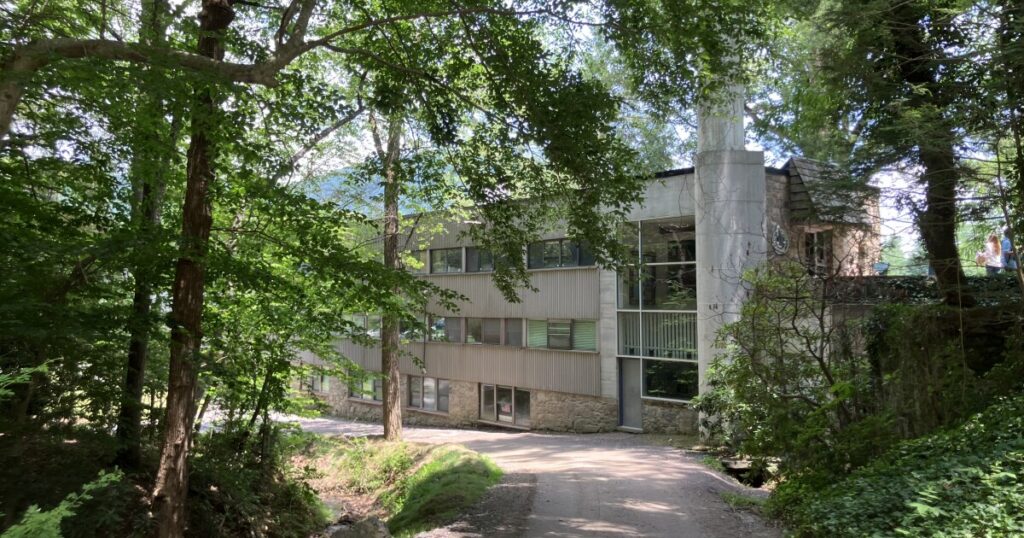
As America approaches the 250th anniversary of the Declaration of Independence, the Black Mountain College Studies Building has been recognized as one of the nation’s historic sites in dire need of preservation. This recognition highlights the building’s significance in shaping American history.
In a recent announcement, the Black Mountain College Studies Building was added to Irreplaceable America, a list curated by the World Monuments Fund to honor sites with a profound influence on the country’s historical fabric.
Amanda Fortini, who wrote a 2022 New York Times magazine article about the college, noted its role in nurturing creative luminaries such as composer John Cage and architect Buckminster Fuller. “It was not just a genius cluster of like-minded souls, of bright, ambitious, talented and sometimes peculiar people who wanted to be together and maybe couldn’t be anywhere else,” Fortini stated. “It created genius. The Studies Building is important because it is a physical artefact of that legacy.”
Felicia Sonmez
/
BPR News
Situated by Lake Eden, the minimalist Studies Building was an endeavor of the college’s students in the 1940s, designed by architect A. Lawrence Kocher in the International Style. After the school ceased operations in 1957, its grounds became the site of Camp Rockmont, a Christian boys’ summer camp.
Joining the ranks of the Irreplaceable America initiative are other notable landmarks like the Watts Towers in Los Angeles, a former smallpox hospital on Roosevelt Island in New York City, and Dallas City Hall in Texas.
Chuck Fluornoy, executive director of the Black Mountain College Studies Building Foundation, emphasized the World Monuments Fund’s recognition as a testament to the building’s enduring legacy, which encapsulates “stories of courage, creativity, collaboration, innovation, ingenuity, resilience.”
“All of these define and undergird the American experience, and they’re all epitomized and codified in this college and in this building,” he articulated.
The foundation plans to initiate a capital campaign aiming to raise between $15 million and $20 million for the building’s restoration, set to commence in the fall of 2027 and complete by spring 2029. Post-restoration, the building will serve Camp Rockmont’s art activities during summers and host artist residencies, public tours, exhibitions, and seminars for the remainder of the year.