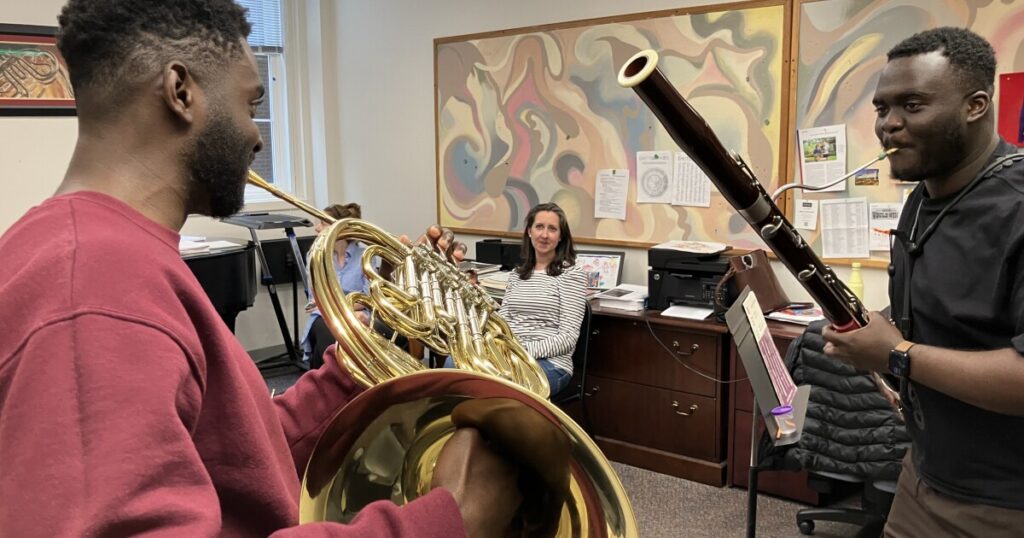
In a heartwarming display of musical talent and dedication, Stephen and Nathan Olusemire, twins from Nigeria, recently graced a Winston-Salem retirement community with their performances. Despite their origins being 5,000 miles away from North Carolina, these young musicians have made remarkable strides in their musical journeys.
The bassoon and French horn, played by Stephen and Nathan respectively, are known for their complexity. The horn requires players to blow through approximately 15 feet of coiled metal, while the bassoon is equipped with about 30 keys, with 13 designated for the thumbs alone.
Stephen’s fascination with the bassoon began with Mozart’s Symphony No. 40. Initially, he played the euphonium in a local church band in Lagos, Nigeria, before transitioning to percussion. However, his first exposure to the bassoon left a lasting impression.
“This instrument just sounds really beautiful,” Stephen reflects. “And I was like, you know, I made more research about it, and I found out, you know, there’s an instrument. It’s called the bassoon. And, you know, it was just like new knowledge for me. Years went by, and I moved from the church band to the church orchestra.”
In his teenage years, when the opportunity to try the bassoon arose, Stephen eagerly accepted. Meanwhile, his brother Nathan’s introduction to the French horn came through a friend’s unexpected visit with the instrument.
“I was just so intrigued,” Nathan recalls. “And then I asked a really funny question at that time, ‘Can you let me try your instrument?’ I hadn’t played any brass instruments in my whole life. And then I was like, ‘Oh, can I try the instrument?’ And he was like, ‘Oh, yeah, for sure.’ So, the first ever note I played on the horn was the middle C, and it came out clean. And I was like, ‘Oh, maybe this is a sign for me to, like, learn the horn.'”

Without formal music education in Lagos, the twins had to innovate, largely relying on YouTube for guidance. Nathan mentions, “Something that we struggle a lot with is having access to people to teach us. So most of our learning was based off YouTube videos.”
However, the limitations of online learning became apparent, as Nathan mistakenly used trumpet fingerings for the horn initially. The brothers faced various challenges, such as affording transportation to practice locations.
Stephen sought assistance via social media, joining a bassoon chat group and posting a video of his performance. “I told them I was from Nigeria,” he says. “I just started playing the bassoon. And you know that I needed help with information of how to play the instrument the right way. And you know, the response I got from that video took everything from here to up there.”
The online community proved invaluable, with professional bassoonists offering lessons and a GoFundMe campaign securing a new instrument for Stephen. He received guidance from members of prestigious orchestras, such as the Philadelphia Orchestra and New York Philharmonic.
UNCSA’s Stephanie Patterson taught Stephen remotely before he earned a full scholarship to study there. She notes the unique experience of teaching Stephen. “It’s completely unlike working with any other student in a lot of ways,” she says. “You know, he’s great in that he has a completely different perspective than most of my students.”
Nathan followed a similar path, benefiting from online lessons and a GoFundMe campaign for a new French horn. His dedication impressed Professor Maria Serkin. “It’s always the most proactive students that go far above and beyond that are the most successful in their careers,” she observes.

Courtesy UNC School of the Arts
Two years ago, their musical prowess brought them to Carnegie Hall with the Africa United Youth Orchestra. The Olusemires aim to continue their studies and eventually establish a music institute in Nigeria, similar to their experiences at UNCSA.