While climate change is often blamed for declining fish populations, recent research suggests that fishing practices have a more significant impact. According to a study spearheaded by the University of Wisconsin-Madison, anglers play a more substantial role in affecting fish numbers compared to rising temperatures.
The findings were published in the journal Science Advances by a collaboration of state, federal, and academic researchers. They scrutinized data from the last 40 years regarding 521 fish populations across nearly 200 Midwest lakes.
The study focused on eight fish species, including those that prefer warm waters like bluegill and bass, alongside cold-water species such as cisco and walleye. Researchers utilized a model to simulate the potential impacts on these populations in the absence of warming and fishing.
Luoliang Xu, a postdoctoral researcher at UW-Madison’s Center for Limnology, stated, “We found that for the majority of the populations so far fishing has far more greater impact than warming on the fish populations.”
According to Xu, fishing exerted a stronger influence on 92 percent of the fish populations examined between 1980 and 2021, even though warmer waters were present in 98 percent of the lakes studied.
Study co-author Olaf Jensen, a professor at UW-Madison, found the results promising, suggesting that it’s not too late to preserve most fish populations. Only cisco, or tullibee, showed significant negative effects from warming.
Jensen remarked, “For the rest of the species here, including cool-water species like walleye, it really is fishing that’s the dominant driver. That means that if we have concerns about population declines, we’re likely to be able to solve them, at least in the short-term, by limiting harvest from fishing.”
Sport fishing plays a major economic role in Wisconsin, generating over $2 billion annually.
The study found that 65 percent of warm-water fish populations increased with warming, while over half of the cool or cold-water species experienced declines. Only one percent of fish populations were more affected by warming than fishing.
Encouraging anglers to target warm-water species could help protect those more vulnerable to climate change. Jensen suggested management strategies such as shortening fishing seasons, reducing bag limits, and increasing size limits to protect younger fish.
“The best approach is to tailor these regulations so that they meet local goals,” Jensen said. “In some places we might want to allow more harvest. In other places, we might be trying to rebuild a previously overfished population, and that’s something that management agencies are already doing.”
Xu highlighted that warming’s impact on cool-water species like walleye varied, with some positive outcomes in certain regions, contrary to common beliefs about climate change effects.
“But from our study, we do find that in some areas, the warming actually has a positive impact on these cool-water species,” Xu said.
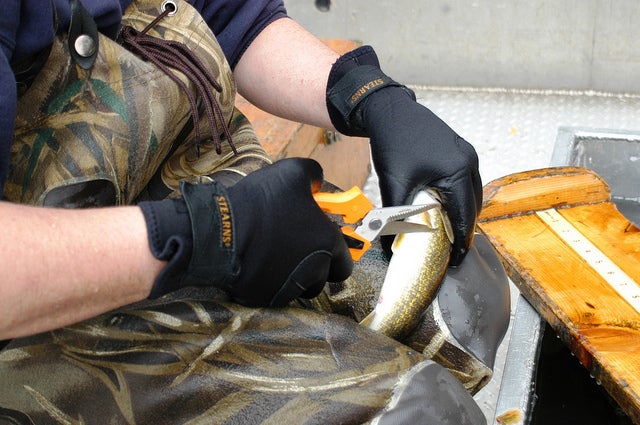
The study suggests that local environmental or ecological factors in specific lakes may significantly influence fish populations. Jensen noted that some lakes contain cold springs, providing refuge for fish during warm summers.
Researchers caution that their findings are based on historical warming trends, and fish populations may still face future challenges.
“As the climate continues to warm, even some of the populations of fish that have been winners so far are likely to show negative impacts of future warming,” Jensen said.
Jensen concluded that the research shows people can influence fish populations positively, even amidst climate change challenges. Xu agreed, emphasizing local action.
“Even under climate change, the local actions still matter,” Xu said. “Managing fishing pressure effectively is probably one of the best tools we have in hand to keep our lakes, and fish we depend on, resilient in a warming world.”
Wisconsin Public Radio, © Copyright 2025, Board of Regents of the University of Wisconsin System and Wisconsin Educational Communications Board.