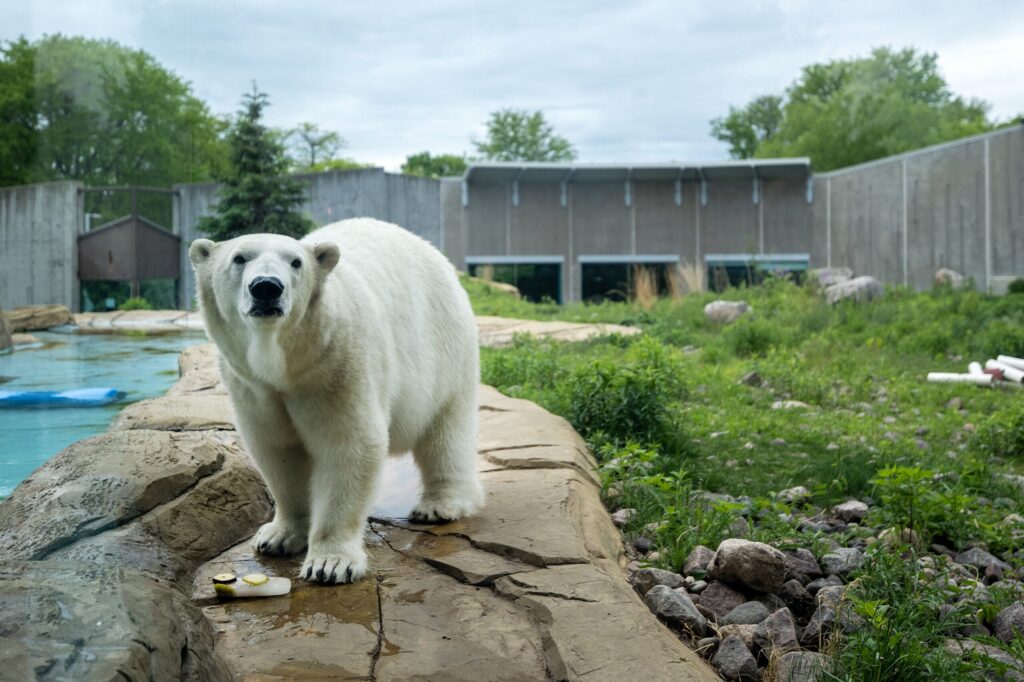
Nora and Siku: A Hopeful Union at Henry Vilas Zoo
The Henry Vilas Zoo in Madison is buzzing with excitement as two polar bears, Nora and Siku, embark on a new chapter. When Nora joined the zoo, it was uncertain how she would interact with Siku, a 16-year-old male who arrived from Chicago’s Lincoln Park Zoo in October. Yet, the two quickly took to each other, frolicking in their shared habitat.
In February, the couple spent three days mating, marking a significant milestone for Nora. “This is the first time that Nora’s ever lived with a boy in her life,” shared Zookeeper Kristin Myers. “So it was very exciting.”
The zoo’s acquisition of Siku and Nora is part of a broader goal to encourage polar bear reproduction. They are collaborating with the Polar Bear Population Alliance to boost the population of captive polar bears. Across the United States, only 35 polar bears reside in facilities accredited by the Association of Zoos & Aquariums, with the Vilas Zoo housing three: Nora, Siku, and Berit, a 27-year-old female.
With shrinking Arctic ice due to climate change posing a threat to wild polar bears, these zoo-based studies are invaluable. Researchers aim to learn from captive bears like Nora and Siku to benefit their wild counterparts. “We’re trying to make some big changes to try and help our our zoo population,” Myers stated. “Because the more we can help with our in-the-zoo populations, the more we can also learn about wild populations.”

Johanna Soto, the Zoo Manager, is thrilled to have such rare creatures in Madison. Having grown up in Canada with wild polar bears, Soto expressed her admiration for them, describing them as “majestic.” She remarked, “A lot of people think they’re very solitary, but they are actually pretty social. It’s an animal I don’t think a lot of people get the opportunity to see.”
Anticipation Builds: Will Nora Become a Mother?
Since her arrival in January, Nora has captivated visitors. As zookeepers Kristin Myers and Johanna Soto strolled through the zoo, they frequently fielded inquiries about Nora, from her diet of frozen fruit, beef, and fish to her weight of 600 pounds. One visitor eagerly asked if she was pregnant.
However, the answer to that question will remain elusive until December, when Nora would be due to give birth. Polar bears experience delayed implantation, with a brief pregnancy lasting less than two months. By then, it is expected that Nora will have gained substantial weight, making ultrasound use impractical.

To monitor her status, zoo staff regularly send Nora’s fecal samples to her former home in Portland, Oregon, to assess hormone levels. Yet, these tests are not foolproof, as female polar bears can exhibit pseudo-pregnancies. Nora experienced one last year, despite never encountering a male bear.
While Nora, at 10 years old, is at an ideal age for motherhood, Berit, the zoo’s elder bear, may still have a chance at pregnancy, although her age reduces the likelihood. Despite Berit’s experience and mentorship, she has shown no interest in breeding with Siku, unlike Nora.

As the summer progresses, hopes are high that Nora will fatten up, preparing for hibernation and denning season. If a cub is born, it will arrive as a tiny, underdeveloped creature, reliant on its mother for nourishment. “They can’t really move around,” Myers explained. “They just scooch up on mom to get to the milk, and then they grow from there.”
Wisconsin Public Radio, © Copyright 2026, Board of Regents of the University of Wisconsin System and Wisconsin Educational Communications Board.