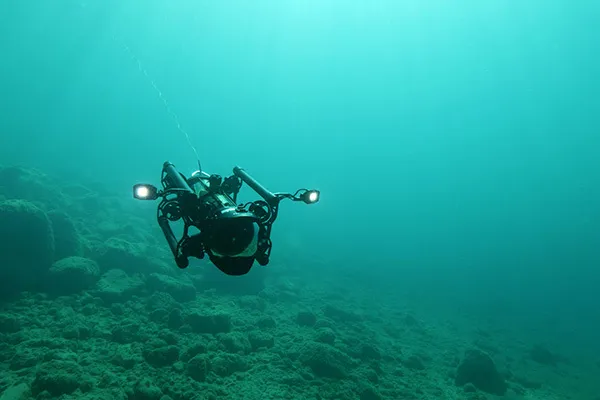
In the mysterious depths of Lake Superior lies a world few have ever seen. Known as Superior Maximus, this area can plunge more than 1,300 feet beneath the surface, making it one of the planet’s least explored regions. Recently, a team of scientists and filmmakers embarked on a groundbreaking mission to uncover its secrets.
Shawn Sitar, a fisheries research biologist with the Michigan Department of Natural Resources, has been studying this hidden realm for two decades. Despite his extensive research, Sitar had never witnessed the depths firsthand until this month, thanks to an innovative robotic expedition.
Exploring the Unknown Depths with Advanced Technology
The exploration team deployed a specialized robot, named Kiyi after a rare deepwater fish, to navigate the depths of Superior Maximus. Equipped with eight thrusters and a 750-meter fiber optic tether, Kiyi sent back unprecedented footage from the lakebed. The pressure at these depths is 40 times greater than at the surface, but the robot withstood the conditions, capturing a world unseen for over four decades.
“A lot of things need to go right in terms of the weather and technology to get us that far,” noted filmmaker Yvonne Drebert, who aims to encapsulate the expedition in a documentary titled “Hidden Below: The Great Lakes”, set to debut in 2028.
Uncovering an Ecological Enigma
While the robotic mission revealed an alien-like environment, the team was particularly focused on a peculiar phenomenon affecting the Siscowet lake trout. These fish, which inhabit depths of 250 feet and deeper, have been found increasingly emaciated since 2015. Dubbed “zombie fish,” their numbers have surged from 3% in 2015 to a staggering 54% in 2025 at Superior Maximus.
Sitar explained that the condition might be a natural ecological event like a famine, but further investigation is required to dismiss the possibilities of disease or contamination. “We’re not totally alarmed,” he said, “We are concerned.”
Discoveries and Human Impact
In addition to biological studies, the team uncovered reminders of human presence, including a rusted Busch Light beer can. Such finds underscore the impact humans have even in remote places. The scientists also encountered unique species adapted to this extreme environment, like mysis shrimp and deepwater sculpin.
The research continues, with hopes to locate a time capsule from the 1980s. As these explorations advance, they highlight the importance of understanding the health of Superior Maximus as a reflection of the broader Great Lakes ecosystem.
Reflecting on the mission, Sitar expressed the thrill of discovery: “To still have the ability to make discoveries in the world, it’s marvelous. It seems like everything’s answered in today’s world — but it really isn’t. The more I look at Lake Superior, I find more questions than answers.”