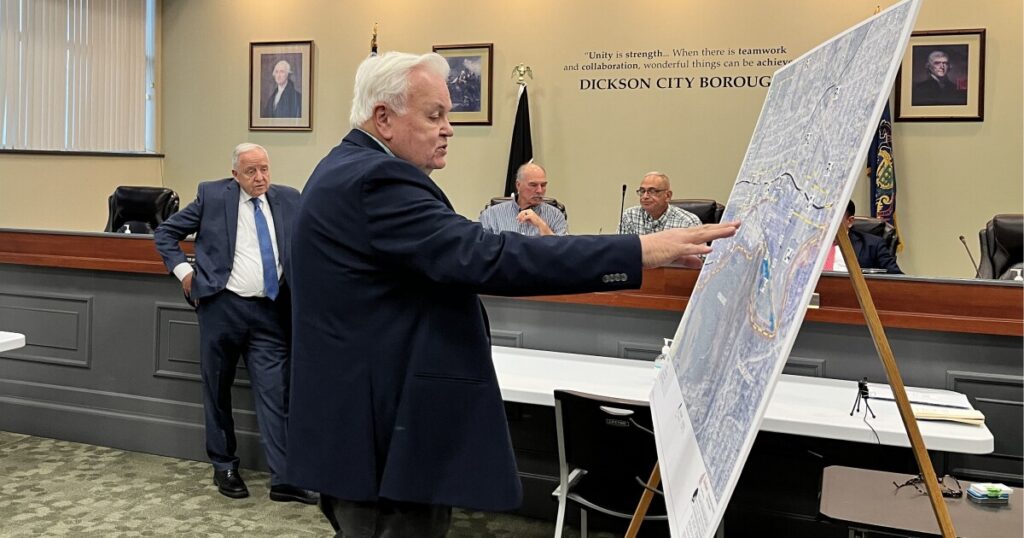
In a recent development, plans to construct a four-building data center in Dickson City have encountered a significant hurdle. This setback follows a decision by the borough’s Zoning Hearing Board, which unanimously rejected an appeal related to the zoning ordinance brought forth by Dickson City Development LLC. The proposed site for these data centers is situated on Bell Mountain, adjacent to Business Route 6, an area traditionally designated for residential and commercial purposes.
Currently, the matter’s resolution lies with the Lackawanna County Court of Common Pleas, as stated by Bill Jones, the borough’s solicitor. Michael Mey, the attorney representing the developer, refrained from commenting after the extensive hearing, which spanned over two hours.
The Zoning Ordinance
Earlier this year, in February, the Dickson City Council approved a zoning ordinance that facilitated the establishment of data centers on 70 acres within the light manufacturing (M1) zone, with the provision of a special exception. Mey, who also represents other developers in the region, contested the ordinance’s validity, arguing it didn’t align with the prerequisites and site requirements for his client’s intended data center development.
The development company, associated with Kriger Construction President Jim Marzolino, sought four distinct zoning permits for construction along Business Route 6. However, Jones and the borough’s planner, Tom Shepstone, maintained that the designated manufacturing district near the Lackawanna River and Throop border was more suitable for data centers.
Highlighting the essence of zoning, Shepstone emphasized, “What we’re trying to do is we’re trying to preserve the character of certain zones for what they’ve been previously designated for, and that’s what zoning is about. We would like commercial to be commercial.” The hearing saw Shepstone as the lone witness, with Mey focusing on the availability of land in the M1 district, proximity to high-voltage power lines, and querying whether any manufacturing processes occur within a data center.
Under Pennsylvania law, municipalities are required to permit all land uses, governed by zoning regulations that dictate property use. It’s noteworthy that until a year ago, many communities in Lackawanna County and neighboring areas lacked specific zoning laws for data centers, prompting developers to challenge and propose language for these ordinances statewide.
The Dispute
Mey raised 65 issues concerning the zoning ordinance. Shepstone addressed many of these, covering topics such as fire department requirements, decommissioning protocols, and the ordinance’s perceived inflexibility. Mey spotlighted the lack of high-capacity electrical substations nearby and questioned the feasibility of routing power lines from Business Route 6 through residential areas to the manufacturing district.
Shepstone responded, “We are providing a location for your project, it’s your job to design it. Now, if you find that you can’t do that then you may have a valid claim, but at this point we don’t know that you can’t do that.” Despite the presence of high-voltage lines throughout Lackawanna County, including east of the Casey Highway, Mey expressed concerns about sufficient space for both a data center and an adjacent electrical substation yard within the manufacturing district.
Jones objected to speculation regarding the power requirements, highlighting that Dickson City Development LLC hadn’t disclosed their energy needs. “Our objection, and one of the reasons they were denied as a permit, is we don’t have any of that information. So now he’s got to speculate as to what their load is. They won’t tell us, but we have to speculate,” he remarked. Mey is challenging this decision as well.
The Nature of Data Centers
Discussion also centered on whether data centers qualify as manufacturing entities. The borough’s 2003 zoning ordinance included “data processing and record storage” as permissible in both commercial and manufacturing districts. Dickson City Development leveraged this language in their January permit application for the commercial district. Shepstone argued that this didn’t pertain to data centers but rather traditional data processing, as seen in healthcare claim processing.
He elaborated, “That is not manufacturing data, it is not doing AI, it is not thinking like human intelligence. It is not generating a new product. It’s simply doing bureaucratic work.” Mey contested Shepstone’s interpretation, arguing it was an attempt to retroactively fit definitions to exclude data centers.
Shepstone considered data centers as “digital manufacturing,” citing their resource consumption and output. “I’ve noted in my report several reasons why this would be a manufacturing use, starting with the water use, the electrical use, the sound concerns, the fact that it’s making a product, and the nature of the product,” he stated. When Mey queried the tangible output of a data center, Shepstone replied, “It’s digitally conveyed. It’s oftentimes a report, it’s oftentimes a research result. It’s oftentimes an image that is created.” Mey persisted in his assertion that data centers don’t constitute manufacturing.
The hearing board deliberated for over 20 minutes before deciding to reject the appeal. Dickson City Development LLC is also contesting the zoning officer’s decision to refuse their zoning use permit for the proposed data centers. An initial hearing on this matter took place on April 29, with proceedings set to continue on Wednesday, May 27, at 5 p.m. at the Dickson City Borough Municipal Building, 901 Enterprise St., Dickson City.