Tracking Trash with Technology: A North Carolina Initiative
In an innovative approach to understanding pollution, researchers in eastern North Carolina are employing GPS technology to track the journey of plastic waste from urban areas to the ocean. This initiative highlights the critical path from city streets to coastal waters, turning discarded bottles into data sources.
The project, spearheaded by NC State and NC Sea Grant, involves deploying plastic bottles equipped with GPS devices into the Neuse River. By monitoring their movement, the study aims to uncover the pathways through which terrestrial waste becomes marine debris.
Related content: New ENC research shows increasing plastics in oceans may be causing whales to eat things that are harmful
Dr. Barbara Doll, a Professor of Ecological Restoration at North Carolina State University, leads the project. She stated, “What’s the what we call load of this material? How much of that is plastic? And what’s the consequence of all this plastic if it gets into these local creeks, the river, or the sound?”
The issue of plastic waste is significant, with oceans worldwide receiving millions of tons of plastic annually. North Carolina’s waterways, which feed into the Albemarle-Pamlico National Estuary, serve as conduits for such debris.
To map out this debris path, researchers initiated the project by releasing 40 GPS-tracked bottles from Raleigh. This initial phase provided valuable insights as many bottles journeyed past Smithfield, revealing debris movement patterns in the upper river sections.

Related content: A whale calf died on an ENC beach from eating a balloon and an NC researcher says plastics are a danger to cetaceans
Madison Haley, a PhD student at NC State, oversees much of the research. She noted, “A lot of that loading is coming from urban areas, and Raleigh is one of the biggest urban areas in that watershed. So, a lot of our focus is actually in Raleigh, but it’s all connected. Everything that enters the streams in Raleigh slowly flows down into bigger streams and bigger streams and into the Neuse River, and that’s going towards and through eastern North Carolina.”
Progressing downstream, the project expanded into the lower Neuse River. New GPS-tracked bottles have been released from Goldsboro and Kinston, helping to complete the narrative of plastic waste’s journey from land to sea.

Related content: Weird Science: N.C. researchers using AI to help conserve endangered species like the Right whale
In addition to tracking, the team is also quantifying microplastics and assessing litter at key locations. Doll explained, “It’s mostly plastic, generally over 90% is plastic, and then of that is it breaking down into these smaller fragments called microplastics.”
Haley expressed concerns, stating, “I think a lot of us see really scary headlines right now about microplastics, about how they’re in our bodies and our brains and our reproductive organs. And I think it’s getting a lot of press and it’s on people’s minds.” Highlighting the project’s comprehensive nature, she added, “We’re looking at a huge range of things, but one of them is litter.”
Future research will likely build on this study’s findings, as Doll pointed out, “There’s a lot of studies, that are collecting the crabs or fish or oysters, and they are sampling the actual organism to say how much is in that. And so, it’s, relatively new emerging contaminant. And some of these questions still have to be asked because anytime we have a water quality contaminant and for it to be regulated or whatever their needs, they have to have a standard that says this is, and this is how we sample and measure it.”
The project encourages public involvement. If individuals encounter these distinctively marked bottles, they are invited to scan the QR code and report their locations.
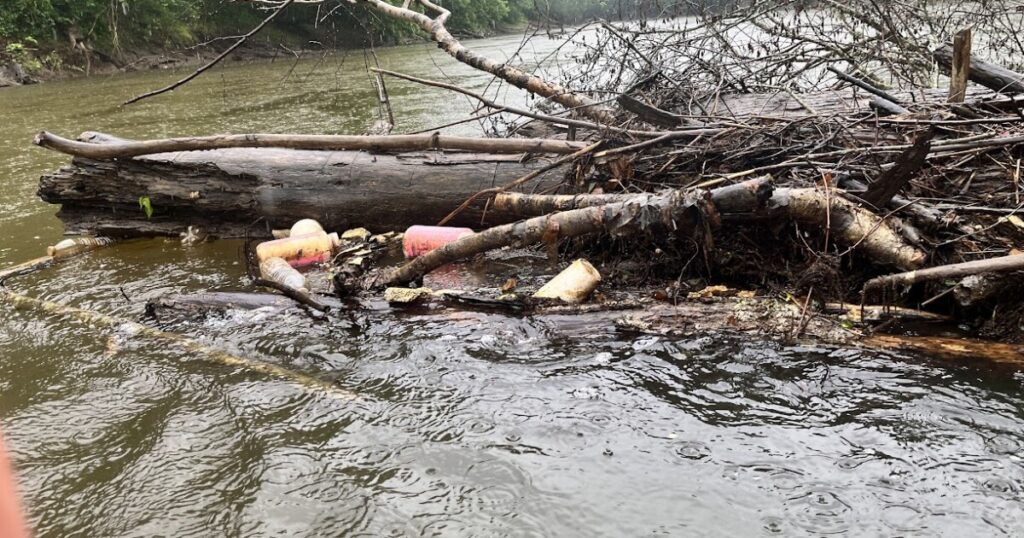
Haley urged community participation, saying, “If folks are out kayaking or on their boats, if you see a pink or orange bottle, please scan the QR code and let us know where you found it. Send us a picture, put it back if you do find it.” She emphasized, “But, yeah, that’s a really fun citizen science. And it’s not just that you can find the bottles out in the river, it’s that you can all track them.”
The project also studies the specific human behaviors that lead to littering in the first place. The ultimate goal is to use this data to create a community toolkit that helps towns across North Carolina keep their watersheds clean.