A Monument to Creativity: Randy Shull’s Tribute to His Father
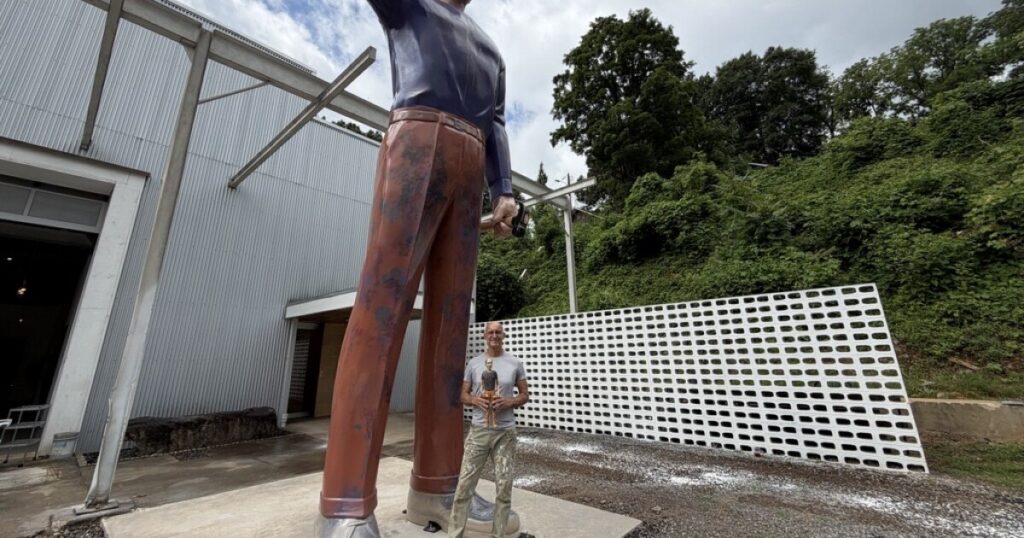
In a striking homage to his father’s legacy, Randy Shull has unveiled a 22-foot statue that captures the essence of his father’s artistic journey. Despite featuring his own likeness, Shull emphasizes that the creation serves to honor his father’s work.
“It’s really about my father. It’s not about me,” Shull remarked. “It’s taking his work and amplifying it. I just happen to be the choice image.”
The statue, crafted from 800 pounds of fiberglass, is an enlarged version of a small wooden figure that Don Shull, Randy’s father, carved thirty years ago. The original sculpture, standing at about a foot tall, depicts a young Randy Shull as an artist. He is shown with a pencil tucked in his mouth, dressed in paint-splattered trousers, clutching a paintbrush and a hammer.
Reflecting on the piece, Shull commented, “I feel like that’s a really good representation of myself, kind of divided. I feel part carpenter, part artist, part creative, part practical.”
Named “Augmented Man,” the statue now resides at 22 London art studio in Biltmore Village. It will be formally revealed on Saturday, June 20, as part of a broader exhibition celebrating Don Shull’s dual legacy as both a carpenter and an artist. The exhibition, titled “Don Shull: Not For Sale,” showcases 14 of his original wood carvings, including figures of a devil, a grandmother, and Albert Einstein.
Unlike his father’s more modest creations, Randy Shull opts for grandiose and conceptual pieces. Don Shull, now 92, spent his career building homes in the Midwest, but his artistic expression found its outlet in whimsical wood carvings. “I think he has a creative streak regardless of whether or not there’s an audience. And I just love that,” Randy said. “He likes to only give them away. He never sells his art.”
In contrast, Randy Shull freely sells his artworks and is drawn to large-scale, immersive projects. “I’m much more intuitive and impatient,” he explained. “I need a large format. It really becomes an experience — a performative experience. And it’s also like an experience for the viewer. They really become immersed in the work.”
Randy Shull finds inspiration in his father’s creations, which continually encourage him to reevaluate his own artistic path. They remind him of “what it is to be creative, what it is to come in and, on a daily basis, be an artist,” he said. “I feel challenged by this piece, and I now need to live up to its presence.”