This coverage is made possible through a partnership between BPR and Grist, a nonprofit environmental media organization.
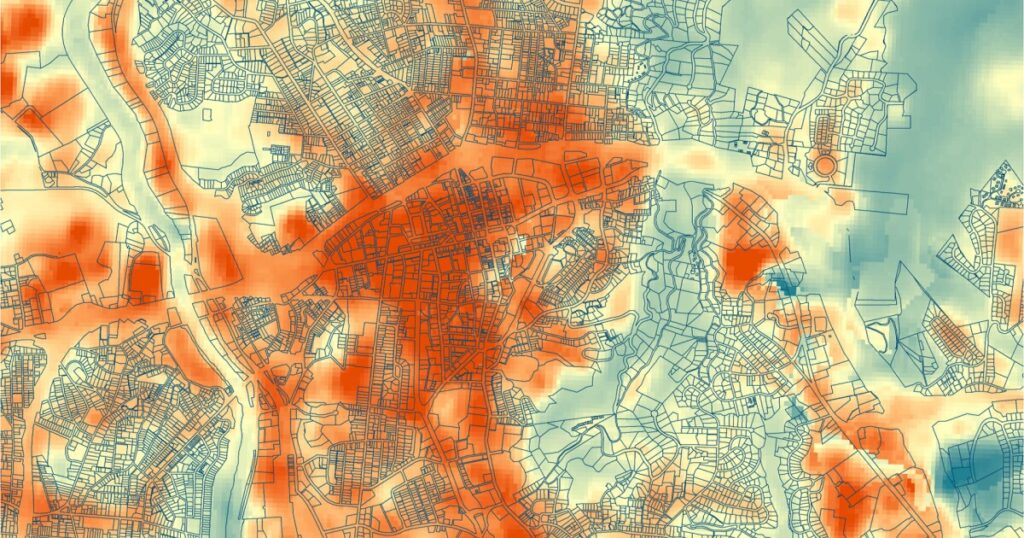
Amid the challenges of climate change, Asheville is revisiting its plans to expand the urban tree canopy to tackle the growing issue of urban heat inequity. Recent sweltering temperatures highlight the city’s need to enhance its green spaces, particularly in low-income areas where trees are sparse and residents feel the heat more acutely.
Retired forester Ed Macie, who is actively involved with Asheville’s Urban Forestry Commission, emphasizes the complexity of this initiative. “It’s important for the public to understand that this is a pretty complex process and that their input and the data all fits together and establishes goals,” he stated. “Those goals will set the work plan for the city and its management of the resources for the next 10 years.”
A Plan Disrupted by Natural Disasters
Hurricane Helene derailed previous efforts to gather accurate data on the city’s tree canopy, redirecting focus to immediate recovery needs. According to Macie, the project was re-initiated last summer, but the storm’s impact, coupled with ongoing construction, has complicated efforts to assess the canopy’s current state. “We know that Hurricane Helene wiped out a lot of trees,” Macie said. “And then there’s been a lot more building construction and land development.”
Despite these setbacks, the city remains committed to community engagement. Michael Fisher, a new member of the Urban Forestry Commission, expressed concern that the hurricane might have diminished public interest in the planning process. “Helene reduced the interest in prioritization for these matters within the actual community,” Fisher noted. “But if you remove that, this isn’t just to address Helene. This is to go 15 to 20 years into the future.”
In the aftermath of Helene, the Helene People and Environment Recovery Board has been instrumental in advising on the urban forest plan. City spokesperson Kim Miller highlighted the importance of consulting both the Urban Forestry Commission and the Recovery Board to align efforts with community needs and available resources.
Community Concerns and Future Plans
A comprehensive public engagement analysis revealed that over 2,375 residents participated in discussions about the master plan, with many expressing concerns over heat and urban development. A significant 70% of survey respondents identified reducing heat levels as a top priority.
Demographic data from the engagement process showed participants were predominantly white, middle-aged homeowners, prompting the city to target younger voices through a special survey at Asheville High School. As Asheville looks to other cities like Knoxville and Pittsburgh for inspiration, the city plans to finalize its urban tree canopy assessment and draft a master plan by December, with publication slated for January 2027.