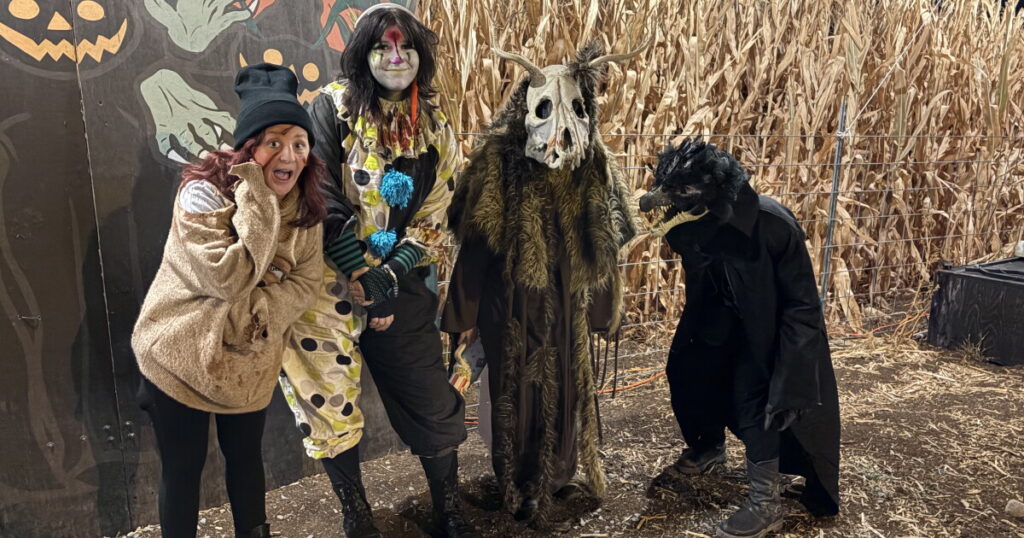
Underneath a luminous moon, a black cat gracefully makes its way across the muddy ground. The chilly air adds to the atmosphere at Andelin Farm’s Corn Creepers attraction, where visitors of all ages find a perfect thrill on a Thursday night.
Fall brings with it a penchant for haunted attractions and horror films, offering adrenaline seekers an outlet for their cravings. Yet, beyond the cinematic scares, many mundane aspects of life contribute to feelings of fear and unease.
Social psychologist Dr. Frank McAndrews delves into the nuances of fear, explaining that while the physiological reactions to being scared and feeling creeped out are similar, our surroundings and the people in them shape our emotional responses.
“Being scared is a very clear emotion. You know you’re in danger. You know what the nature of the problem is…creepiness is all about uncertainty,” McAndrews explained.
The ambiguity of potential threats, whether from unknown corners or unpredictable individuals, often triggers a sense of being creeped out. According to McAndrews, this response persists until the nature of the threat is discerned.
Haunted attractions skillfully invoke the fight or flight reflex, with their maze-like structures, shadowy corners, and strategic use of fog. Such an environment provides scare actors an ideal setting to elicit fear or unsettle guests.
Tiffany Williard, a scare actor portraying Freddy Kreuger’s victim, believes that creepiness thrives on unpredictability, such as emerging from shadows or quietly trailing someone.
“Being creeped out, you’re more just like unsettled. It’s just that feeling in your stomach almost, where being scared, you are actively experiencing what creeps you out,” Williard commented.
For fellow scare actor Shianne Price, everyday scenarios often possess a creepy aura.
“Being creeped out, like I don’t know if you know, like the uncanny valley type stuff, where it’s like something that looks human is trying to be human, but it’s not,” Price remarked.
McAndrews’ research often explores our tolerance for ambiguity and how it influences our perception of creepiness. He suggests that the level of ambiguity serves as a fulcrum between fear and being creeped out.
“Whenever anything is so human that it starts making your brain automatically identify it as human…But you consciously know that it isn’t, That creates a cognitive tension that’s really uncomfortable,” McAndrews noted.
Our evolutionary history reveals that ancestors feared tangible threats like heights or snakes due to their immediate danger. These fears persist today, even though modern life presents different hazards, like cars and guns, which are often overlooked.
As McAndrews pointed out, “there has never been a documented case of somebody being killed by a ghost.”
So why do people indulge in horror movies, ghost stories, or haunted mazes?
McAndrews believes it’s a pursuit of “the fun of fear,” a controlled environment where individuals can mentally prepare for real-life threats.
Mo Mowrey, a scare actor, uses horror films to channel anxiety. “It gives me a reason to funnel my anxiety into it, and after so long, you can recognize the pattern in them. It’s a safe release of that anxious fear,” Mowrey shared.
As one navigates through the towering corn stalks, each corner holds the promise of creepiness. For many, such experiences provide a safe space to confront fears and practice reactions.
While feeling creeped out is a natural response, McAndrews advises against hastily labeling people as creepy, stressing that jump scares are part of the fun but should not lead to quick judgments.