Unseen Sinkholes Emerge in Omaha’s Blackstone Neighborhood
Amidst the bustling activity of Omaha’s Blackstone neighborhood, a series of undisclosed sinkholes have quietly surfaced, adding to the complexities of local infrastructure challenges.
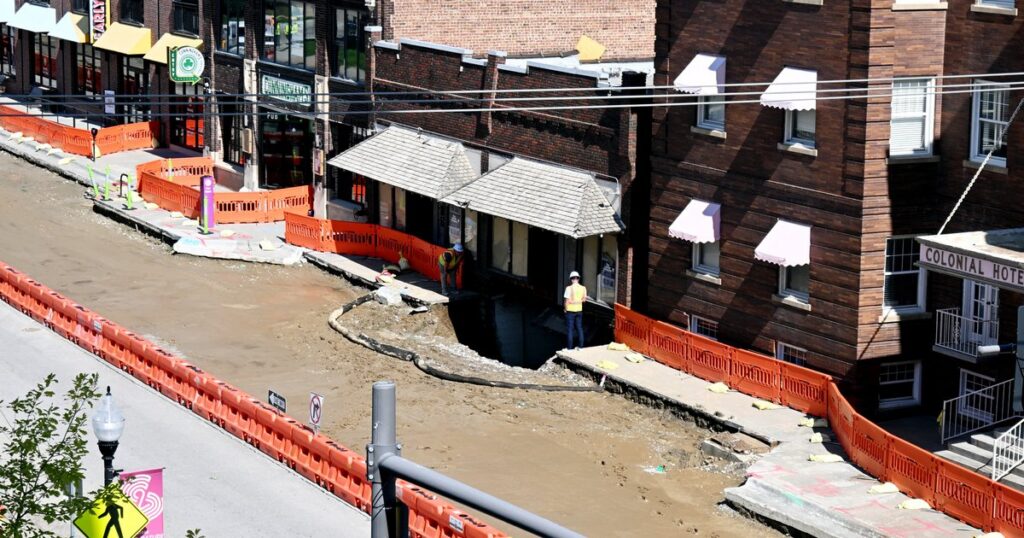
In late June, a significant void was discovered when the foundation wall of an unoccupied building at 3810 and 3812 Farnam St. collapsed, engulfing the sidewalk and part of the structure itself. The resulting hole remains, with city officials awaiting the building owners’ decision on whether to repair or tear down the property.
Nearly two weeks prior to this incident, engineers involved in the nearby streetcar line project convened to discuss similar sinkholes in the area, based on a timeline acquired by Nebraska Public Media through a public records request.
On Monday, city officials disclosed via email that four minor voids were identified near the center of Farnam between 38th Street and 38th Avenue. “Workers with Kiewit packed dirt in the voids to minimize more dirt sloughing and rain infiltration,” officials noted. Additionally, city contractor assessments post-collapse confirmed the safety of Farnam’s south lane for travel.
Investigations into the void on Farnam Street are ongoing. Steve Jensen, a veteran city planner and interim director of the Omaha Streetcar Authority, attributed the June 21 collapse to construction conditions exacerbated by heavy rainfall.
The affected building, formerly Brother’s Lounge, is situated along the streetcar line where extensive underground utility work occurred earlier in the year. The decision on next steps lies with the property owners, with the city committing to use streetcar funds for repair or demolition costs.
Email correspondence reveals that engineers detected underground water weeks ahead of the void’s appearance. The source of this water remains unclear, as MUD, responsible for over 3,000 miles of Omaha’s water distribution mains, reported no water main break evidence.
A high-level streetcar project team convened on June 9 to “discuss sinkholes from 38th Street and 38th Ave.,” as per a June 9 log shared with the city’s law department. The log noted, “Limits of east sinkhole have extended, however, no additional settling observed.” It also mentioned that the “City of Omaha will further investigate a source for water issues before stabilization efforts to commence.”
Crews examined a nearby storm sewer and water main, sending samples to a lab to identify the mysterious water source. As of late August, conclusive findings remain elusive.
Another sinkhole incident in Omaha garnered national attention when a void appeared at 67th and Pacific streets on Feb. 24, swallowing two vehicles but causing no serious injuries.
One potential contributor to Omaha’s sinkhole woes is the prevalence of loess soil in eastern Nebraska. This wind-deposited sediment, found across the Midwest, Central Europe, and China, is highly susceptible to erosion when wet.
State Geologist Matt Joeckel told Nebraska Public Media in March that while Nebraska isn’t typically prone to natural sinkholes, the state’s erodible soils often lead to sinkholes from infrastructure failures.