Nebraska Faces Financial Challenges as Tax Receipts Fall Short
Nebraska is grappling with financial pressures as monthly tax receipts have consistently fallen below expectations for three consecutive months. This trend raises concerns for state legislators as they prepare for the 2027 legislative session.
In May, the state’s Department of Revenue reported a 7.8% decline in tax receipts compared to the forecasts made by Nebraska’s Economic Forecasting Advisory Board in February. This shortfall amounts to a $43 million decrease in anticipated revenue for the state.
During the 2026 session, lawmakers managed to address a fluctuating shortfall that once peaked at approximately $646 million. Despite implementing difficult spending cuts, they managed to achieve a projected surplus of $6 million. Yet, just days before the session concluded, March tax receipts plunged the budget back into deficit. Subsequent receipts in April and May also fell below forecasts, resulting in an estimated $172 million deficit.
The upcoming 2027 session will focus on forming the state’s next two-year budget, covering the period from July 1, 2027, to June 30, 2029. Current projections indicate a $631 million deficit for this biennium.
If the current biennial budget still projects a deficit when the 2027 session starts in January, Legislative Fiscal Analyst Keisha Patent noted that lawmakers would need to address both the existing deficit and the projected $631 million shortfall for the future.
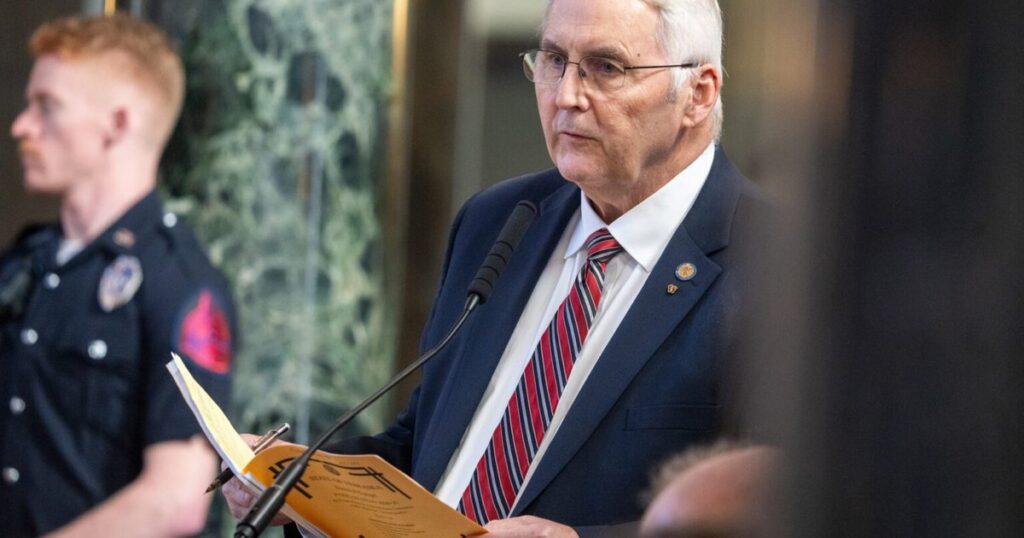
State Sen. Rob Clements of Elmwood, the term-limited chair of the Legislature’s Appropriations Committee, reassured that the budget has not reached a crisis stage. He suggested that the $172 million deficit could be offset using the state’s cash reserve, which stands at approximately $546 million. Clements stated, “The $172 million can be absorbed through the state’s cash reserve.”
Despite concerns from several lawmakers, including Clements, about depleting Nebraska’s rainy day fund, he argued that using the entire reserve would still leave around $330 million in minimum reserves.
In the past three months, individual and corporate income tax revenues have consistently fallen short of projections, whereas sales and use tax revenues have surpassed expectations. In May, sales and use taxes increased by 7.1%, contributing an additional $14.7 million to the state’s revenue.
However, individual income taxes were reported to be 14.5% below forecasts, resulting in a $46.4 million loss, while corporate income taxes were 33% below projections, leading to a $3.2 million loss.
Clements attributed the decline in income tax revenue to higher-than-expected tax refunds, a factor that also affected March and April’s receipts. He explained that although May is past the April 15 filing deadline, the state’s tax receipts reflect the timing of refund issuance by the Department of Revenue.