Wisconsin’s Wild Rice Harvest Promises a Bountiful Year
This year, Wisconsin’s wild rice harvest is expected to see significant growth, marking an important cultural moment for the state’s northern tribes. At the heart of this celebration is the first “Wild Rice Week,” initiated by tribal leaders and the Wild Rice Stewardship Council, to honor the sacred traditions surrounding this essential crop.
Mike Wiggins Jr., the former Tribal Chair of the Bad River Band, emphasized the spiritual importance of the powwow grounds, describing it as a place where tribal members express gratitude to Mother Earth through drumbeats. “Manoomin, the food that grows on the water, it is the reason we’re here as Ojibwe in the Great Lakes,” he stated.
The journey of the Ojibwe, Odawa, and Potawatomi tribes to the Lake Superior region centuries ago was guided by the quest for “the place where the food grows on water,” as signified by the Council of the Three Fires.
The Kakagon-Bad River Sloughs, located on the reservation, host the largest natural wild rice bed in the Great Lakes basin, spanning over 16,000 acres and representing a majority of coastal wetlands on Wisconsin’s Lake Superior shore.
This year, the harvest has been notably successful, with Wiggins noting, “It’s been really awesome seeing a lot of our tribal members return with good harvests.” Miles Falck from the Great Lakes Indian Fish and Wildlife Commission attributes this success to lower water levels, thanks to reduced rainfall in northern Wisconsin.
According to the Wisconsin Department of Natural Resources, the combination of heavy April rains followed by drought has created stable growth conditions for wild rice, which is sensitive to water level changes during its floating leaf stage. Other threats, including shoreline development, pollution, and climate change, pose challenges, such as the intense storms that flooded the reservation in 2016.

Renewed Initiatives for Wild Rice Preservation
In a bid to preserve this vital crop, the Wild Rice Stewardship Council, established by Gov. Tony Evers, is working to protect wild rice beyond its status as a crop. “It’s an important part of faith, food security, and culture,” Evers remarked. The council aims to educate the public on conservation measures, such as avoiding fertilizers near water bodies.
Tribal President John Johnson of Lac du Flambeau shared hopes of revitalizing lakes where wild rice has vanished. “There are a lot of lakes (where wild rice has) died out. We’re trying to replenish those in the future,” he expressed.

Efforts by the Department of Natural Resources include educational signage in state parks about wild rice’s growth cycle. DNR Secretary Karen Hyun noted, “I think if we had a little bit more authority to protect, and a little bit more funding that the tribes need to restore and create the conditions, we could do a lot of good,” suggesting stricter penalties for damaging wild rice.
Cultural Traditions Unite Communities
Activities during the event included boat tours of the Kakagon Sloughs, led by Angelina Godinez, the tribe’s deputy director of natural resources. She highlighted the cultural significance of wild rice as a staple in community gatherings. “It’s also good to eat. We have it for feasts, funerals, celebrations. It’s a big way of bringing people together,” she shared.
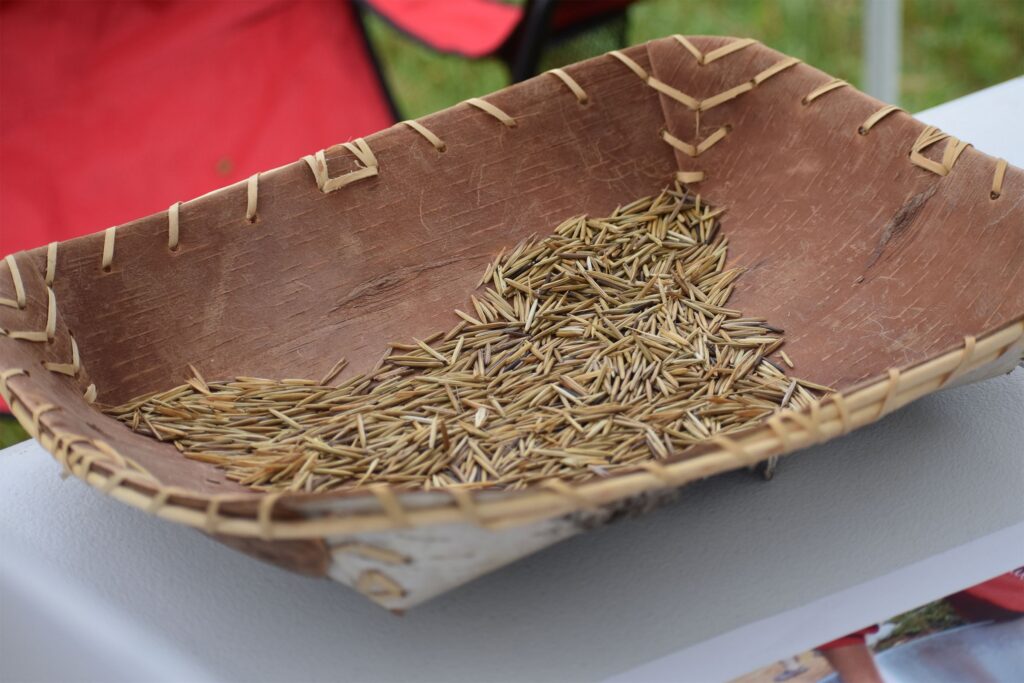
Red Cliff tribal elder Mark Duffy demonstrated traditional harvesting methods, using cedar sticks to collect the rice, which is then dried, parched, and processed. The rice is “danced” on using moccasins to break the husks, a practice now often replaced by machines like the “thrasher.”

Duffy fondly recalled cleaning rice with elders as a cherished memory. “That was a big bonus to have the elders around there picking through that rice and sharing stories and regenerating themselves,” he said.
For more information on wild rice harvesting, including open or closed waters and regulations, visit the GLIFWC website.