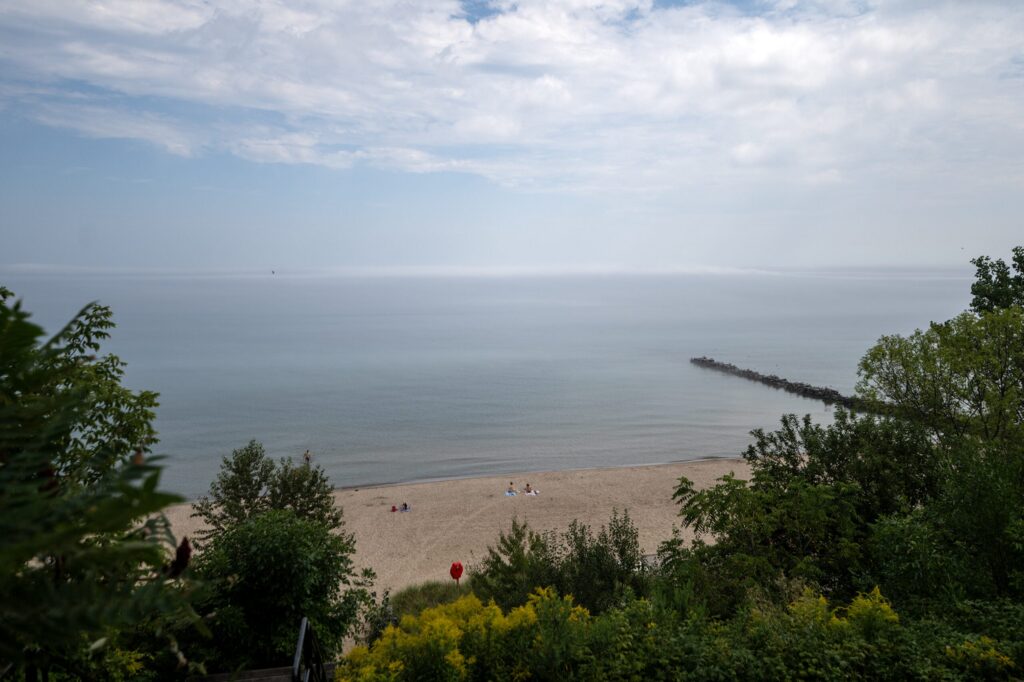
In a significant ruling for public access rights, a Milwaukee County judge recently dismissed a trespassing citation given to a Shorewood resident, confirming that walking along the Lake Michigan shoreline is protected by the public trust doctrine.
Paul Florsheim, the man at the center of the case, was initially found guilty of trespassing by a municipal judge. However, this decision was overturned by Circuit Court Judge J.D. Watts, who cited the public trust doctrine in his ruling. Florsheim had appealed the initial decision with support from the nonprofit Midwest Environmental Advocates, aiming to potentially bring the case before the Wisconsin Supreme Court for a broader decision on public beach access.
“It was very gratifying to read the decision,” Florsheim, a professor emeritus at the University of Wisconsin-Milwaukee, told WPR, expressing his sense of vindication.
Florsheim had received a $313 citation from the Shorewood Police Department for walking along the shoreline past Atwater Beach, an area he contended was public land. Representing himself in municipal court, he argued that his actions were permissible under state law.
The public trust doctrine in Wisconsin safeguards public rights on navigable waterways, allowing access up to the ordinary high water mark. This doctrine served as the foundation for Florsheim’s argument that his walk along the shoreline was lawful.
Despite this, Municipal Judge Margo Kirchner had initially ruled against Florsheim, referencing a 1923 Wisconsin Supreme Court decision, Doemel v. Jantz. This ruling affirmed that property owners have exclusive rights to the shoreline area between the ordinary high water mark and the water’s edge.
According to the Wisconsin Department of Natural Resources, the ordinary high water mark is defined by a distinct mark left by water action on the shoreline.
Judge Watts, in his decision, clarified, “The title to the beds of Lake Michigan up to the line of OHWM is in the State.” He further stated that Florsheim’s actions were protected under the public trust doctrine and did not infringe upon any riparian landowner’s rights.

While the Midwest Environmental Advocates praised the decision, they noted it does not overturn Doemel v. Jantz. Legal fellow Michael Greif explained that the ruling reaffirms the public trust doctrine but is limited to Florsheim’s case and does not establish a binding precedent.
“While the decision is limited to Paul (Florsheim) in a narrow sense, we believe that the principles that the judge recognized ultimately should be applied to everyone,” Greif stated, indicating a readiness to continue advocating for broader application.
Legal experts noted that similar cases in Indiana and Michigan affirm public rights to shoreline access, and advocates hope Wisconsin will follow suit. Midwest Environmental Advocates is prepared to challenge Doemel v. Jantz if the case progresses to higher courts.
The possibility of an appeal by the village remains open. Village attorney Nathan Bayer mentioned he would discuss this with village officials before making a decision.