For over a year, Lula Mays has been unable to return to her lifelong home in the Burton Street neighborhood of West Asheville, a community where she raised her family and intended to pass on her house to them. The devastating impact of Hurricane Helene altered those plans significantly.
The hurricane caused severe flooding and structural damage to Mays’ residence, forcing her to vacate and seek refuge elsewhere. “What I miss most is being there cooking and cleaning, things that I usually do. I miss that,” Mays shared about her displacement. “I really do miss being near my neighbors, and not driving so far going to church.”
In an effort to restore her home, Mays applied to the Renew NC program, funded by a Department of Housing and Urban Development grant, specifically designed to aid low-income, elderly, or disabled homeowners like her. Mays, however, faces uncertainty about whether her home will be repaired due to financial limitations imposed by local policy.
Gerard Albert III
/
BPR News
The city of Asheville, having received its own HUD grant, allocated $3 million of the $225 million towards single-family home repairs. However, this budget, influenced by a misunderstanding regarding a partnership with Renew NC, is only sufficient to assist a handful of residents. Mays’ application initially faced rejection due to a documentation issue, but she is actively appealing while the city begins spending its limited funds.
More than 100 homeowners remain waitlisted
With 285 applicants and over 100 households waitlisted, many homeowners in Asheville, including those categorized as Phase One Priority One, await assistance. These individuals, predominantly low-income, elderly, disabled, or with children, face a protracted wait as the city considers reallocating funds. A decision on increasing the program’s budget is expected no sooner than June.
The prolonged uncertainty leaves many homeowners living in compromised conditions, with temporary solutions such as tarps and buckets to combat water intrusion. “They just leave these families lingering. They’ve got to put a tarp on the side of their house to try to keep the water out. They’ve got buckets in the house catching water, all that kind of stuff. And it’s been like that since the storm,” shared Yvette Jives, a social worker and advocate for affected residents.
“They just leave these families lingering. They’ve got to put a tarp on the side of their house to try to keep the water out. They’ve got buckets in the house catching water, all that kind of stuff. And it’s been like that since the storm.”
Applicants are left in limbo, with some considering returning to their damaged homes if repairs remain elusive. Jives, who is actively assisting Mays, hopes for a reallocation of funds to better support single-family home repairs, emphasizing the need to build generational wealth by improving existing homes rather than temporary fixes.

One of the lucky ones
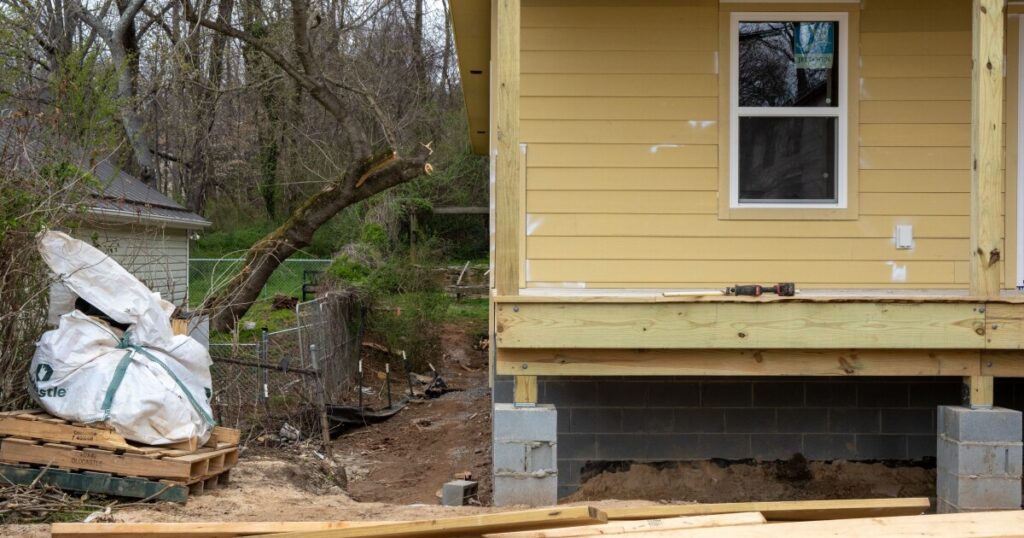
While many are still waiting, others like Sybriea Lundy have seen the Renew NC program change their lives. After Hurricane Helene wreaked havoc on her home in the River Arts District, causing extensive damage, Lundy is now on the verge of moving back, thanks to the program’s assistance.
Despite facing numerous bureaucratic hurdles and working with multiple case managers, Lundy secured the necessary aid, leading to a complete rebuild of her home. Her future home, elevated on stilts for flood protection, represents hope and a new beginning, though she acknowledges the plight of those less fortunate.

Gerard Albert III
/
BPR News
Lundy, reflecting on her journey, expressed gratitude for the aid received but also empathy for those still waiting. “I’m mourning the loss of what we had while happy about what we are getting,” she said. “But still I’m torn about the people who are in worse condition than us that aren’t going to have access to the program.”