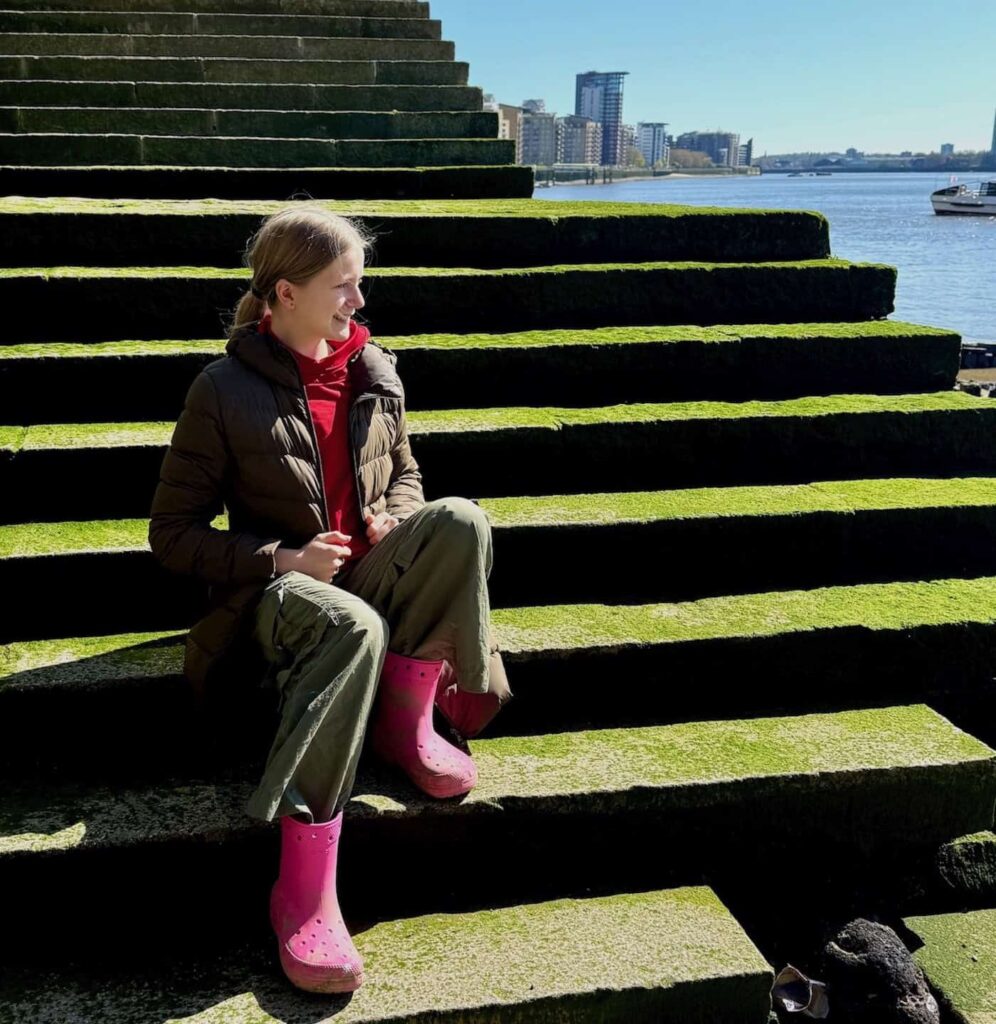
On a peaceful Sunday morning, young author and proficient mudlark, Emmylou Vaxby takes us on a journey through her quest for precious fragments from the city’s past on the Thames foreshore. This article explores the art and science of mudlarking, a pursuit that involves searching for historical artefacts on riverbanks, and Emmylou’s passion for uncovering the artefacts of London’s rich history.
Here on the tranquil north bank of the Thames near Wapping, the sounds and sights of city life give way to gently lapping waves and the occasional passer-by. The mission today, as always for Emmylou, is to mudlark. Her method involves bending low to the ground to look for something with a different colour amidst the silt and rocks that the low tide exposes.
Today’s first find is a mud-brown bone, possibly from a sheep, dog, or larger animal like a horse or cow. Its origins could be from a butcher discarding it after procuring meat or from an animal that died and was discarded into the river. Determining its age is challenging but Emmylou suspects it has been there for many years, harkening back to the days of the Great Stink in 1858 when the Thames was full of sewage and rotting flesh.
Emmylou’s knowledge of the Thames, tidal science, and human history is impressive, all gleaned from her near-decade of mudlarking and the everyday objects she collects. For such activities, a permit from the Port of London Authority is mandatory, although it is currently managing a waitlist. Her journey into mudlarking began as a child when a friend’s mother introduced her to the activity and gained momentum during the lockdown when she and her family would spend their daily outdoor hour on the Thames foreshore.
Finds such as cobalt-glazed chinoiserie pottery possibly from Georgian or Victorian times, clay tobacco pipes dating back to the 16th century, and various shells have fueled her passion further. She has documented her experiences and research on her blog and her YouTube channel as Emmylou the Mudlark.
Emmylou’s dedication to mudlarking led to a publishing contract for her book, A Guide to Mudlarking on the River Thames. Between writing 1,000 to 2,800 words a day for her book, she also founded the Wapping Plastic-Free Community and organises riverbank clean-ups, all sparked by witnessing a swan mistaking plastic for food.
For Emmylou, mudlarking is relaxation and meditation, a break from the everyday stress of a student’s life. It is also a source of excitement and satisfaction, especially when she discovers a treasure like a pipe bowl made by the famous 18th-century pipemaker William Manby. She dutifully records and reports her finds through the Portable Antiquities Scheme, but she admits, the real reward is the joy of the hunt itself and the gratitude she feels for being able to pursue this hobby. Emmylou’s self-taught specialist interest has boosted her confidence and made her an expert in her field.
For those interested in joining Emmylou in unearthing the past, her book, A Guide to Mudlarking on the River Thames, is available now. It offers a window into a unique hobby that combines history, science, and a love for the outdoors.