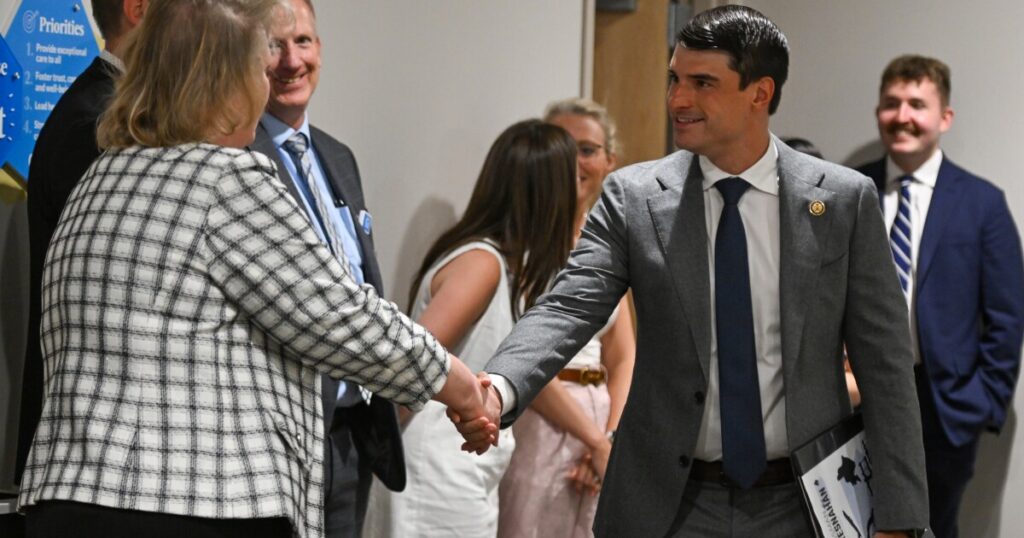
In a bold move, U.S. Representative Rob Bresnahan has vowed to challenge proposed federal Medicaid rules that some advocates worry could endanger access to treatment for critical illnesses like cancer and HIV. His announcement came amidst a briefing where he celebrated a significant financial victory for hospitals in his state.
During a news event at Geisinger Wyoming Valley Medical Center, Bresnahan highlighted the successful acquisition of $192 million in overdue federal COVID-19 relief funds for Geisinger and other healthcare facilities. He criticized the proposed Medicaid regulations for their “shortsightedness.”
“It’s certainly something that we take offense to,” Bresnahan stated, referencing the personal battle of his wife’s sister with cancer. “And we plan on fully fighting this every step of the way.”
The One Big Beautiful Bill Act’s Impact
Last year, the passage of the One Big Beautiful Bill Act introduced requirements for Medicaid recipients to engage in at least 20 hours of work or community service weekly starting January 1, 2027. This legislation also necessitated more frequent eligibility renewals for continued Medicaid benefits.
The Congressional Budget Office forecasts a reduction in federal Medicaid spending by $911 billion over the next decade, with work requirements contributing $326 billion to this decrease. The number of uninsured individuals is expected to rise by 10 million, with 5.3 million of these due to the work stipulations.
Bresnahan, a supporter of the act, defends it as a means to protect Medicaid while eliminating inefficiencies. He emphasized, “By ensuring states are not using Medicaid dollars on illegal aliens, conducting more frequent eligibility checks, and requiring work for able-bodied recipients, we are securing Medicaid for those who truly need it.”
He noted the numerous exceptions to the work requirement, including those for minors, seniors, pregnant women, caregivers, full-time students, veterans, and individuals with specific medical needs.
However, the bill has faced criticism from Democrats due to the anticipated reductions in coverage.
Concerns from Patient Advocacy Groups
Earlier this week, 48 patient advocacy groups, such as the American Cancer Society Cancer Action Network and the American Heart Association, expressed their “deep concern” about the proposed Medicaid rules.
They argue that the regulations fail to adequately protect individuals with severe health conditions and could significantly increase the number of people losing healthcare coverage.
Adrianna McIntyre, a health policy expert at Harvard University, commented to NPR, noting that the rules extend beyond the listed exemptions. “So people with early-stage cancer who are in radiation treatment but still have the capacity to work or people who have HIV but can still technically work, are not exempted from the work requirement,” McIntyre explained.
Dr. Terry Gilliland, president and CEO of Geisinger, chose not to comment on the rules due to a lack of familiarity.
Appreciation for COVID-19 Relief Efforts
Nevertheless, Gilliland expressed gratitude towards Bresnahan and Pennsylvania’s congressional representatives for securing the COVID-19 relief funds.
“COVID took an incredible lasting toll on our communities, our people, and our health systems,” he mentioned. “These FEMA reimbursement dollars, will help us as we continue to invest in bringing the highest levels of care to the communities we serve across northeastern and central Pennsylvania.”
Bresnahan, who advocated for the relief funds in a letter with other Republican representatives from Pennsylvania, attributed delays to changes in federal agency leadership and administrative hold-ups.
“Obviously, I think it took some sharp elbows from the Pennsylvania congressional delegation to bring that into a reality,” Bresnahan remarked. He praised the resilience of healthcare workers during the pandemic, highlighting their commitment to saving lives under challenging conditions.
While specific amounts for other Pennsylvania hospitals are yet to be disclosed, statewide hospitals are anticipated to receive nearly $600 million in total relief funds.