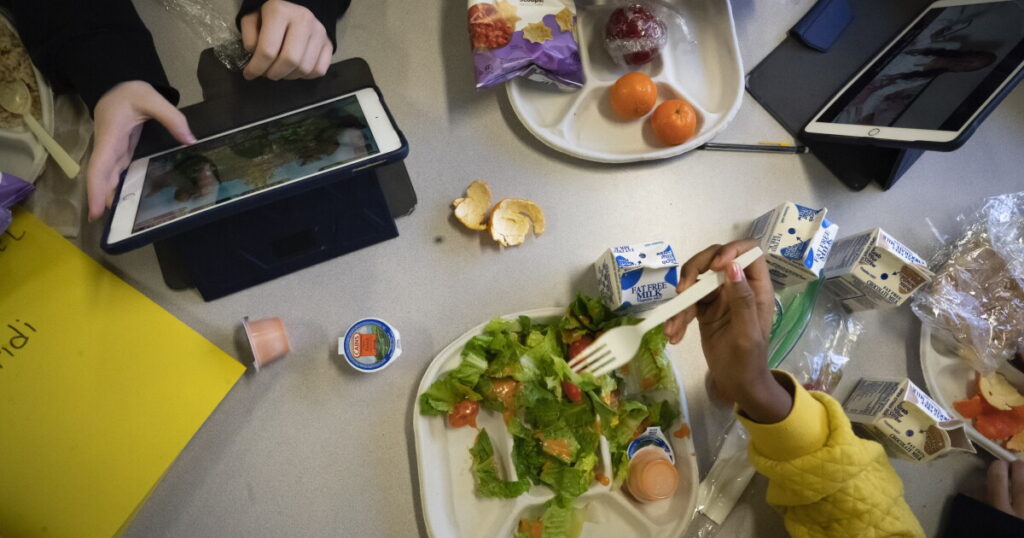
As schools across the United States grapple with budget constraints, changes to federal food assistance programs have left many students vulnerable to food insecurity. The ripple effects of legislative changes are now tangibly felt in school cafeterias.
Paige Shoemaker DeMio, a senior policy analyst with the Center for American Progress, has expressed concerns about the broader impact of reduced access to the Supplemental Nutrition Assistance Program (SNAP). “Anytime we’re hearing about cuts to SNAP or Medicaid, we’re worried about what’s going to be the domino effect of this,” she stated.
SNAP benefits are closely linked to school meal programs, providing children with access to free breakfast and lunch. When families lose SNAP eligibility, their children may no longer automatically qualify for free meals at school, threatening the existence of universal free meal programs for many schools.
The Center on Budget and Policy Priorities reports that over a million children have lost food benefits since the enactment of the One Big Beautiful Bill Act in July 2025, which imposed stricter work requirements for food assistance.
As this school year begins, several schools in places like San Antonio, Houston, and Miami-Dade County have discontinued their universal free meal programs. The full effects of the SNAP participation drop on school meals remain uncertain, according to Diane Pratt-Heavner of the School Nutrition Association.
“This moment in time could potentially be a tip-of-an-iceberg situation,” Pratt-Heavner suggests, warning of a possible worsening scenario.
The U.S. Agriculture Department, overseeing SNAP and school meals, stated that it invests $385 million in nutrition assistance for low-income communities. “School meal programs have varying income limits, and while SNAP participation may ease the application process, a family not on SNAP is not automatically disallowed participation,” they noted.
School Districts Face Financial Challenges
The Community Eligibility Provision of the Agriculture Department enables schools to offer universal free meals if at least 25% of students participate in assistance programs like SNAP. Schools receive federal funding proportionate to the percentage of families receiving assistance. Declines in SNAP participation can result in reduced federal funding, forcing schools to shoulder more of the cost, according to Pratt-Heavner.
Schools may need to redirect funds from essential classroom needs or eliminate universal free meal programs, Pratt-Heavner warns. This financial strain was evident in 2023 when the end of a federal pandemic waiver led schools to accumulate meal debt, sometimes reaching $1.7 million, as reported by the School Nutrition Association.
Erin Bronner, director of child nutrition and wellness for a small Arizona school district, highlights the challenges posed by the sharp drop in SNAP participation. Her district, due to renew its Community Eligibility Provision next year, faces financial uncertainty. “Due to the dramatic decline in SNAP assistance, the percentage of eligible families [is] not high enough for us to be able to financially sustain operating this provision,” she explains.
The “Danger Zone” for Students
Students qualify for free meals if their family income is at or below 130% of the poverty line, which is $42,900 for a family of four in 2026. Reduced-price meals are available to families earning up to $61,050. The process of applying for these benefits can be complex and burdensome, Shoemaker DeMio points out.
Pratt-Heavner explains that the application process does not consider family expenses or hardships, such as medical treatments or rent increases, which can leave some families without help despite financial strain.
Bronner describes this as the “danger zone,” where families earn just above the threshold yet remain financially stressed. “They do fall through the cracks,” she notes, emphasizing the lack of options available to assist these families.
Noncitizen children may also face challenges accessing free meals due to fears of sharing personal information, such as Social Security numbers, amidst immigration enforcement actions.
The loss of free meal access could cost families nearly $1,000 per student annually, according to the Center for American Progress. Shoemaker DeMio stresses that this financial burden worsens the affordability crisis many families face.
State Efforts and Ongoing Concerns
Permanent universal free school meals are available in nine states, including California and New York. While some states are pursuing similar initiatives, debates continue over the costs and benefits of such programs. Critics argue against government-funded meals for those who can afford them, while supporters highlight the health and educational benefits of school-provided meals.
“ Schools provide books, they provide pencils, they even provide laptops these days to help students be ready to learn, and nutrition is no different,” Shoemaker DeMio asserts. “ Nutrition is a foundational ingredient to student success.”
In San Antonio, Sharon Glosson of the North East Independent School District advocates for universal free meals, noting how they reduce stigma and shame for low-income students. Despite this, her district has had to cut back on such programs due to declining assistance participation, though the need persists.
“We know that within our families in our school district, their economic status between now and four years ago, they don’t feel that it has improved to the point where they are now able to pay for school meals,” she says.