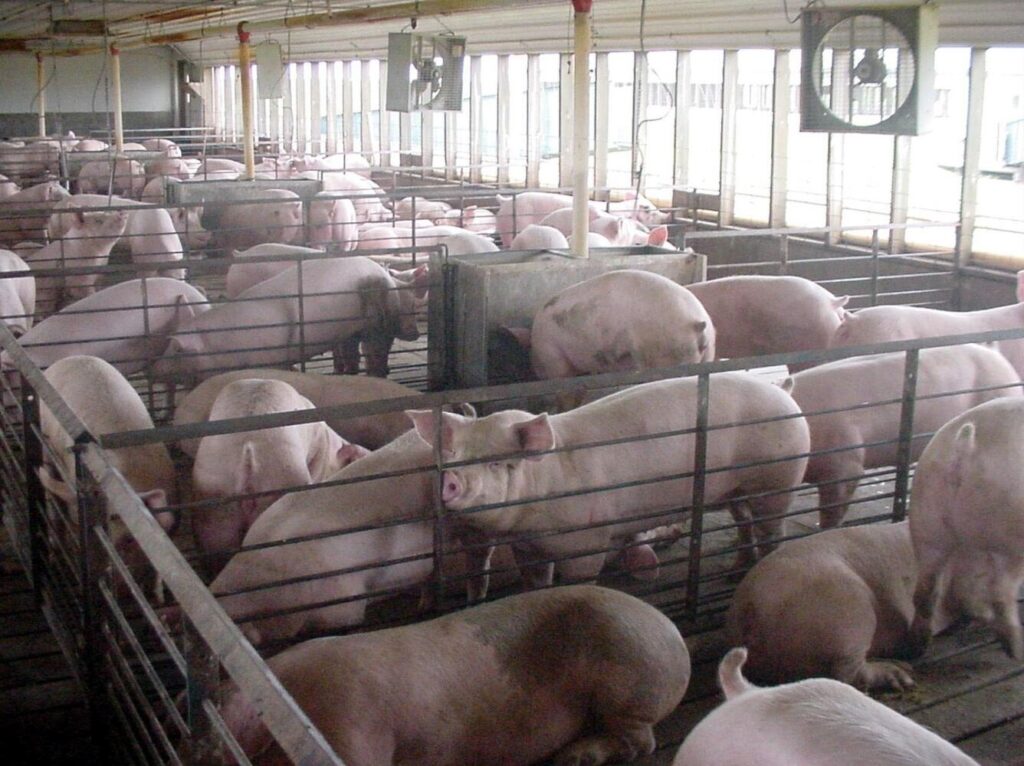

A confined swine feeding operation is shown in this photo. Congress is once again taking aim at state animal welfare laws regarding livestock confinement. (Photo by Kent Becker/U.S. Geological Survey)
Congress is considering changes to state animal welfare laws with the reauthorization of the federal farm bill. The farm bill, revamped every five years, governs food assistance, farm subsidies, and agriculture programs. A current version includes the Save Our Bacon Act, aimed at stopping states from regulating livestock practices. This targets California’s Proposition 12, enforcing animal welfare standards like cage-free confinement.
California’s law, effective on hog sow farms, bans gestation crates, ensuring animal freedom. At least 15 states ban restrictive confinement for farm animals. The farm bill proposal, however, excludes protections for egg-laying hens.
Opponents argue California’s standards impose burdens on out-of-state producers. “This legislation will stop out-of-touch activists — who don’t know the first thing about farming — from dictating how Iowa farmers do their job,” stated U.S. Rep. Ashley Hinson, introducing the Save Our Bacon Act. Supporters of California’s law argue it reflects consumer demand for higher welfare standards.
California Assemblywoman Esmeralda Soria noted the law’s voter support and its importance in maintaining stable food systems. “Taking Prop 12 away now, would create long term uncertainty and disruption to California meat and egg production,” she stated, emphasizing the need for solid agricultural foundations.
Following failed legal challenges by pork producers, the farm bill’s anti-Proposition 12 measure gained traction with bipartisan support in the U.S. House, passing by a 224-200 vote. The measure is now under Senate consideration.
An issue of state autonomy
The debate over agricultural regulation highlights the tension between state and federal governance. Critics warn that congressional proposals could disrupt hundreds of state laws. A Harvard Law analysis suggests the Save Our Bacon Act might impact over 600 state regulations.
Texas Agriculture Commissioner Sid Miller, though opposed to California’s rules, supports state rights, citing the 10th Amendment. Proposition 12, he claims, raised prices for pork and eggs, yet he respects California’s autonomy.
Producers who adapted to Proposition 12 standards might face losses if Congress overrides the law. “They spent all that money for nothing if that happens,” Miller remarked. Advocates argue consumer-driven demand pushes higher animal welfare standards.
Alicia Prygoski of the Animal Legal Defense Fund supports Proposition 12 as a reasonable measure allowing animals freedom. She highlights market-driven changes as states already have diverse agricultural regulations.
‘We care a lot about our animals’
Trish Cook, managing a large-scale Iowa pig farm, relies on scientific guidance for swine operations. She and others argue Congress needs to protect farmers from varying state regulations. “I do still feel like it’s really important that we get a fix for things like Prop 12,” Cook noted.
Critics of industrial agriculture confinement systems support more humane practices. Alicia LaPorte from Niman Ranch asserts that Proposition 12 encourages these changes. Producers see profitability in humane practices through improved animal health.
With growing consumer demand for humane meat, laws like Proposition 12 ensure stable markets. “The consumer drove the change,” LaPorte said, “and policy secured the marketplace.”
This story was originally produced by Stateline, which is part of States Newsroom, a nonprofit news network which includes Daily Montanan, and is supported by grants and a coalition of donors as a 501c(3) public charity.