Teachers and School District at Odds Over Grievance Process Amid Ongoing Contract Negotiations
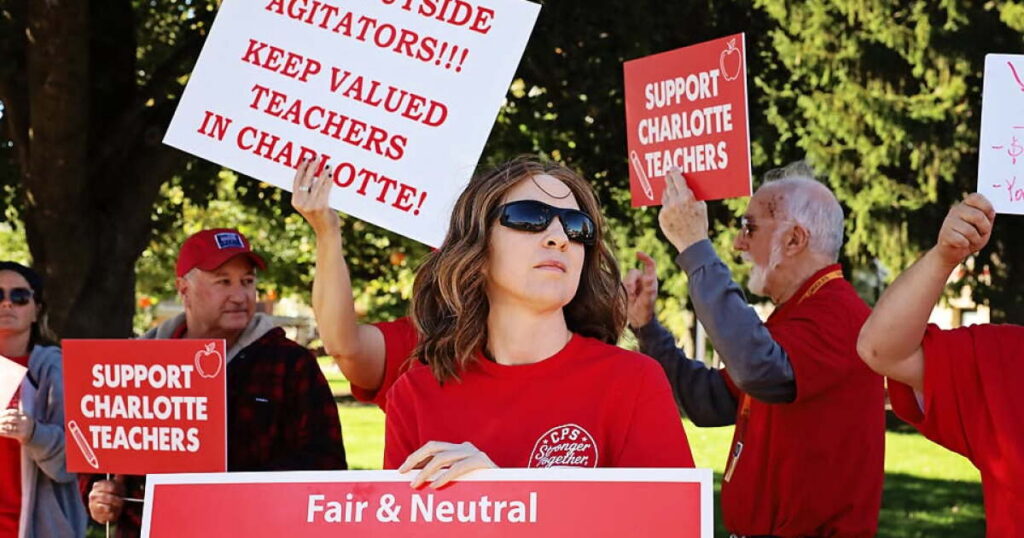
After taking to the picket line over stalled contract talks, members of the Charlotte Education Association (CEA) engaged in a mediation session with Charlotte Public Schools officials on Tuesday, October 7.
Since July, teachers in Eaton County have been working without a new contract. Mediation was requested by school administrators in September, aiming to resolve negotiations that have been ongoing since the year’s start.
According to Becky Carter, co-president of the CEA, the parties have agreed on salaries, insurance, and the school calendar. However, the primary contention remains the method for resolving grievances.
The union is advocating for disputes regarding teacher evaluations and discipline to be settled through independent binding arbitration. Currently, the process is limited to non-binding mediation, where, as Carter explains, administrators retain “the final say.”
In the district’s grievance resolution process, arbitration serves as the last step if issues persist after discussions with the principal, superintendent, and a mediator. The costs for arbitration are shared, with each side covering their own legal fees and witnesses.
The district’s latest proposal seeks to limit arbitration in disciplinary cases to instances where a teacher faces a suspension of at least seven days without pay. For evaluations, arbitration would only be allowed if a teacher receives two consecutive “needing support” ratings, as mandated by state law.
District officials did not issue a comment on the ongoing negotiations.
Mark Byers, President of the Charlotte Board of Education, stated in an online statement that “reasonable limitations” on arbitration are necessary due to associated time and costs.
Carter argues that teachers should not have to forfeit pay to seek arbitration and suggests that the district should allow arbitration for any evaluation below “effective” or include the evaluation process in the contract.
“It’s not like we are going to go to arbitration for every single situation,” Carter said. “We just want there to be accountability on both sides … so that one side doesn’t have an imbalance of power by always having the final say.”
This push for updated grievance procedures is supported by a 2023 law signed by Governor Gretchen Whitmer, which allows teacher unions to negotiate terms for discipline, evaluation, and placement, countering a 2011 law that restricted these areas.
The parties have reportedly reached consensus on most other contract issues. Byers noted the district’s acceptance of the CEA’s recent financial proposal, resulting in enhanced benefits and the “largest pay raise in several years.”
While Carter acknowledges that the salary agreement does not meet the average market rate compared to similar districts, she believes they have made considerable progress. “We feel like we got as far as we were going to be able to get,” she said.
Support among union members for more expansive arbitration rights remains strong. “They feel like we’ve given and given and given over the years and they have asked me to continue fighting,” Carter shared. “This is what is right and fair for teachers and it’s going to have a lasting impact into the future.”
Carter noted that the mediation session on Tuesday night resulted in “significant progress,” with plans to reconvene on Monday, October 12.