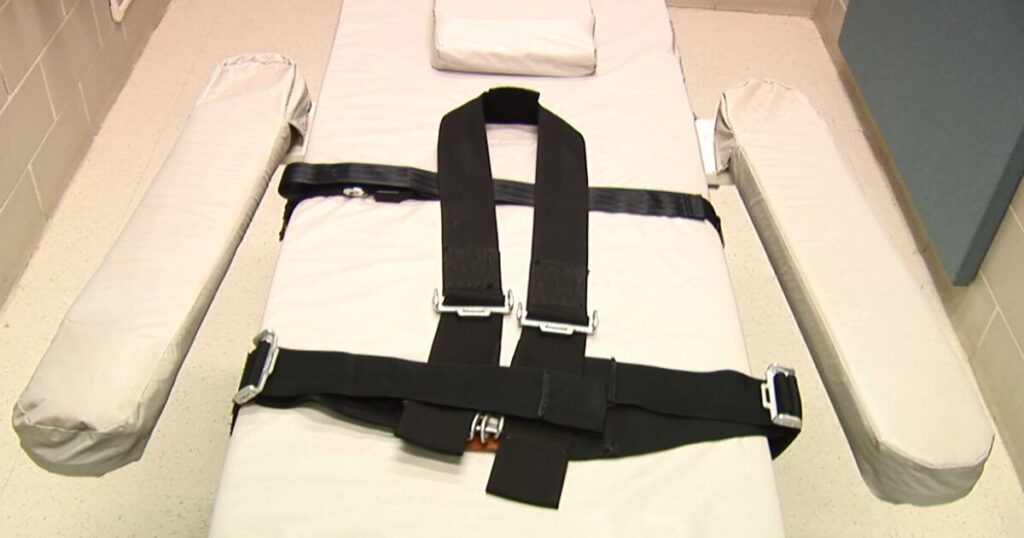
When a government carries out an execution, it is also — inescapably — performing a medical procedure. The drugs used, the veins accessed, the dosages administered: these are healthcare decisions, made under the authority of the state. And when those decisions go wrong, the human suffering that follows raises urgent questions not just about criminal justice, but about what happens when medical oversight is absent, inadequate, or simply ignored.
That question sits at the center of a disturbing story unfolding across two states. Christa Pike, a convicted murderer, survived two doses of pentobarbital during a scheduled execution in Tennessee last week and was taken to a hospital in critical condition. The state’s top prison official has since resigned. But the failure didn’t happen in a vacuum — and for Arizonans, the story carries an uncomfortably familiar echo, reported by KJZZ’s Lauren Gilger on The Show.
A Pattern of Predictable Failures
Dale Baich, a former federal public defender who witnessed 15 executions in Arizona — including the longest in U.S. history — says what happened in Tennessee was not a surprise. Now an adjunct professor at ASU’s Sandra Day O’Connor College of Law and a leading expert on capital punishment, Baich points to a pattern of warnings ignored and medical evidence dismissed.
“I was horrified when I heard the news. It was really predictable. Her lawyers brought to the court’s attention that she had compromised veins and that she had a blood disease. But the court allowed the execution to go forward. And as I said, the outcome was predictable.”
Pike’s attorneys had raised serious medical concerns before the execution — the kind of clinical red flags that, in any other healthcare context, would trigger immediate reassessment of a treatment plan. Instead, the court allowed the procedure to move forward. The result was a woman in critical condition, a resigned corrections commissioner, and a state left to reckon with what went wrong.
For families of incarcerated people across the country, this case underscores a painful reality: the medical care — or lack thereof — that their loved ones receive behind prison walls can have life-or-death consequences, and the systems meant to provide oversight don’t always work.
Arizona’s Own Medical Reckoning
Arizona has lived through its own version of this story. In 2014, the execution of Joseph Wood became the longest in U.S. history, stretching nearly two hours as Wood gasped and struggled for air. The state had been unable to obtain the lethal drugs it had previously used and turned to a new combination — one that had already raised alarms in Ohio, where a similar execution had taken 25 minutes just months earlier.
Baich, who was present that day, described what witnesses watched unfold:
“The witnesses sat there and watched Joe gasp, gulp and struggle to breathe for over an hour and 40 minutes.”
What the public didn’t know at the time was that the director had ordered additional drug doses to be administered — 15 doses in total, beyond what the approved protocol allowed. This is the kind of improvised, unaccountable medical decision-making that healthcare advocates and patient safety experts warn against in any setting. In a prison execution chamber, there is no second opinion, no patient advocate, no regulatory body stepping in to stop it.
The connection between what happened in Tennessee and Arizona runs deeper than shared history. Frank Strada, who served as Tennessee’s corrections commissioner during Pike’s attempted execution, was previously the deputy director of the Arizona Department of Corrections from 2020 through 2022 — where he was directly responsible for overseeing executions. During Arizona’s three executions in 2022, two involved significant problems gaining intravenous access. The same type of failure occurred in Tennessee, and it wasn’t even the first time under Strada’s watch there: months before Pike’s scheduled execution, a different execution had to be halted because his team could not establish IV access at all.
“There’s a history of incompetence,”
Baich said plainly.
When Prison Healthcare Fails Everyone
The failures in execution chambers don’t exist separately from the broader crisis of healthcare in America’s prisons. They are symptoms of the same underlying problem: correctional systems that lack adequate medical expertise, independent oversight, and accountability to the people — and families — they affect.
That reality recently reached the U.S. Supreme Court, which denied Arizona’s bid to delay a court-ordered takeover of healthcare operations in its prisons. The state had been found to provide inadequate care to incarcerated people and had dragged its feet on required improvements. For the families of the roughly 34,000 people incarcerated in Arizona’s state prisons, this ruling matters — it means their loved ones may finally receive the baseline medical care they are legally entitled to.
But the broader systemic problem persists nationwide. As Baich explained, when independent reviews are conducted after botched executions or healthcare failures in prisons, the findings rarely translate into lasting change:
“What happens is a study is completed, the report is turned over, and the directors of the departments of corrections go on with their business. They don’t always follow the recommendations of the experts.”
This dynamic — experts raising evidence-based concerns, officials proceeding anyway — is familiar to anyone who has watched healthcare policy debates play out in recent years. Whether the issue is Medicaid access, prison medical care, or the administration of lethal drugs, the gap between expert guidance and institutional practice carries real human costs.
The Legal Standard That Leaves Families Helpless
Even when families and attorneys have compelling medical evidence that a loved one is at serious risk of suffering, the legal system offers limited protection. Baich broke down the near-impossible bar that must be cleared to stop an execution on humanitarian grounds:
“It’s not enough for a prisoner to prove, even with strong medical evidence, that the state’s method of execution is likely to cause severe or excruciating pain. The prisoner must also identify a feasible alternative method and show that that alternative method would reduce risk.”
“In practice, this is an extraordinarily difficult, almost impossible standard for a prisoner to meet.”
That standard left Pike’s attorneys unable to stop an execution that medical evidence suggested would go wrong — and it did. It’s a reminder that in the intersection of healthcare and the law, the protections that most Americans take for granted — the right to have medical concerns heard and acted upon — do not apply equally to everyone.
Alternatives That Aren’t Solutions
As lethal injection has repeatedly proven unreliable, some states have turned to other methods. South Carolina conducted a firing squad execution last year — the first in some time. But Baich cautioned that no method is foolproof. In one South Carolina case, two of the shooters missed the target, and the condemned person suffered for a minute or two before dying.
Arizona lawmakers have also proposed bringing back firing squads and gas chambers. Baich testified against those bills in the state Legislature. His perspective, shaped by witnessing 15 executions, is stark:
“In my view, the most humane way to carry out a death sentence is old age. Life without parole is a death sentence.”
Meanwhile, public opinion has been shifting. Polling now shows that when Americans are given a choice between the death penalty and life without parole, support for capital punishment drops below 50%. Juries across Arizona and other states are handing down fewer death sentences. The debate over how — and whether — the state should have the power to end a human life is far from settled, and Tennessee’s latest failure has reopened it with new urgency.
For additional reporting on the Tennessee corrections official’s Arizona ties, see Wayne Schutsky‘s earlier story: Tennessee prison official who oversaw botched execution has Arizona ties. Related coverage also includes the ongoing Arizona attorney general’s race, where criminal justice and law enforcement accountability remain central issues, as well as a recent Yuma doctor convicted in a $36 million Arizona Medicaid fraud scheme, reported by Connor Greenwall. You can also follow developments in Arizona prisons and the Arizona House speaker’s DOJ investigation request for broader context on state oversight failures.