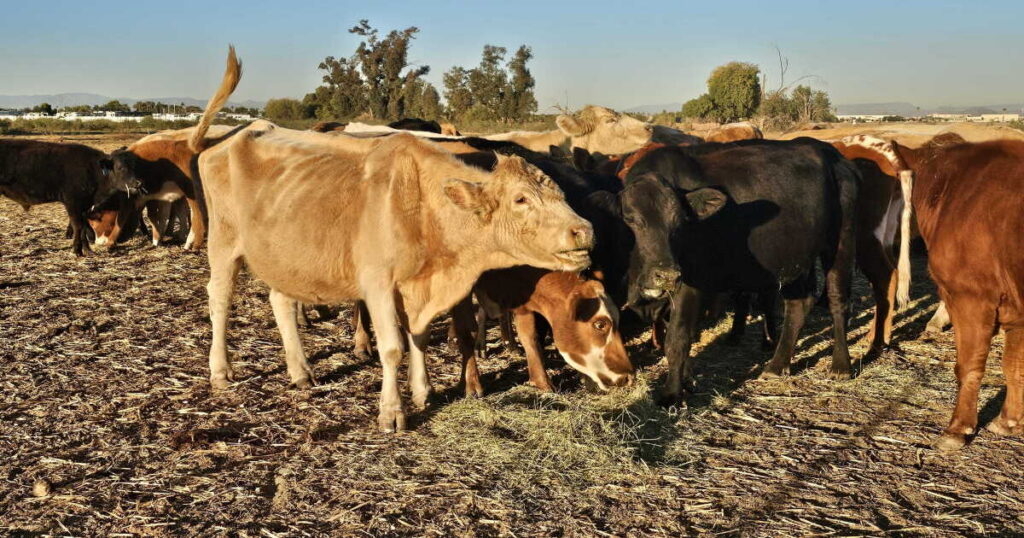
For ranching families across southern Arizona, a livestock disease is more than an agricultural concern — it’s a direct threat to the income, savings, and financial stability that determine whether a family can pay its bills, afford healthcare, or keep the ranch running. The detection of New World screwworm in Cochise County last week has put those families on alert, even as industry leaders say the tools available today give them real reason for cautious optimism.
The Arizona Department of Agriculture confirmed the parasite was found in a dog in Cochise County, marking the state’s first detected case. The discovery follows months of mounting concern as screwworm — a flesh-eating fly larvae — spread through northern Mexico and into Texas and New Mexico. Arizona ranchers had been watching, preparing, and hoping the border would hold. It didn’t.
Bas Aja, executive vice president of the Arizona Cattle Feeders’ Association, says the mood among his members is measured.
“There’s concern. There’s not panic, but there’s concern. Animal care and animal disease is something we consistently watch and are worried about every day, so it just elevates it a little bit.”
Why Ranching Family Finances Hang in the Balance
To understand why this matters beyond the farm gate, consider what a serious screwworm outbreak would actually mean for a ranching family. Estimates tied to outbreak scenarios resembling those of the 1950s and 1960s — when tens of thousands of animals were infected across the country — put potential economic damage in the hundreds of millions of dollars. For individual ranching households, that kind of loss isn’t abstract. It can mean wiping out years of savings, taking on debt, or losing the operation entirely.
When a ranching family’s income collapses, so does their financial cushion for everything else — including healthcare. Many rural ranch families operate without employer-sponsored health insurance, relying instead on marketplace plans or Medicaid. A catastrophic livestock loss can push families below the income threshold where they can afford premiums at all, or above the threshold where they qualify for assistance. Arizona families are already facing premium increases of nearly 28% as ACA open enrollment begins — a financial blow that hits hardest when household income is already under pressure from an animal disease outbreak.
The screwworm fly itself is particularly brutal in how it operates. The parasite lays eggs in open wounds on warm-blooded animals; the larvae then feed on living tissue. Left untreated, an infestation can kill an animal in days. Aja explained that the fly’s spread accelerated partly because of environmental factors:
“It comes on a fly. The fly can’t fly but about 2 miles a day, but if it gets in a windstorm, it can go 50 miles.”
Recent tropical storms in the region are believed to have helped carry the flies further north than they might otherwise have traveled.
Better Tools, Better Odds
The good news — and there is meaningful good news — is that the situation today looks dramatically different from past outbreaks, thanks to advances in treatment, surveillance, and pest control science.
Aja outlined three major advantages ranchers now have. First, effective treatments exist that simply weren’t available decades ago.
“Ivermectin — that is a great treatment, a prophylactic for screwworm. If the animal gets treated with ivermectin and the fly comes in to lay an egg, it will kill it. We didn’t have that in the ’60s, and there’s four or five other products just like that.”
Second, a sterile fly release program — in which male flies are sterilized so that females who mate with them produce no viable offspring — has been a cornerstone of screwworm control for decades. A newer version of this approach improves on the original:
“The new fly process they have, while they’re still doing the old fly, is they can target where 100% of the treatment is for males. It’s not half the flies, it’s 100% of them.”
When the screwworm case was confirmed in Cochise County, response was swift — within one to two days, a million sterile flies were ground-released around the site of the discovery.
Third, modern technology has transformed how ranchers monitor their herds.
“Everybody has a camera now. Everybody has a camera. We have cameras on trees, on water holes. We have cameras in your pocket.”
That kind of real-time visibility means suspicious cases can be flagged, photographed, and reported rapidly — accelerating the response before an infestation spreads.
Ranchers have also benefited from months of preparation. University extension services and the USDA have conducted seminars across the region, training producers on what Aja calls the core response protocol:
“observe, collect and treat.”
The infrastructure for a coordinated response was largely in place before the first Arizona case was ever confirmed.
Timing also works in ranchers’ favor. The screwworm fly thrives in warm conditions, and Arizona is heading into its cooler months. Cochise County temperatures are already dropping into the 40s, which naturally suppresses fly activity. And unlike the massive, geographically dispersed outbreaks of the past, current spread appears contained. Since June, 74 incidents have been recorded nationally, with 20 to 21 still under active investigation. Sterile fly releases are ongoing in affected zones.
Aja acknowledged that conditions could have been far worse:
“When we had it before, it was massively in a lot of places. What we’re seeing now is pretty much isolated.”
Rural Arizona communities watching this situation unfold know that the health of their livestock and the health of their families are deeply connected. For more on how Arizona families are navigating rising costs and healthcare access challenges, medically frail Arizonans are facing new Medicaid verification requirements that could affect hundreds of thousands of residents — another reminder of how fragile the safety net can be for families already operating on tight margins. And for new mothers in rural areas where healthcare infrastructure is stretched thin, home visiting programs that support maternal mental health have received new federal funding that could help expand access — a small but meaningful development for communities where the nearest specialist may be hours away. For more Arizona health and science reporting, visit KJZZ’s science coverage and The Show.