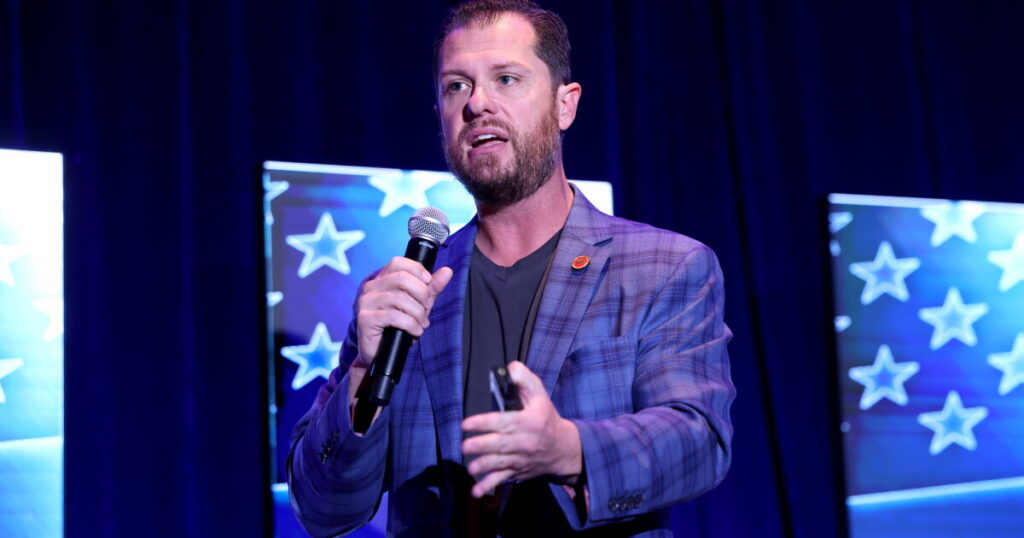
A federal court battle is unfolding in Arizona over whether a campaign finance investigation can compel a political consulting firm to hand over its business records. At the center of the dispute is state Sen. Jake Hoffman, who is asking a judge to permanently block a subpoena targeting his advertising company, 1Ten.
Hoffman filed suit in the U.S. District Court for the District of Arizona on Nov. 18, arguing that the subpoena issued by the Arizona Clean Elections Commission violates his company’s First Amendment rights. The subpoena, signed by Clean Elections Executive Director Thomas Collins and received by 1Ten on Nov. 6, stems from an investigation into Ralph Heap — a failed Arizona Corporation Commission candidate and former Republican state lawmaker accused of breaking campaign finance laws.
What the Investigation Is About
Heap ran in the midterms as a Clean Elections candidate, meaning he agreed to forgo large donations and PAC money in exchange for hundreds of thousands of dollars in public funding from the Arizona Clean Elections Commission. That agreement made him subject to strict spending and disclosure rules.
Investigators say the numbers don’t add up. The commission determined it has “reason to believe” that Heap broke state law and launched a formal investigation. Separately, the Secretary of State’s Office referred a complaint against Heap to the state Attorney General’s Office for investigation.
At issue, in part, is campaign signage. Heap disclosed only a single $644.47 payment to Mesa Sign Shop for campaign signs. But according to the commission, 184 of his signs were deployed across the state — and the invoices for those signs weren’t addressed to Heap at all.
“Dr. Ralph Heap volunteered to accept public funds and follow the Act. He reported a single $644.47 payment to Mesa Sign Shop, while a complaint documented 184 of his signs deployed across the State,”
the Commission stated in its response.
“The invoices for those signs are addressed not to Dr. Heap, but to ‘Jake Hoffman / 1ten.io,’ and one invoice reflects a $96,500.00 payment.”
Heap attempted to withdraw from the Clean Elections program, but the commission rejected that request.
Hoffman’s Legal Challenge
Hoffman, who openly supported Heap’s campaign, is now fighting the subpoena on behalf of his firm, 1Ten. His attorney is state Rep. Alexander Kolodin (R-Scottsdale) — himself a candidate Hoffman backed in an unsuccessful bid for secretary of state. According to campaign finance reports, 1Ten also spent money to benefit Kolodin’s campaign.
In the federal complaint, Kolodin contends that forcing 1Ten to comply with the subpoena would drive away clients who fear having their business dealings exposed publicly. The filing includes 220 pages of social media screenshots showing criticism directed at Hoffman and Heap.
“Highlighting the chilling effect of the subpoena is the fact that the complainants in this matter are not disinterested members of the public. They are political opponents,”
Kolodin wrote.
The subpoena’s scope goes beyond campaign signs. It requests
“documents sufficient to show any other goods or services that 1Ten paid for, provided, or arranged for Dr. Heap’s campaign, the cost of each, and whether, when, and in what amount Dr. Heap paid or reimbursed 1Ten.”
Kolodin argues that sweep is far too wide.
“That is an account of everything a campaign did through its consultant, including any help the firm arranged from others, and of what the campaign chose to spend on each. An account of ‘the giving and spending of money’ can invade privacy of belief as much as a membership list,”
the complaint states.
The Commission Pushes Back
The commission’s response argues that blocking the subpoena would gut its ability to do the job Arizona voters gave it. Arizona voters passed the Citizens Clean Elections Act in 1998, establishing the five-member commission to provide voter resources and strengthen participation in elections.
“If 1Ten prevails, no one can learn who paid for a publicly funded campaign whenever the payment runs through a political consultant,”
the response states.
Commissioners warned that a ruling in Hoffman’s favor would create a wide-open loophole — allowing any Clean Elections candidate going forward to route spending through consultants in order to avoid transparency requirements. The commission also rejected the argument that disclosing payment records constitutes a meaningful privacy violation, contending that business records are not the same as revealing internal campaign strategy. As a result, the commission maintains that Hoffman faces no real harm from complying.
As of Wednesday afternoon, the court had not issued a ruling. The deadline for the subpoena to take effect was set for Nov. 25. Hoffman is asking the court to permanently block the commission from enforcing it.
For more context on related developments, Maricopa County supervisors have also claimed that county Recorder Justin Heap skipped the election canvass to avoid questions. Arizona’s statewide election results were certified by state leaders without any counties formally contesting the outcome. In other statehouse news, Arizona Democrats moved to dismantle a Republican-led committee that had been vetting Gov. Katie Hobbs’ agency appointees, and the Maricopa County Attorney declined to charge eight noncitizens who voted after an MVD system error.