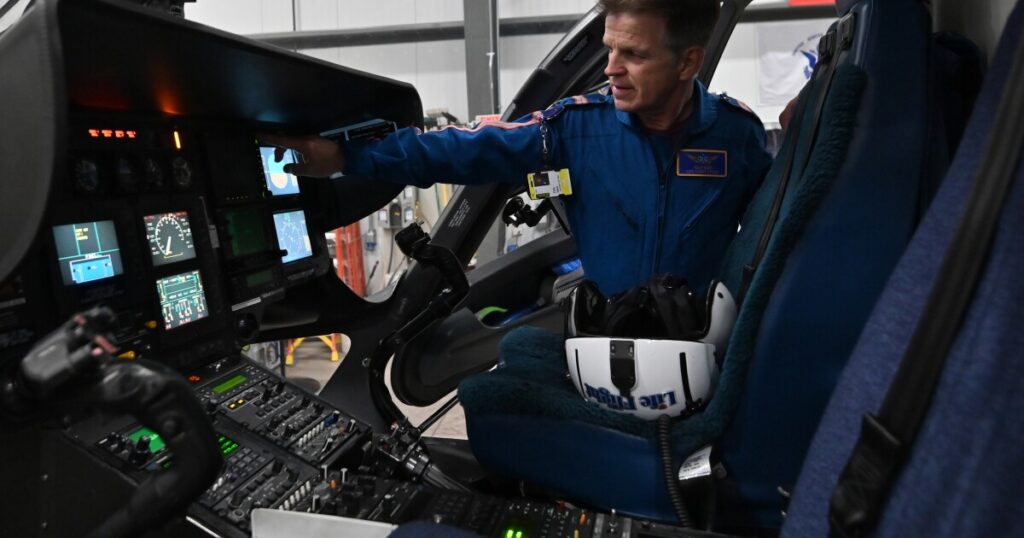
In the bustling environment of Geisinger Life Flight 3 at the Wilkes-Barre/Scranton International Airport, a sense of urgency prevails as the team prepares to respond to critical situations. The Life Flight team’s commitment to rapid response, however, is balanced by a strict adherence to safety protocols, as demonstrated during a recent dispatch.
“From the time that we get the dispatch till the time that we’re off the ground on the way to the call is 15 minutes or less,” says Red Lines, the manager at Life Flight 3. Despite this readiness, pilot Brian Enderes had to decline a dispatch due to atmospheric ice, emphasizing their priority on safety.
Lines highlights the importance of the pilots’ discretion: “We hire them for their ability to say when it’s not safe to go.” This decision-making process does not consider patient information prior to flight acceptance, ensuring unbiased safety assessments.
Geisinger Life Flight Operations
The Geisinger Life Flight program operates multiple bases, averaging 420 to 450 transports monthly across various locations including Selinsgrove, State College, and Williamsport. The program extends its reach beyond the Geisinger health system, facilitating patient transfers to numerous cities such as Boston and Pittsburgh when necessary.
Red Lines describes the diverse scenarios the Life Flight crew encounters, from landing directly at accident sites to transporting critically ill patients between hospitals. “Our job is to not just move them from one hospital to another, but continue that critical care,” he explains.
Life Flight Crew and Equipment
Each Life Flight dispatch involves a collaborative team effort, typically comprising a pilot, a critical care nurse, and a critical care paramedic. The crew is trained to manage high-stakes situations with limited resources, often needing to perform complex medical procedures while in transit.
Morgan Fuller, a Life Flight nurse, emphasizes the need for extensive experience and certification in emergency or ICU settings before joining the team. “We need to either have worked in the emergency room or the ICU of a large volume hospital,” Fuller states, highlighting the rigorous training required.
Equipped with advanced medical technology, the Life Flight ambulances and helicopters are designed to provide comprehensive care. “We’re capable of transporting patients with balloon pumps or heart lung bypass ECMO,” Lines notes, underscoring the program’s capacity to handle complex medical cases.
Challenges and Rewards
Life Flight crew members face constant challenges, from navigating cramped helicopter cabins to managing emergencies with limited resources. “Every call you go on is very high stakes,” remarks Brooke Lininger, a Life Flight paramedic.
Despite these challenges, the crew finds immense satisfaction in their work. “We’re meeting a patient who’s having the worst day of their life,” says Fuller. The team’s ability to provide reassurance and expert care in such critical moments is a testament to their dedication and professionalism.