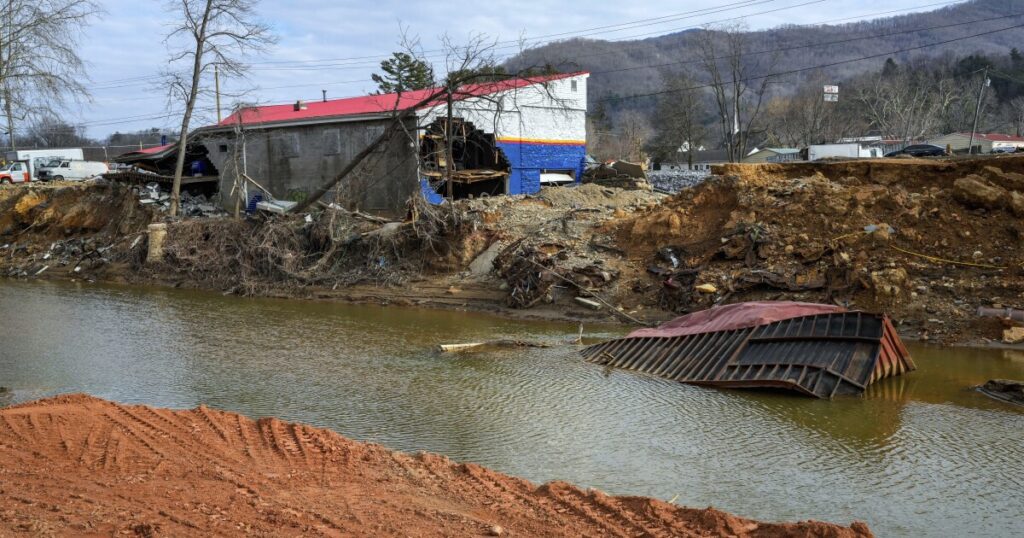
In a move to bolster resilience post-Hurricane Helene, the Buncombe County Board of Commissioners has given the green light to a comprehensive recovery document just two weeks after rolling out a strategic plan for the county. The board has vowed to leverage all available funding and resources to see these recovery projects through, although a specific budget has not been established.
Spanning 205 pages, the recovery plan encompasses all six municipalities of Buncombe, as well as unincorporated regions. The county government has taken on responsibility for 31 of the 114 projects listed, equaling the commitment of Asheville. Meanwhile, Asheville City Council and Weaverville Town Council have separately approved their respective portions of the plan, with Weaverville focusing on 14 projects.
Kevin Madsen, appointed as the Helene Recovery Officer, noted that the recovery plan aligns with community goals identified in the countywide strategic plan. Public safety emerges as the top priority among these initiatives, followed by growth, development, and community health.
Key public safety projects include acquiring heavy equipment for disaster response, building a new Emergency Operations Center, and establishing wildfire protection schemes for Buncombe’s 19 fire districts. Madsen also pointed out the potential of “resilience hubs,” which could involve enhancing existing county facilities with renewable energy and water sources to support communities during emergencies.
Board Chair Amanda Edwards expressed her anticipation for the plan’s emphasis on public safety. “I’m excited about our long-term focus on resiliency as well as preparedness, but also what this means for the future of Buncombe County as we prepare not for if, but when we have the next disaster,” she said.
With the plan now officially sanctioned, Madsen’s team will begin detailing timelines and budgets for each project, currently categorized by duration, cost, and complexity. Buncombe spokesperson Lillian Govus clarified project classifications, noting that low-cost projects are estimated at less than $1 million, whereas high-cost endeavors exceed $10 million. Short-term projects are slated for 1-2 years, while long-term initiatives require at least five years. The county continues to pursue financial support from state, federal, and nonprofit sources.
Additional Developments
- The board authorized over $3.6 million for six park and greenway projects from the $30 million Open Space Bond approved by voters in 2022. The most significant allocation supports Riverside Park in Woodfin with $2.1 million, alongside other grants such as $326,174 for the Hominy Creek Greenway Trail and $150,000 for a river trail at Warren Wilson College. However, acquisition of 33 acres for the Enka Heritage Trail was not recommended by county staff.
- During a pre-meeting briefing, Edwards communicated a unified statement concerning potential federal immigration enforcement in Asheville. The statement, backed by all commissioners and Asheville City Council members, emphasized that local law enforcement does not partake in federal immigration operations and encouraged peaceful protests. Meanwhile, a separate proposal to restrict federal use of city property for immigration enforcement remains under discussion.
- Budget planning for the fiscal year 2027 commenced with a retreat on Nov. 13. Budget Director John Hudson’s presentation highlighted potential new expenses, including the Deaverview Mountain park development, enhanced security measures for county facilities, and a revival of Strategic Partnership Grants to nonprofits. A subsequent budget session is scheduled for March 24.
- Raleigh-based John R. McAdams Company secured a $159,000 contract for engineering and design at Hominy Creek River Park, with an expected completion by July. Construction timelines remain to be announced.
- The county accepted several grants related to Hurricane Helene. These include $150,000 from the state Department of Health and Human Services for child welfare, $101,300 from the Dogwood Health Trust for FEMA grantwriting, and $10,000 from the state Wildlife Resources Commission for the Swannanoa Small Area and Resilience Plan.
The Buncombe County Board of Commissioners convenes every first and third Tuesday at 200 College St., Room 326, in downtown Asheville, starting at 5 p.m. The next meeting is set for Tuesday, Dec. 2. For further details, view the full recording and agenda of the Nov. 18 meeting.