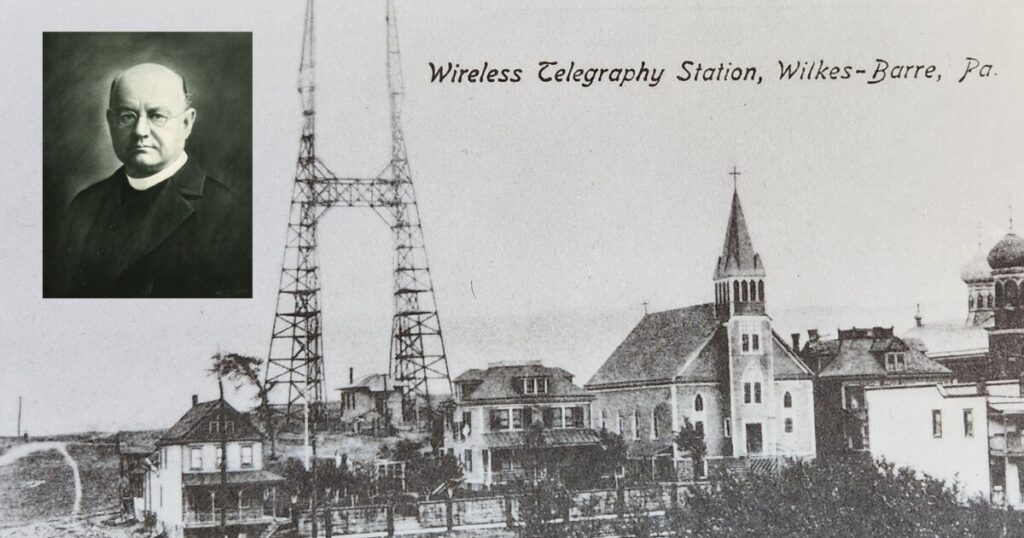
In a quiet corner of Wilkes-Barre, the basement of a historic church was once the site of an invention that forever changed communication. The Rev. Joseph Murgas, who was equal parts priest and scientist, developed a wireless tone communication system that paved the way for radio transmissions across land.
This groundbreaking achievement will be celebrated this Saturday, with current mayors of Scranton and Wilkes-Barre re-enacting the messages sent by their predecessors 120 years ago using the same Morse code system.
“Today we take it for granted talking to Wilkes-Barre over your cell phone or over a radio. But back then, people didn’t know that you could actually use radio signals to talk long distances over land,” said Nathaniel Frissell, a physics and engineering professor at the University of Scranton and a member of the Murgas Amateur Radio Club. “It’s just a really neat piece of history that we have right here in Northeast Pennsylvania that maybe many people don’t know about.”
The Birth of a Revolutionary Idea
Born in Slovakia in 1864, Murgas had a passion for electricity and physics from an early age. After emigrating to the United States, he became a priest at the Sacred Heart Church in Wilkes-Barre. There, he began experimenting with wireless communication in the church rectory’s basement.
Murgas’ wireless tone method involved high and low pitches that corresponded with Morse code dots and dashes. His work was seen as more advanced than Guglielmo Marconi’s, whose transmissions were limited to over-water distances.
Pioneering Tests and Recognition
In 1905, Murgas conducted a public demonstration of his system, linking Scranton and Wilkes-Barre. The event was attended by local dignitaries, and President Theodore Roosevelt showed interest in Murgas’ work, reportedly commenting that he “never saw such a phenomenon.”

The demonstration was praised by the Scranton Republican newspaper, which described it as a “day of triumph” for Murgas. However, the subsequent destruction of the antenna towers by a storm halted further developments.
Legacy and Commemoration
While Murgas eventually shifted his focus to other interests, including butterfly collection and fishing, his impact on communication technology remains significant. His story is kept alive by the Murgas Amateur Radio Club, formed in response to the communication needs highlighted by natural disasters in the 1970s.
Saturday’s event will not only honor Murgas’ contributions but also celebrate the 50th anniversary of the Murgas Amateur Radio Club. The reenactment of the historical transmission will take place at both King’s College and the University of Scranton, where visitors can explore exhibits dedicated to Murgas’ work.

The events will take place at both campuses from 1-4 p.m., with live demonstrations and exhibits exploring the historical significance of Murgas’ achievements in wireless communication.