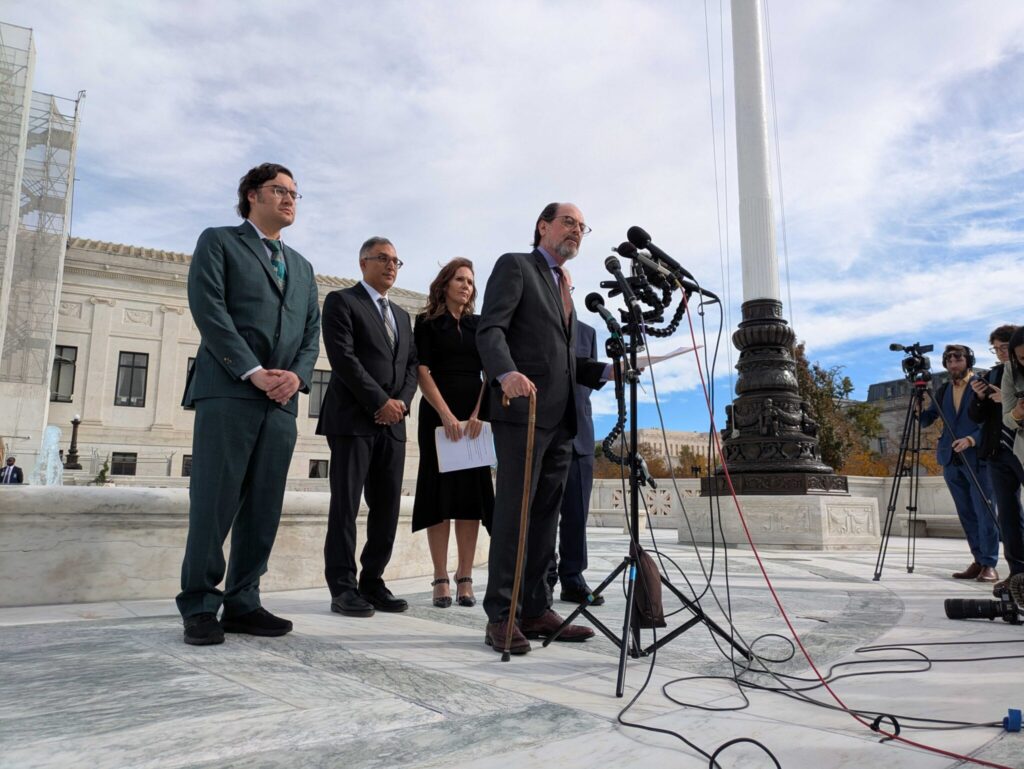
WASHINGTON — The U.S. Supreme Court engaged in extensive debate on Wednesday over whether President Donald Trump breached constitutional boundaries by imposing comprehensive global tariffs using an economic emergency powers law. This statute, typically reserved for tackling rare threats, was invoked by Trump, marking a first for a U.S. president. Justices from both conservative and liberal factions, including Chief Justice John Roberts, scrutinized the broad powers the administration claims under the International Economic Emergency Powers Act (IEEPA).
The courtroom was filled with members of the president’s Cabinet, Congress, and comedian John Mulaney, all attending the major case of Trump’s second term. Tariffs, central to Trump’s foreign policy, are credited for recent trade framework agreements with countries like the European Union, Japan, and China. The justices spent nearly three hours dissecting the language of IEEPA, a 1970s-era sanctions law, which Trump used to levy import taxes on goods globally.
Small business owners contested the president’s unilateral authority to impose tariffs under IEEPA, arguing it disrupts their livelihoods. Victor Schwartz, a lead plaintiff, stated that American businesses and consumers bear the financial burden of these tariffs. The case, brought to the Supreme Court by small businesses and Democratic state attorneys general, challenges Trump’s authority to impose taxes, a power constitutionally reserved for Congress.
Small business owners ‘footing the bill’
The Trump administration argues that tariffs are vital for achieving economic and national security objectives. Officials claim IEEPA authorizes the president to “regulate” imports and exports during extraordinary threats. U.S. Solicitor General John Sauer defended this stance, asserting that the power to impose tariffs is inherent in the statute’s language.
Justice Elena Kagan questioned why a president would bypass specific tariff powers that have constraints, if IEEPA allows more expansive authority. Kagan pointed out that recent cases reveal the U.S. is in constant emergencies. Trump has frequently petitioned the Supreme Court, often placing cases on the shadow docket, which bypasses full arguments.
Trump comfort with tariffs
Justice Brett Kavanaugh noted that no prior president used IEEPA to impose tariffs despite numerous emergencies. Sauer attributed this to the unique comfort Trump has with using tariffs as a tool for economic and foreign policy. Political reasons also play a role, according to Sauer.
Fentanyl smuggling targeted
Trump began imposing tariffs via executive orders in early 2025, targeting products from China, Canada, and Mexico, labeling these countries as responsible for illegal fentanyl smuggling. He escalated tariffs globally, citing trade imbalances as a national emergency. Recent measures include a 25% tariff on Indian goods and a 40% tariff on Brazilian imports, reflecting geopolitical tensions.
Treasury Secretary Scott Bessent expressed optimism about the case’s proceedings, remarking on the strength of the solicitor general’s arguments. However, he declined to comment on contingency plans if the Supreme Court invalidates the tariffs.