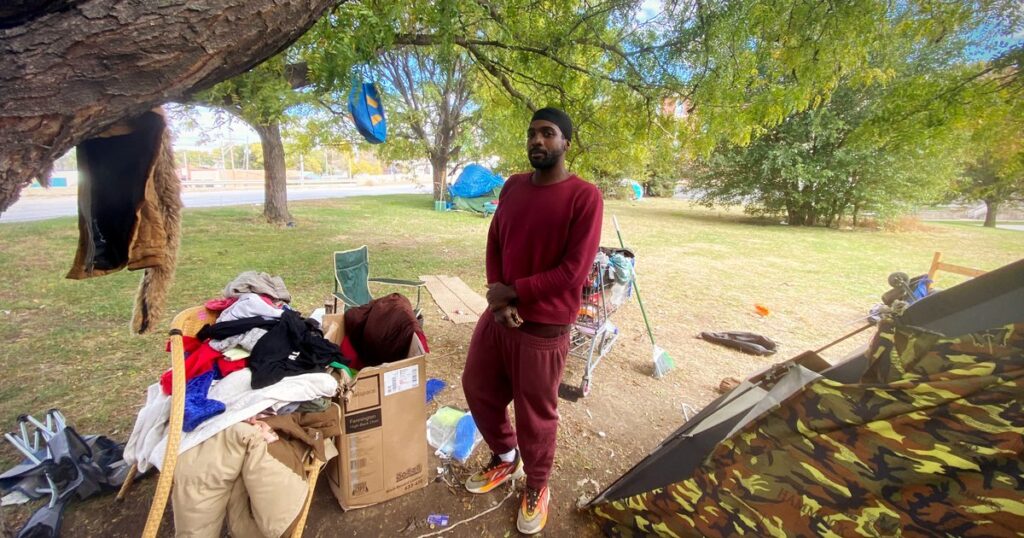
Amidst the rustle of autumn leaves, Taylor Daniels busily arranged his clothes outside a gray camping tent. The recent spell of sunshine had broken days of rain, providing a chance to dry out essentials.
Reflecting on the previous night, Daniels commented, “Last night was cold. If I wasn’t here with someone else, it’d be too cold,” as cars zipped by on the nearby road.
The makeshift encampment, nestled in a patch of land intersected by Dodge Street and Saddle Creek Road, offers minimal seclusion. The tents, shopping carts, and assorted belongings have become a visible reminder of a growing issue in Omaha: homelessness.
Omaha faces a significant challenge with a rising number of individuals experiencing homelessness, many opting for public encampments over emergency shelters. This has spurred concerns over mental health, public safety, and effects on local businesses, prompting city officials to seek solutions.
In response, city leaders back a nonprofit-driven initiative aimed at reducing street homelessness. This endeavor, if successful, could reshape Omaha’s future strategies in addressing homelessness.
The Initiative and Its Goals
In collaboration with the mayor’s office, leading agencies in Omaha’s homelessness response will intensify their efforts over the next six months through a pilot program. The initiative focuses on diminishing encampments, connecting individuals to shelters and housing, and preserving clean public spaces, explained Jason Feldhaus, executive director of Threshold Continuum of Care.
“Our goal is simple but critical,” said Feldhaus. “Help people move from encampments to safety, and at the same time, support our city departments, local businesses and neighborhoods in building a compassionate and effective community response.”
The program proposes an electronic system to monitor encampments, a public data dashboard, and prioritized shelter and housing access. Insights from the pilot will guide a long-term strategy, stated Mayor John Ewing during a program announcement with Feldhaus and city homeless coordinator Tamara Dwyer.
Rather than enacting policy, the pilot encourages advocacy. Mayor Ewing endorsed the program as an alternative to a proposed ordinance that would have prohibited encampments on city property.
The ordinance, introduced by Councilman Brinker Harding, would have required police to offer shelter options to those in encampments before any citations or arrests. Despite an amendment proposing a diversion program, the ordinance was defeated in a two to five vote, with most council members preferring to trial the pilot program first.
Striking a Balance
Threshold’s street outreach team prioritizes preventing deaths on the streets and assisting the most vulnerable. Feldhaus shared with Nebraska Public Media their goal to “build up that trust and then hopefully engage them in broader services, housing, mental health, addiction services.”
Despite the challenges of harsh weather and fluctuating resources, the outreach team remains dedicated to linking homeless individuals with essential services.
Feldhaus highlighted a “counterbalance” to these efforts, emphasizing community rights. “There’s also the general citizenry of our community. Businesses, neighborhoods, individuals who also have the same right to that space as an individual who’s homeless,” he said. “We are hoping this pilot program balances both of those a little more effectively.”
Over the past decade, Omaha has seen an increase in homelessness, according to data from an annual count. However, this growth mirrors Omaha’s overall population rise. Notably, the recent point-in-time count marked a decline for the first time in five years.
Despite the decrease, Feldhaus pointed out that visible signs of homelessness, like encampments, have become more prominent.
For Daniels, living in a camp is a straightforward choice. “I’d rather be without the crowd,” shared the 33-year-old. “With the crowd it becomes more of a hassle to keep track of belongings and the trouble others can bring. Unnecessary problems.”
Meanwhile, optimism was cautiously shared two miles away in the mayor’s office, where pilot program leaders outlined their plans. Feldhaus remarked, “I want to be really clear, this initiative will not end homelessness overnight, but this pilot represents a new approach. A coordinated, compassionate and countable response. It’s a recognition that we can’t do everything at once, but we can do something meaningful right now.”