Controversial Congressional Map Proposal Faces Criticism in North Carolina
A newly proposed Congressional map is advancing through the North Carolina General Assembly, sparking a heated debate about its potential effects on Black voters in the northeastern part of the state. Despite opposition, the map continues to make legislative progress.
The reconfiguration involves shifting four counties from around Goldsboro and Kinston out of the 1st Congressional District, replacing them with six coastal counties and a portion of Onslow County. This move, according to Republicans, aims to enhance political competitiveness by securing an 11th Congressional seat for their party and bolstering support for former President Donald Trump’s policies. However, Democrats argue that this redistricting effort compromises the voting strength of minority communities, particularly in the historically significant Black Belt region.
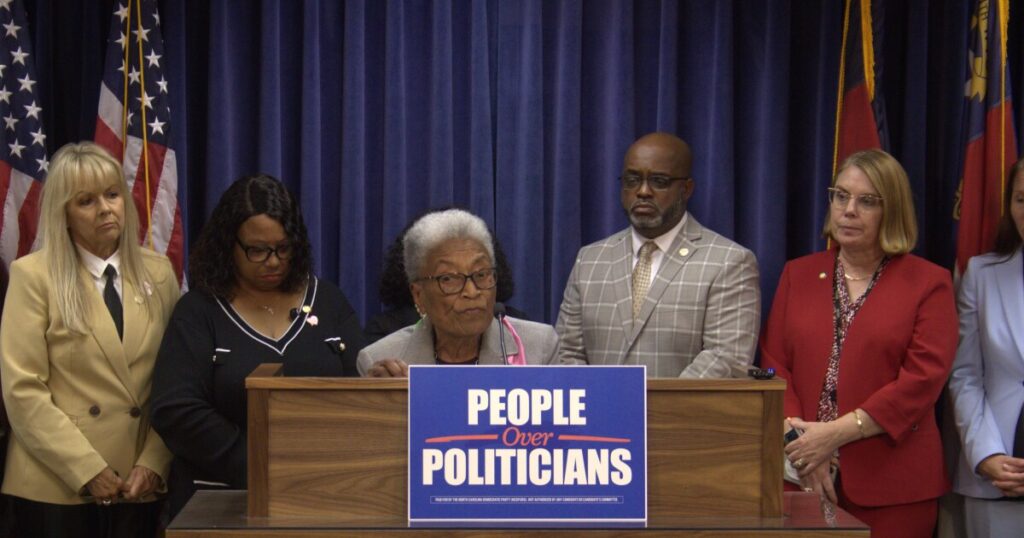
Eva Clayton, the first Black politician elected to Congress from this district since Reconstruction, voiced her concerns at the General Assembly. “It was from 1901 until 1992, 91 years, that a Black citizen happened to be elected. It happened to be myself,” Clayton remarked. “And the North Carolina General Assembly appears ready now to make it almost impossible for a Black citizen to be elected from North Carolina’s northeastern area.”
The district recently backed President Trump in the 2024 election while also re-electing Democratic U.S. Rep. Don Davis, highlighting its diverse political landscape.
The new map proposal was unveiled last Thursday, following an announcement by the General Assembly. Since then, over 11,000 public comments have been submitted, with the majority expressing opposition, as noted by Rep. Pricey Harrison, D-Guilford, during a press briefing.
Despite opposition from Clayton and numerous other North Carolinians, the House Redistricting Committee approved the map, with the House Rules Committee following suit. The full House is slated to review the proposal on Wednesday, where Republican dominance suggests likely passage.
If enacted, the new map could face significant legal challenges, although Governor Josh Stein, a Democrat, lacks the authority to veto redistricting proposals.
data-size=”fallbackImageSizeMobile” />
data-size=”fallbackImageSizeMobile” />
data-size=”fallbackImageSize” />
data-size=”fallbackImageSize” />
srcset=”https://npr.brightspotcdn.com/dims4/default/e616286/2147483647/strip/true/crop/1700×802+0+0/resize/1760×830!/quality/90/?url=http%3A%2F%2Fnpr-brightspot.s3.amazonaws.com%2Ff5%2Feb%2F755222ec49c4b5136998cba7abf3%2F251016-congressionalmap.jpg 2x”
width=”880″ height=”415″ loading=”lazy”
src=”https://npr.brightspotcdn.com/dims4/default/b4bc822/2147483647/strip/true/crop/1700×802+0+0/resize/880×415!/quality/90/?url=http%3A%2F%2Fnpr-brightspot.s3.amazonaws.com%2Ff5%2Feb%2F755222ec49c4b5136998cba7abf3%2F251016-congressionalmap.jpg” />
During a Senate session, Sen. Ralph Hise, R-Mitchell, stated that no racial data was used in drafting the map, emphasizing the necessity of adding a Republican district to counteract Democratic gerrymandering tactics. “The purpose of this map was to pick up a Republican seat. That’s been stated over and over again,” Hise expressed.
While courts have traditionally been unable to overturn maps based on partisan bias, they can intervene if a map undermines minority voting power—a judicial stance that might shift following a pending U.S. Supreme Court decision in a related Louisiana case.
Currently, the 1st Congressional District has the state’s highest percentage of Black voters at about 40%, but the proposed changes would reduce this to around 32% by reallocating Greene, Lenoir, Wayne, and Wilson counties to the 3rd District.
Under the new map, U.S. Rep. Alma Adams’ district in the Charlotte area would have the highest concentration of Black voters. Adams criticized the proposal before the N.C. House’s Redistricting Committee, stating, “You’re not just targeting a Democratic member, that’s obvious. And he is Black, you must know that. You’re trying to dismantle the district with the largest record of Black Congressional leadership in North Carolina history, and that’s just not right.”