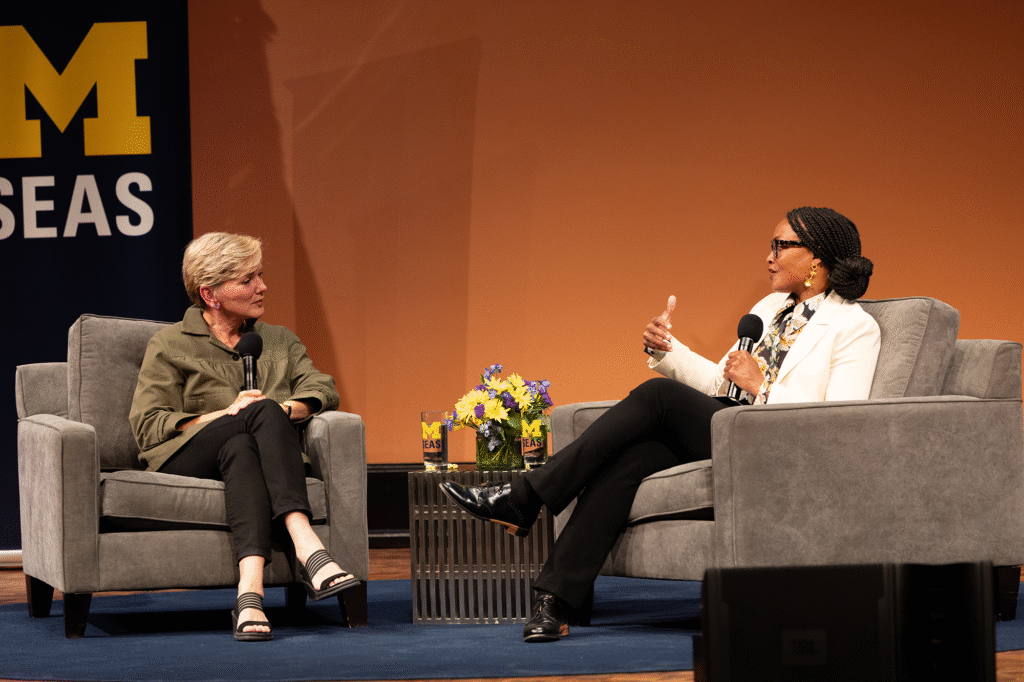
Optimism in Renewable Energy: Insights from Jennifer Granholm
Momentum is building in the renewable energy sector despite challenges at the federal level, with states and private enterprises leading the charge in wind and solar power initiatives. Former U.S. Energy Secretary Jennifer Granholm shared this positive outlook during the annual Peter M. Wege Lecture on Sustainability on September 30.
Granholm highlighted the urgency surrounding the availability of existing tax credits, which is expected to drive a surge in renewable energy deployment for the foreseeable future. “There will be an acceleration of deployment for at least the next two years,” she noted.
In a significant projection, Granholm referenced a report from the Solar Energy Industry Association, which anticipates nearly 250 gigawatts (GW) of solar power will be deployed by 2030. To put this into perspective, Granholm compared it to the capacity of the Hoover Dam, stating, “The Hoover Dam equates to 2 gigawatts. So, we will have added to our nation’s electric grid by 2030, 125 GW or 125 solar dams worth of clean power, regardless of what is happening in the next 1,200 days.”

The 23rd annual Wege Lecture, a flagship event in sustainability dialogue at the University of Michigan, attracted over 800 participants. The lecture was hosted by the School for Environment and Sustainability, its Center for Sustainable Systems, and the Gerald R. Ford School of Public Policy.
Moderated by Shalanda Baker, U-M’s vice provost for sustainability and climate action, the session featured questions from the audience. Granholm and Baker, who have previously collaborated in the Department of Energy, engaged in a comprehensive discussion on advancing a clean energy future.
Granholm emphasized efforts at the local level to reduce energy costs, such as removing “soft costs” linked to clean energy and energy efficiency improvements in homes. Addressing concerns about the high resource consumption of data centers, Granholm suggested that they could promote clean energy growth if policies incentivize collaboration between utilities and data centers for optimized grid usage.
She introduced the concept of virtual power plants, which could enhance the energy management of data centers. “If these huge data centers allow the local utility to use that data center to turn on the dimmer switch when they need more power, then the data center actually becomes a grid asset,” Granholm explained.

Highlighting the affordability of renewable energy, Granholm stated, “At this moment, wind and solar are the cheapest forms of energy in most places.” She pointed out that data centers, by choosing renewables and energy storage, could quickly and economically come online.
Granholm envisions a future enriched by technological advancements that ensure “free, abundant, clean energy,” enabling future generations to focus on other global challenges. She called for a proactive stance among emerging climate leaders, underscoring a “warrior ethos for the planet.”
Concluding her talk, Granholm recounted a poignant reflection shared with her by U.S. Rep. Nancy Pelosi. On a bishop’s office wall in South Africa, she read, “when at last I stand before him, God will say, show me your wounds. And if I have no wounds, God will ask, was there nothing worth fighting for?” Granholm expressed hope that future generations will bear the “scars from the wounds that we have earned on behalf of the people on the planet.”