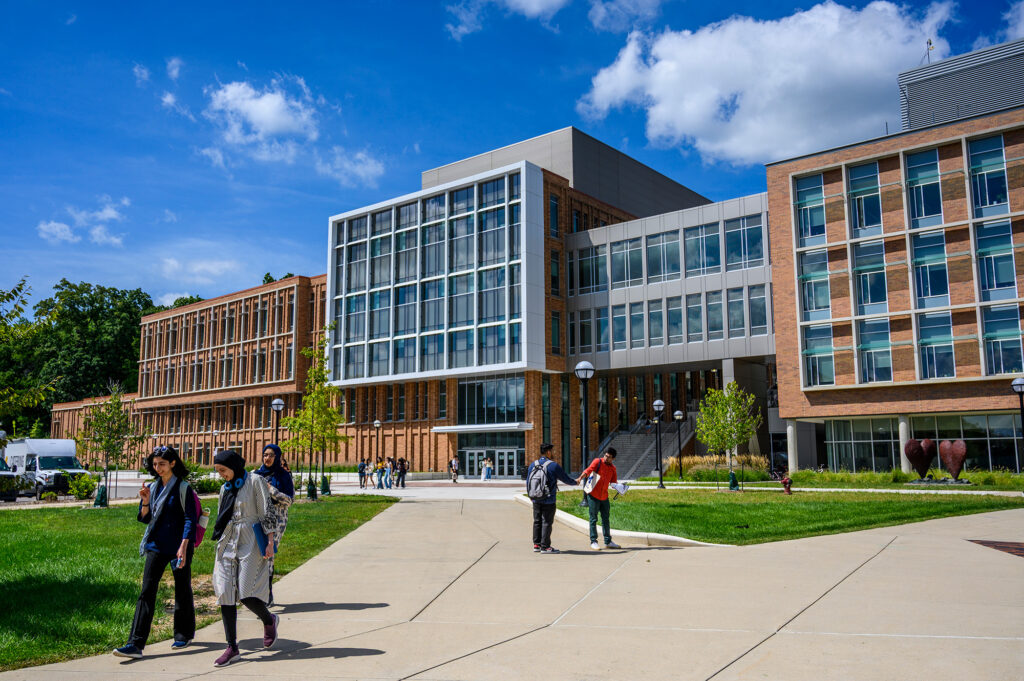
As the University of Michigan marks a milestone of over 150 years in sustainability leadership, it unveils a comprehensive report highlighting its historical and ongoing commitments in this field. This document not only chronicles past accomplishments but also boldly charts a future course in academics, operations, research, and healthcare, embedding sustainability into the very fabric of campus life.
The report, titled “A History of Action, A Foundation for Change: 150 Years of Sustainability at the University of Michigan”, consolidates insights from previous institutional reports and discussions with faculty, staff, and student leaders. It serves as a record of past achievements and a call to action for future endeavors, aiming to bring various sustainability initiatives under a unified future vision.
MORE INFORMATION
- Sustainability and Climate Executive Leadership Council
- “A History of Action, A Foundation for Change: 150 Years of Sustainability at the University of Michigan”
- Look to Michigan
Emphasizing community-driven efforts and shared values, the report is both a retrospective and an invitation to shape the university’s sustainable future. As President Domenico Grasso stated, “This report is both a reflection and a call to action. We are building on U-M’s long-standing leadership to address the most pressing environmental, health and social challenges of our time — together, and at scale.”
This foundational document supports the university’s next phase of implementation, guided by a newly established leadership model that aligns with its strategic vision. It calls for integrated actions across academic, operational, research, and healthcare areas, linked with community involvement. Climate Action, Sustainability & Environmental Equity are central themes of the university’s Look to Michigan initiative.
The release of the report coincides with the university’s first-ever Climate Week, featuring events from Sept. 27 to Oct. 5 that encourage the campus community to engage with the report’s themes and contribute to the university’s sustainability objectives.
New Executive Leadership Structure
In a pioneering move for public universities, the Sustainability and Climate Executive Leadership Council was formed in January 2025. This council unites senior leaders from various sectors—including operations, academics, research, and healthcare—to strategically align efforts and foster collaboration across all U-M campuses and Michigan Medicine.
Key leaders such as Shana Weber, Shalanda Baker, and Tony Denton are leading this mission, charged with steering the university’s sustainability, climate action, and environmental equity initiatives. Their combined efforts aim to transform U-M into a living and learning laboratory, connecting research with operational practices and community partnerships.
By facilitating a cohesive approach, this council is more than a leadership body; it represents a reimagined way for U-M to live its values and fulfill its public mission, setting a new benchmark for large institutional sustainability.
Progress and Opportunities
The report details significant advancements and opportunities within the university, including:
- Michigan Medicine achieved an 88% reduction in emissions from inhaled anesthetics, surpassing its target ahead of schedule.
- The launch of the Leinweber Computer Science and Information Building, the university’s first all-electric academic facility, utilizing ground source heat pumps and geo-exchange systems.
- Expansion of the Maize Rays solar program to enhance renewable energy capacity by over 25 megawatts in three years.
- Innovations in research, including cleaner aviation technologies and wave energy, demonstrating the university’s global impact.
- Community partnerships, such as medical supply reallocation and river restoration projects.
- A longstanding commitment to environmental justice and community-engaged scholarship.
- Offering over 800 sustainability-related courses involving more than 700 faculty members.
- Funding for faculty research through the Graham Sustainability Institute’s Catalyst Grants.
“Michigan Medicine’s progress shows the impact we can have when sustainability is included in our strategic decisions as an enterprise, and daily practices at a local unit level,” remarked Denton. “Through the leadership council, we can take that same commitment and connect it with efforts across academics, operations, and research to deliver results at scale.”
Highlights from the report underscore U-M’s role as a living and learning laboratory, with student initiatives like the Student Sustainability Coalition exemplifying leadership. Sustainable practices are embedded in daily operations, from MDining’s plant-forward menus to sustainable health programs.
Research efforts extend to understanding climate change’s long-term impacts, with faculty and students contributing to data-driven projects. The “Make Climate a Class” initiative, integrating climate content across disciplines, reflects growing academic and research leadership.
Looking Ahead
The university is intensifying its efforts to synchronize sustainability initiatives across campuses, driving progress toward carbon neutrality and environmental equity. Priorities include expanding renewable energy, enhancing energy efficiency, and integrating sustainable practices into healthcare operations.
Students and faculty remain central to these efforts, continuing to transform the campus into a living laboratory and translating research into tangible climate solutions.
“The report gives us a roadmap for turning our sustainability efforts into measurable, coordinated impact across operations, academics, and health care,” Baker emphasized. “It shows how we can work together to accelerate progress and create solutions that extend beyond campus.”