National Guard’s Involvement in Counter-Drug Operations Spurs Legal Controversy
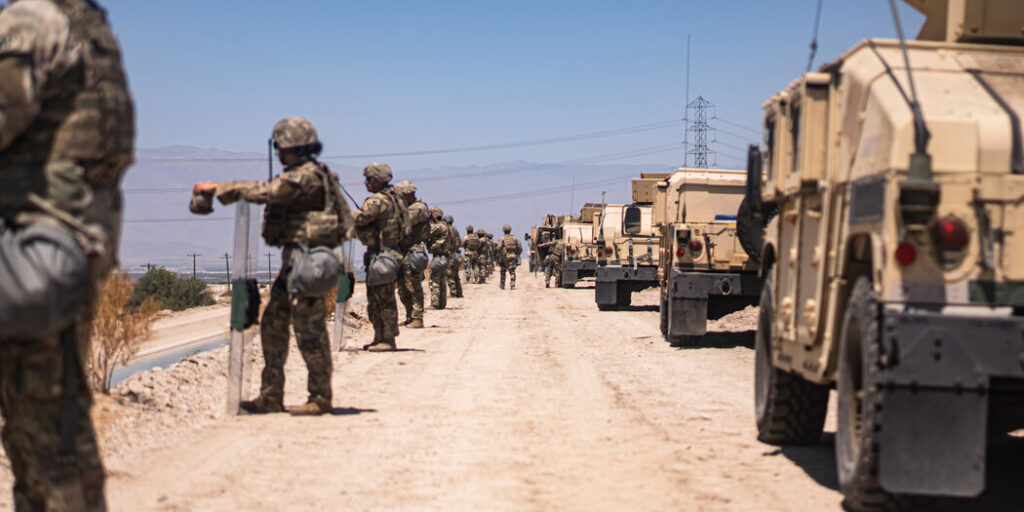
Federalized National Guard troops were involved in a significant counter-drug operation east of Los Angeles, assisting the Drug Enforcement Administration (DEA) last week. The operation’s legitimacy has been questioned, highlighting concerns over President Donald Trump’s use of military forces for domestic policing.
Details of the Operation
Approximately 315 National Guard personnel were involved in executing a federal search warrant as part of an investigation into large-scale marijuana cultivation in the Coachella Valley, about 130 miles from Los Angeles. The DEA sought assistance due to the operation’s scale and challenging conditions, which covered 787 acres with temperatures soaring to 112 degrees.
In addition to the National Guard, the operation included participation from the Federal Bureau of Investigation, Customs and Border Protection, Immigration and Customs Enforcement (ICE), the Bureau of Alcohol, Tobacco, Firearms and Explosives, the U.S. Marshals Service, and the Internal Revenue Service. During the operation, ICE detained between 70 to 75 individuals alleged to be undocumented workers, as well as one U.S. citizen for obstruction.
NORTHCOM mentioned that the National Guard’s primary role was to protect federal personnel engaged in law enforcement activities. The DEA further noted that the Guard was also tasked with safeguarding residents and workers in the area.
Legal Justifications and Challenges
NORTHCOM justified the involvement of National Guard forces under the presidential memorandum issued on June 7, which permits deployment to areas experiencing or likely to experience protests against federal functions. Nonetheless, no protests were planned against the drug operation in Coachella Valley. This raises questions about whether the deployment was authorized.
Additionally, federalizing the National Guard under 10 U.S.C. § 12406 is limited to scenarios involving invasions, rebellions, or when federal laws cannot be executed without military assistance. None of these conditions were met in the Coachella Valley operation, highlighting a potential breach of legal authority.
Implications of the Posse Comitatus Act
The Posse Comitatus Act restricts federal forces, including federalized National Guard troops, from engaging in civilian law enforcement unless explicitly permitted by Congress or the Constitution. The extent of the National Guard’s activities at the site remains unclear, but establishing security perimeters could be interpreted as direct law enforcement, which the Act aims to prevent.
The administration could argue that protecting federal functions exempts this deployment from the Act. However, courts have determined that military involvement in civilian law enforcement that exerts regulatory, prescriptive, or compulsory power would invoke the Act.
Concerns Over Military Use in Domestic Affairs
The deployment of National Guard forces for drug raids signals a shift in domestic military use under Trump’s administration, raising alarms about potential encroachments on civil liberties. While deploying troops to manage protests has sparked debate over First Amendment rights, using the military for routine law enforcement could blur the lines between military and civilian authorities.