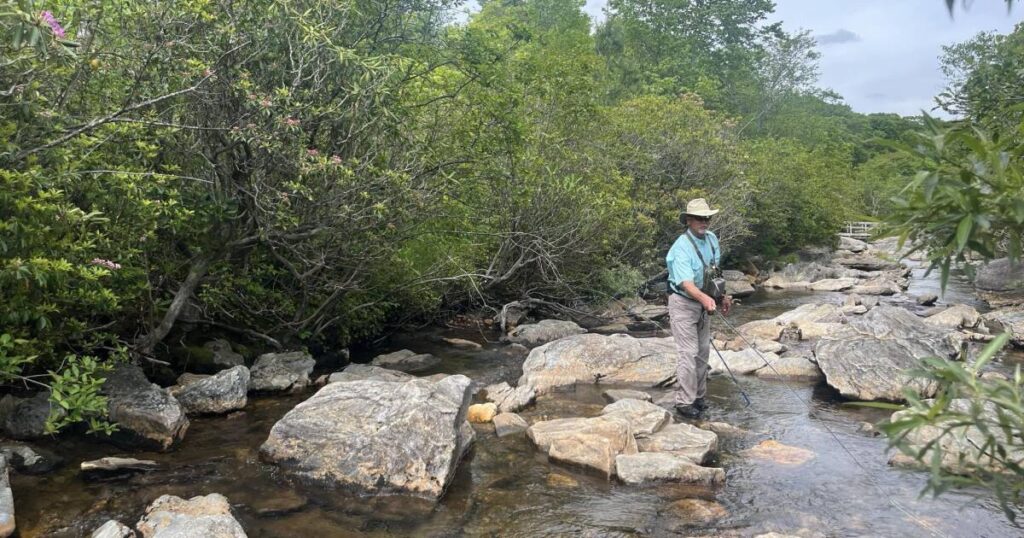
In the serene environs of Yellowstone Prong near Brevard, Thomas Champeau found himself immersed in the pursuit of the Southern Appalachian brook trout. These high-altitude streams, resting 5,000 feet above sea level, provide the cold, clear waters these elusive fish thrive in. Champeau, a seasoned angler, moved cautiously, his fishing approach akin to a thoughtful hunt.
“Your approach has to be low, quiet, and so it’s a little bit like hunting ‘cause you’re kind of stalking as opposed to just fishing blindly,” Champeau explained as he navigated the smooth rocks.
Amidst the blooming mountain laurels, this picturesque setting attracts millions of tourists annually, drawn by the blend of solitude and recreational promise. Champeau, leading a local Trout Unlimited chapter and a former biologist, is dedicated to educating others about the trout’s climate vulnerability, especially in the face of storms like Helene which have reshaped their habitats.
“It’s amazing how those big rocks have moved,” Champeau observed. “I mean, rocks bigger than a refrigerator have been pushed around.”
In Western North Carolina, the trout fishing industry is not only a cultural touchstone but also a significant economic driver, contributing $1.4 billion in tourism revenue each year. Yet, the native brook trout, now threatened, requires the cold, rocky streams of the region to survive. The aftermath of Hurricane Helene inflicted considerable damage on these habitats, impacting both the fish and the local economy dependent on them.
While Champeau’s high-elevation fishing spot escaped severe damage, downstream areas faced significant disruption. The storm’s floodwaters ravaged the landscape, removing shade-providing trees and leading to increased water temperatures harmful to coldwater fish. The wider fishing industry felt the strain, with outfitters and guides experiencing downturns.
Impact on Local Businesses
Kevin Howell, owner of Davidson River Outfitters, recounts the challenges posed by Helene. “Born and raised in Transylvania County, grew up here, fished the river my entire life,” Howell shared. His business, reliant on his intimate knowledge of the waterways, was hit hard as blocked access to streams deterred anglers.
“We did lose our two busiest months of the fall as far as income,” Howell noted, with some guides turning to other employment opportunities. Cleanup efforts, though underway, have been met with critique as federal contractors’ actions have raised concerns among locals. Tree removal and heavy machinery have further altered the delicate river ecosystems.
“… Adding to the sedimentation and adding to the warmer temperatures, which again results in less fishable water and less fish and less habitat,” Howell added.
The elevated temperatures pose additional challenges, particularly during catch-and-release periods. “We had to make the decision today to stop fishing at noon because in the afternoons it’s getting to 68 degrees already in June,” Howell said. “Which is very early.”
Cultural and Economic Significance
The relationship between Western North Carolina and fishing, particularly for the Eastern Band of Cherokee Indians, is steeped in history. Mike LaVoie, EBCI’s Natural Resources Director, emphasized the tribe’s symbiotic connection with both native and nonnative trout, which support an economy generating $93 million annually.
An economic analysis by Responsive Management highlighted that trout fishing sustains approximately 700 jobs on the reservation. While brown and rainbow trout largely contribute to this, the protection of native brook trout remains a priority without disrupting their habitats.
EBCI is actively involved in studies and climate resiliency plans to anticipate and mitigate the impacts of climate change on their lands and aquatic life. A collaborative study with N.C. State University predicts that brook trout could lose up to 92% of their habitat due to warming streams and extreme weather events.
LaVoie reflected on the river’s cultural significance, “Cherokee have always viewed the river as a long person, so it was an embodied identity and given human attributes,” he said. “It’s all about understanding how to live within that landscape and waterscape and how to ensure that that remains healthy.”
Looking Ahead
Tourism remains a vital component of the local economy, with businesses and authorities eager to welcome visitors while respecting those affected by recent storms. Tamika Hunter from the Brevard Chamber of Commerce expressed optimism, saying, “We’re open (for tourists while) being sensitive to those who are still suffering.”
Despite the challenges, the community remains resilient, with Champeau and others continuing to engage with the land and water that define their lives. On Yellowstone Prong, Champeau waved to visiting anglers, maintaining hope that the vibrant fishing culture will endure.
“But you never know!” Champeau reflected as he concluded his day of fishing. “That’s why they call it fishing and not catching, right?”